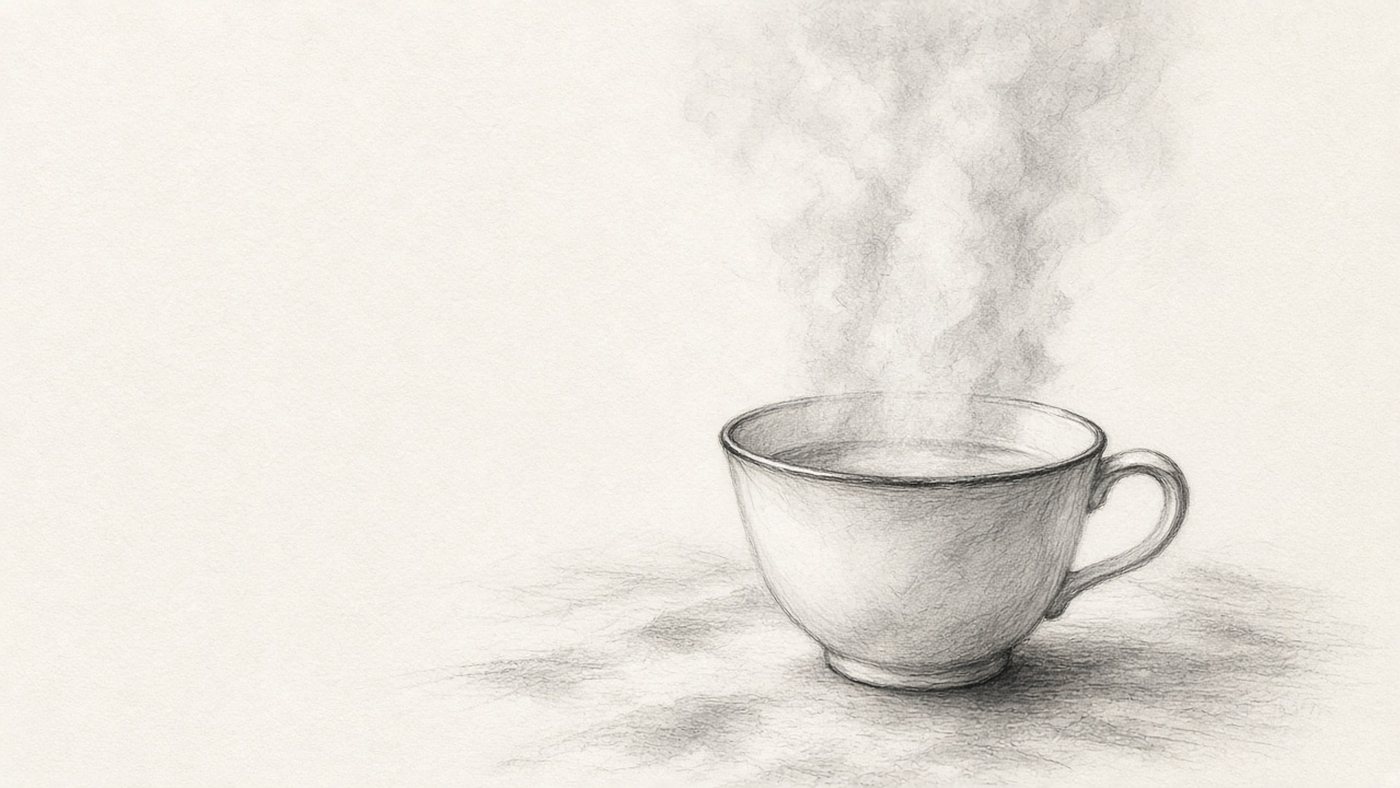
Smoke without an outline
A contour turns smoke into an object, like a rope or a piece of cotton. Smoke has no edge. There is a place where the background is still background, and a place where it is already duller. Next to a flame this is especially clear, as in how to draw fire and glow.
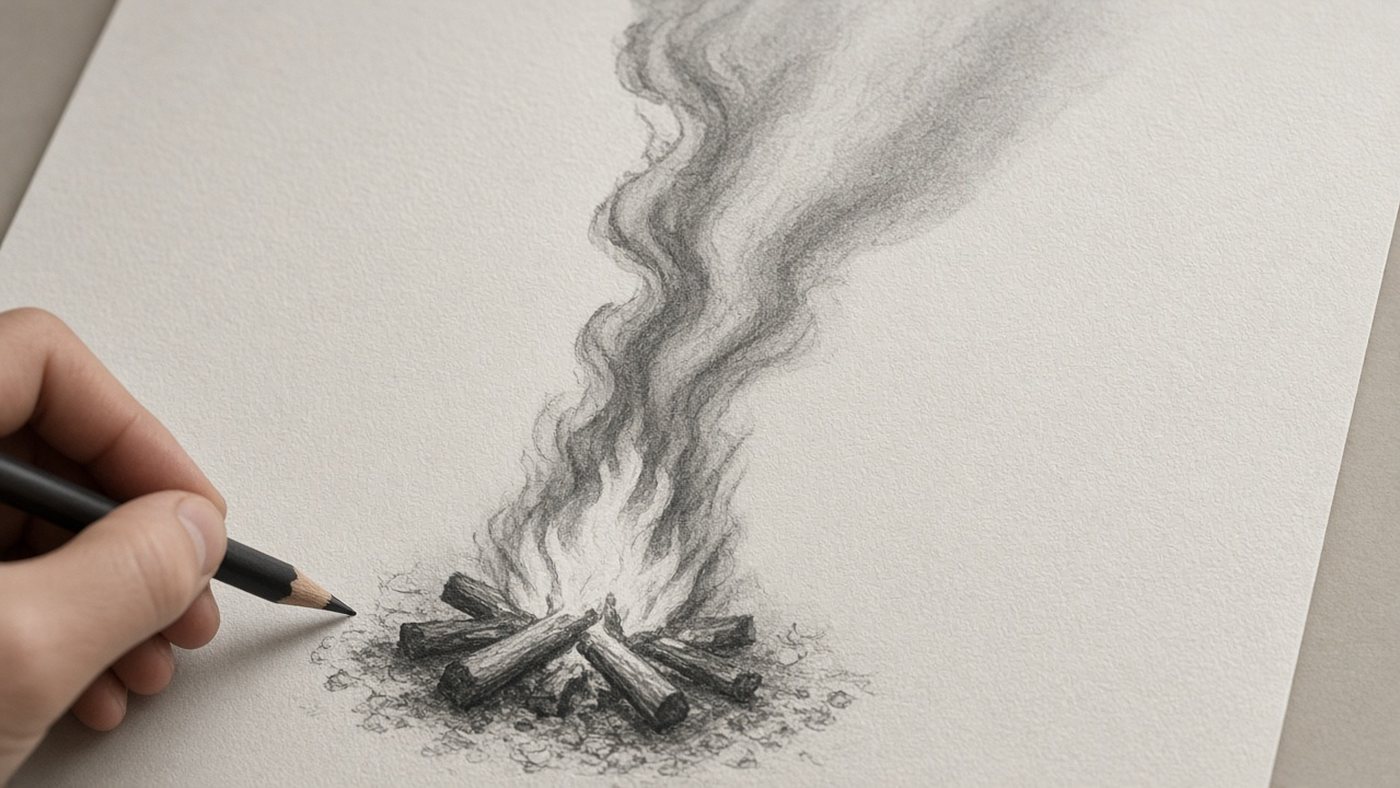
A soft edge
Build the edge with the side of the pencil or a dry brush, with no line. If a line is already there, rub it until it no longer reads as its own stroke. Leave a harder edge only where smoke crosses a dark background and the silhouette happens to be crisp.
Thinner toward the top
Near the source the smoke is denser. Higher up it thins, and the paper or the sky shows through more. The same gray from bottom to top is a post, not smoke. Ease the pressure toward the top. Do not add a new paint “for volume.”
- Mark the source: a cup, a fire, a pipe.
- Set a narrow start to the column.
- Widen it higher up and lighten the tone.
- Erase the edge if it has become a line.
A column and puffs
The column is the path. Puffs are places where the path paused. You do not need a puff on every centimeter.
Narrow at the source
Above a wick, coals, or the spout of a kettle the smoke is still gathered. A wide cloud straight off the point looks like a burst, not like a draft. Leave a neck about one third the width of the upper puff.
Wider and lighter above
Each next puff is wider than the last and lighter, if the background is light. On a dark background it may become lighter than the ground, but the edges are still thinner. Smoke has value like any shadow, which is why light and shadow still applies. Only the source is small and soft.
Steam and smoke
People mix them up because neither has a contour. Their tone against the background is opposite.
Steam is lighter than the background
Steam over a cup in a dark kitchen is a light veil. Draw it with an eraser or with white over a background you already laid, not with gray pencil on white paper. On white paper there is almost nothing to show steam with until the background behind it is darker than the steam.
Smoke is darker than the sky
Smoke from a fire against the sky is usually darker than the sky, and warmer or grayer. A white puff on blue with no gray looks like a cloud that lost its weather. Paint the sky first, then the smoke over it, weaker at the edges.
- No closed contour.
- Narrow at the source, wider above.
- Steam is lighter than the background behind it.
- Smoke on the sky is darker than the sky.
Check
If you could cut the smoke out with scissors along a crisp border, it is an object. Rub the border until the scissors have nothing to catch.
How to avoid cotton
Cotton is an evenly soft lump with no holes and no direction.
Holes in the puff
A puff has gaps of background. Leave two or three openings where the paper or the sky is almost clean. A solid lump reads as a cushion.
One edge sharper
Wind or light makes one edge of a puff a little sharper than the other. Both edges equally woolly, and the form does not turn. The sharper edge is still soft. It is not the contour of a bottle. It is a more gathered edge of the blending.
Time to draw, not just read
Theory fades in a couple of days if you never use it. Open the editor and spend 15 minutes on what you just read. That is enough for the skill to stick.
Try it now
A free online editor: brushes, layers, a palette, and a shared canvas. No install and no sign-up.
Start drawingTopics in this guide
- how to draw smoke
- drawing steam
- smoke from a fire
- steam from a cup
- soft edge in a drawing
← Vector: Not “Worse Than Painting,” a Different Tool — From Zero in an Evening How to draw a city at night →