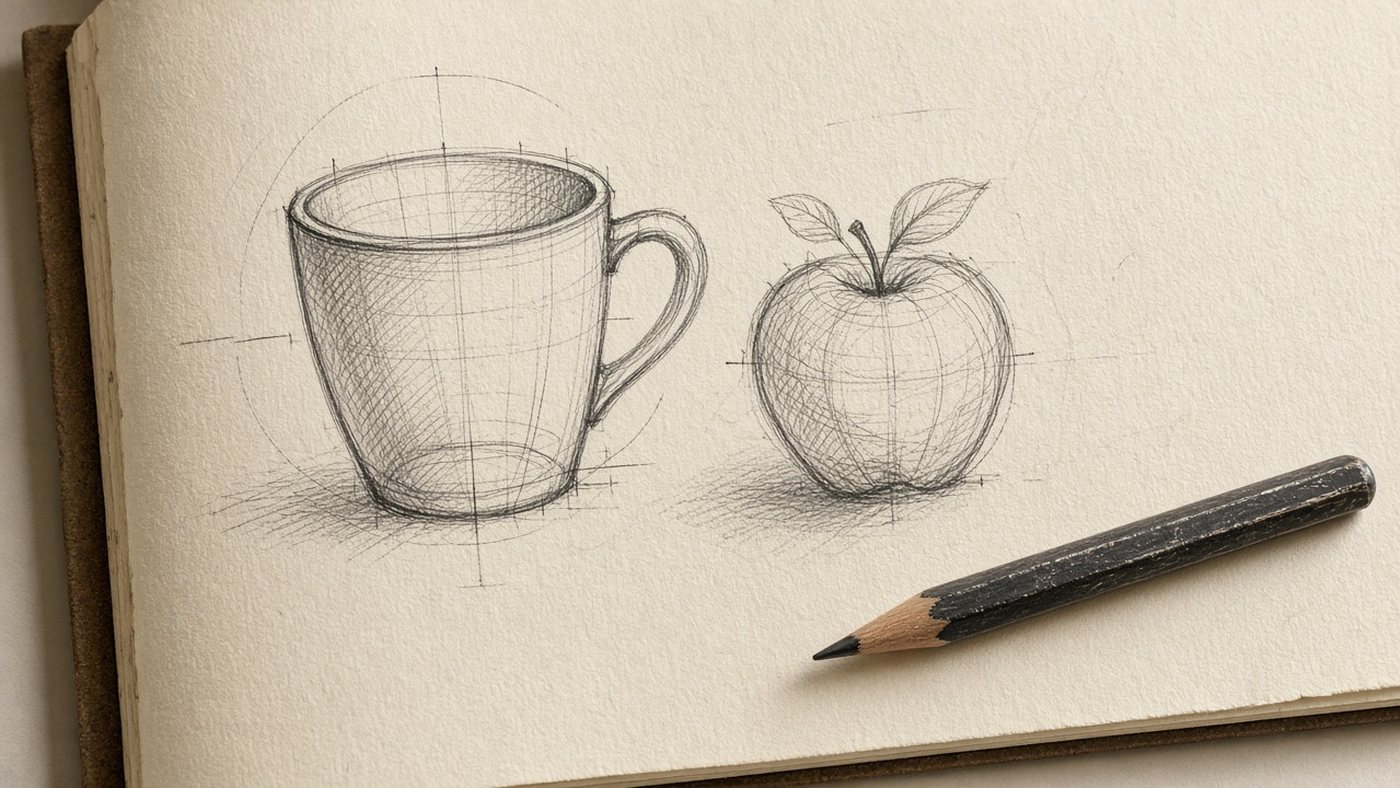
How a Sketch Differs from a Drawing
A drawing is finished. A sketch is stopped on time. They have different goals, so the standards are different. Judging a sketch by neatness is like judging a run by how pretty the handwriting is.
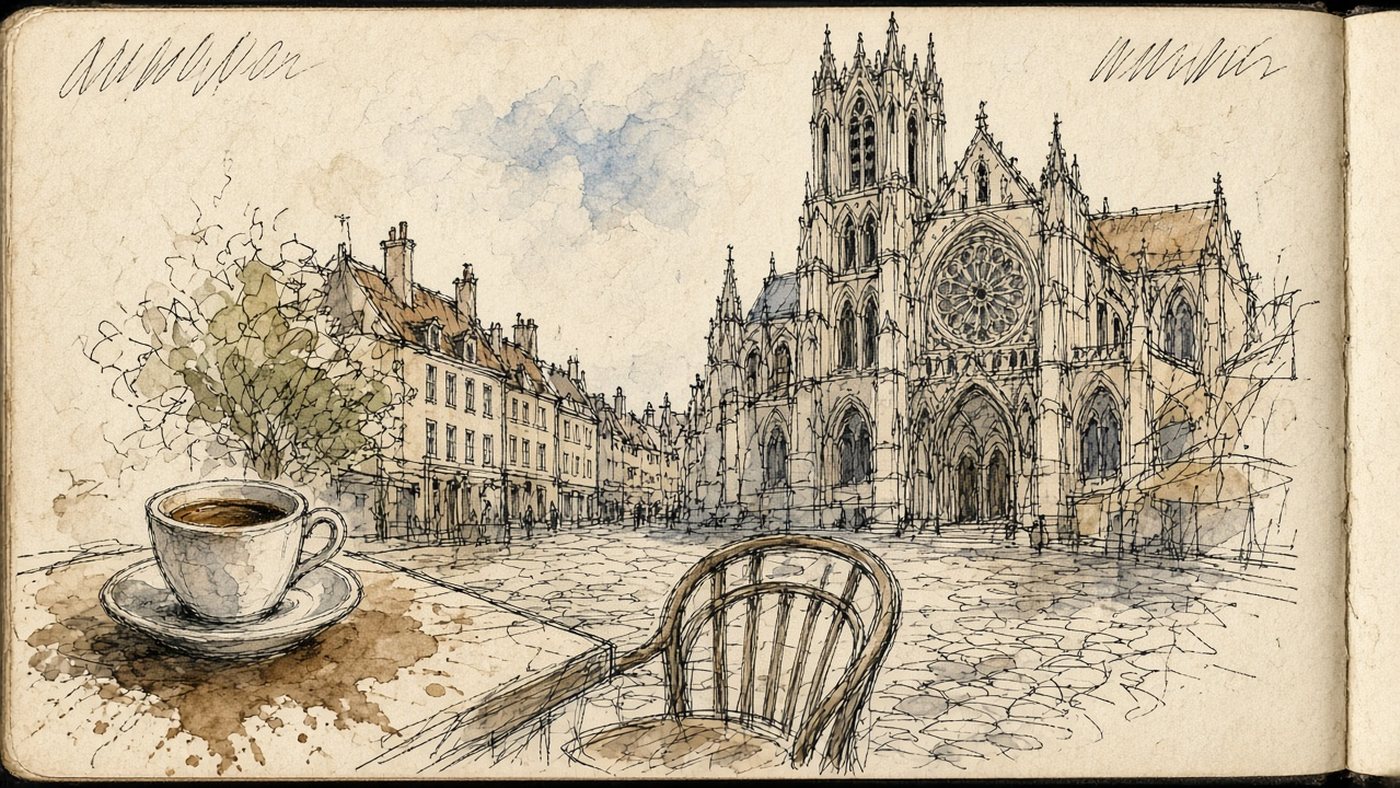
The Goal Is to Catch the Main Idea
A sketch records one idea: the tilt of a figure, the character of a face, the shape of a building. You can leave the rest undrawn. If after five minutes it is clear that the person is tired and leaning on a counter, the sketch worked, even with no fingers and no face.
Permission to Be Inaccurate
In a sketch you can leave searching lines, misses, and an open contour. Don't erase. Draw a second, more accurate line on top. A stack of lively sketches with mistakes teaches faster than one polished drawing in a week.
Fast Sketch Technique
Speed comes from the right order, not from a fast hand. The whole first, then the parts. Details come at the very end, and only one of them.
Large Masses in the First 30 Seconds
Block the subject in with two or three ovals: head, rib cage, pelvis. Check the overall size right away: how many heads fit into the height of the figure. The first thirty seconds decide whether the figure fits on the sheet and which way it is facing.
The Line of Action
Draw one arc from the crown to the supporting foot. That is the axis of the whole gesture. It should be long and unambiguous: a bend in one direction, with no wobble. The shoulders and the pelvis tilt in opposite directions, and the pose stops looking wooden.
Focus on One Detail
Pick one place to add detail and pressure: the face, the hand, a fold at the elbow. Leave the rest as light lines. The contrast between a worked-up patch and a light contour reads as a choice, not as something left unfinished.
Speed Exercises
Sketching is trained with a timer. Without a time limit the hand drifts into details on its own, and the exercise turns into an ordinary drawing.
30 Seconds, 2 Minutes, 5 Minutes
A working set for 20 minutes looks like this:
- Ten sketches of 30 seconds: only the line of action and the overall size.
- Five sketches of 2 minutes: the masses of the body and the tilt of the shoulders.
- Two sketches of 5 minutes: add the silhouette of the clothes and one detail.
- One sketch with no timer, where you use all of it at once.
Sketching People in a Cafe
Real people move, and that is a plus: you learn to draw from the memory of what you saw a second ago. Look for ten seconds, then move your eyes to the page and draw. Catch the whole pose, not the face. The same mechanism is trained in the article on drawing from memory.
Tip
Set a timer on your phone and don't extend it. The point of the exercise is to leave the sketch unfinished and start the next one.
What to Sketch
You don't have to hunt for a subject. It is all around you. Drawing the same place in different ways is more useful than changing the topic every day.
People and Poses
Start with figures on public transit and in lines: they stand still for several minutes. Note where the center of gravity is and which leg the person is standing on. You can check your proportions in the guide on proportions.
Objects and Interiors
A mug, a boot, a crumpled jacket on a chair: ideal models. They don't move, and they have a complex shape. In an interior, look for patches of light on the floor and the walls, not for the furniture. A room reads from those patches faster than from the outline of a cabinet.
City Views
A city sketch is built from the horizon line and one vanishing point. Don't draw every window. Mark a rhythm of three or four and stop. A detailed order of work for a street is in the guide on how to draw cities.
Sketching Digitally
In an editor it is easy to drown in settings and spend the time on something other than drawing. A hard limit on yourself helps.
One Brush and One Layer
Take one pressure-sensitive brush and work on a single layer with no eraser. That forces you to think before you put down a line. A few useful limits:
- turn stabilization off. It hides the shake and gets in the way of training your hand;
- take the eraser off the toolbar for the exercise;
- keep the canvas small: 2000 pixels on the long side;
- don't change brushes in the middle of a sketch;
- save every sketch, including the ones that failed.
A Time Limit
Get in the habit of making three sketches a day and stacking them in one continuous file. After a month, scroll through the whole thing: the difference between the first page and the last is obvious without a detail-by-detail comparison. How to keep that rhythm is covered in the article on the daily drawing habit.
Time to draw, not just read
Theory fades in a couple of days if you never use it. Open the editor and spend 15 minutes on what you just read. That is enough for the skill to stick.
Try it now
A free online editor: brushes, layers, a palette, and a shared canvas. No install and no sign-up.
Start drawingTopics in this guide
- sketching for beginners
- quick sketches
- how to sketch
- a 5-minute sketch
- sketching exercises
← Fantasy Art for Beginners: How to Invent Creatures and Worlds Calligraphy and Lettering: Where to Start and How They Differ →