What a visual library is
A visual library is the set of forms you can pull from your head without a reference. It is not photographic memory. You remember how the object is built, not a picture of it.

A bank of forms in your head
An artist with a full library knows that a hand is a flat box plus four cylinders. They do not remember one particular hand. They can construct any hand.
Why everything looks the same without one
If the library holds one scheme for a face, every character you draw will look related. Five types of nose that you have taken apart immediately give you five different faces.
How to memorize an object
Memorizing works through simplification. You cannot hold something complex. You can hold something simple. Take the object apart into forms and learn the scheme, not the surface.
Break it into simple forms
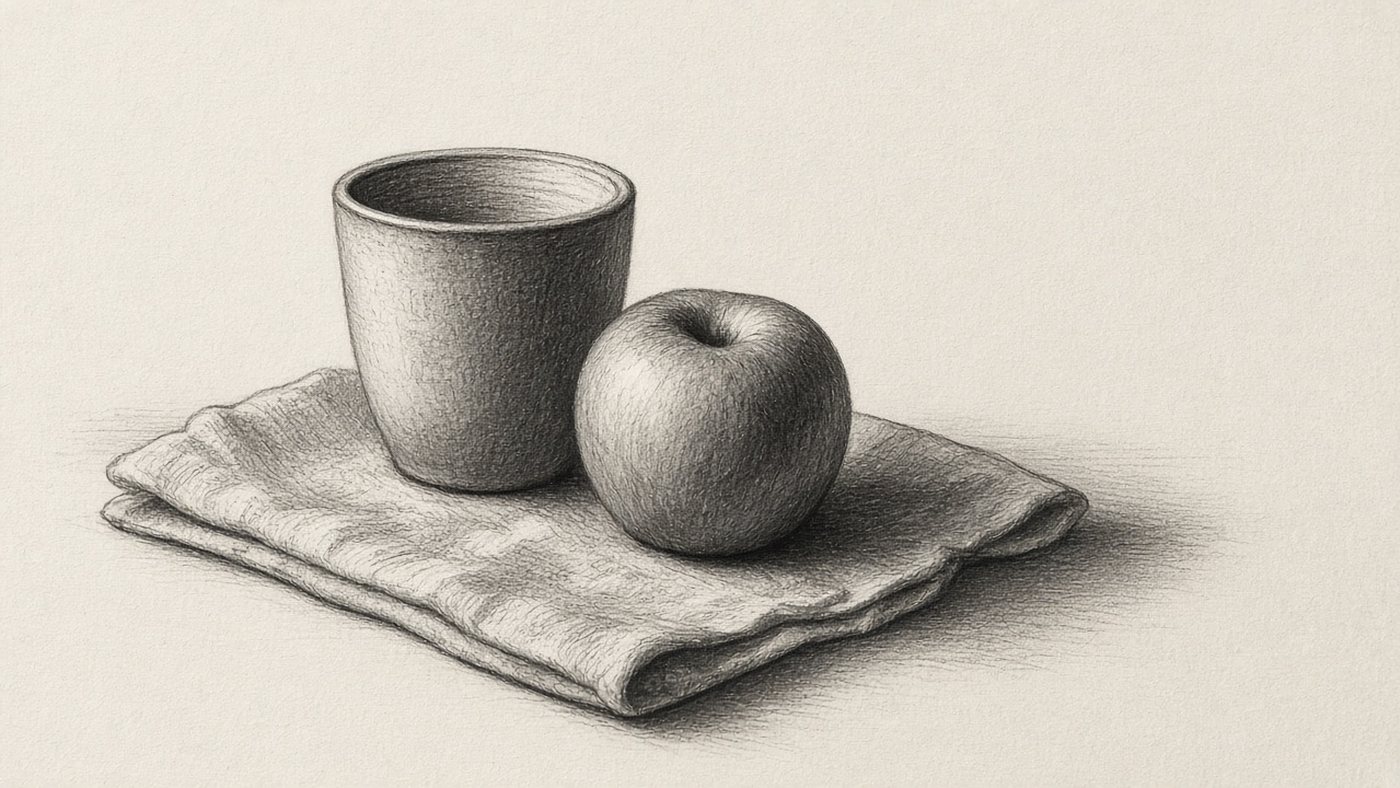
Take a photo of a mug and draw it as a cylinder with a donut glued on for a handle. Then a kettle: a sphere, a cone, and two arcs. The mechanics of that breakdown are shown in the guide to building form and volume.
Three main traits of an object
- proportion — what is longer here, and by how many times;
- silhouette — whether you would recognize the object as a black shape;
- the telling detail — the thing that, if you remove it, means the object stops being itself;
- direction — which way the object leans or reaches;
- the joint — how the parts connect to each other.
Write these five points in words for one object. A day later, try to draw it from that note alone.
The "look, then draw" exercise
This is the main memory exercise, and it takes three minutes per object. The point is that you draw with the reference closed. Otherwise you are training copying, not memory.
30 seconds of looking
Set a timer for 30 seconds and look at the reference without drawing. In that time, do not study details. Say the scheme to yourself: which forms the object is made of, and which way it leans.
Drawing without peeking
- Close the reference. Collapse the tab, or turn away from the screen.
- Draw from memory for 2 minutes, starting with the overall form.
- Do not erase. Leave the wrong line and draw the right one beside it.
- Finish it, even if you can tell you went wrong.
- Only then open the reference.
Compare, then repeat
Put the drawing next to the photo and find three differences. No more than three, or the review turns into beating yourself up. Then draw the object a second time with the reference closed. The second try is more accurate, and that is the one that locks the form in.
Check
A week later, draw the same object from memory without opening the photo or the old drawing. If the scheme comes back without a struggle, the object really is in the library.
Filling the library
The library fills by subject, not by random pictures. Taking everything apart at once is useless. A day later, nothing from that kind of review is left.
One subject for the week
Take a narrow subject for seven days: hands, tree crowns, kettles, folds on a sleeve. Each day, do three breakdowns and three drawings from memory, 15 minutes in all.
Sketches from life
Life gives you what photographs do not: volume, movement, and a sense of how the object is built from every side. Draw objects from your table, people on transit, dogs in the park, two minutes per sketch. File those sketches in an online sketchbook by date, so you can see which subjects are already covered.
How to combine it with references
Memory and references are not opponents. Each one checks the other. Draw from your head, and use the photo to check, not to trace.
From memory first, then a check
Start any piece without a reference. Sketch the composition and the pose from your head. Then open a photo and fix what drifted. The rules for that way of working are in the guide to drawing from a reference.
Inventing from what you have studied
Once the library holds thirty objects you have taken apart, you can build things that do not exist: a creature from two animals, a house from three houses. If you run short on ideas, the techniques in the guide to finding inspiration will help.
Time to draw, not just read
Theory fades in a couple of days if you never use it. Open the editor and spend 15 minutes on what you just read. That is enough for the skill to stick.
Try it now
A free online editor: brushes, layers, a palette, and a shared canvas. No install and no sign-up.
Start drawingTopics in this guide
- drawing from memory
- how to draw without a reference
- an artist's visual memory
- visual library
- memory exercises
← Grid drawing: an accurate transfer onto the canvas 25 drawing assignments for artists: a month of practice →