How to use the list
The list closes the only question that matters: what to draw today. Open it, take the next assignment in order, and set a timer for 15–20 minutes.

From simple to hard
- Go in order. Each assignment builds on the one before it.
- One assignment per session, not two, and not half of one.
- If it did not work, repeat it the next day instead of dropping it.
- Mark the finished numbers in a note or a file.
- When you reach 25, start a second round with half the time limit.
The "done" criterion
An assignment is closed when the condition is met, not when it looks beautiful. The criterion is stated after each block. Check against that, not against the feeling of "I like it" or "I do not."
Line and form assignments
The first ten assignments settle the hand and teach you to see an object as a volume. Part of it is dull. Without it, the rest does not work.
Assignments 1–6: lines, arcs, ellipses
- Assignment 1. Thirty straight lines between two points, each in a single stroke.
- Assignment 2. Fifty arcs in one direction, then fifty in the other.
- Assignment 3. Forty ellipses at different tilts, inside rectangles you have drawn.
- Assignment 4. A spiral of ten turns with no crossings, three tries.
- Assignment 5. Hatch a square of 5 by 5 cm with an even gap between the lines.
- Assignment 6. Trace one of your own lines ten times on top of itself, without lifting.
Done if the lines do not wobble, and the miss at the endpoint is no more than 3 mm.
Assignments 7–10: everyday objects
- Assignment 7. A mug from the table, contour only, ten minutes.
- Assignment 8. The same mug from three angles, on one canvas.
- Assignment 9. Three objects side by side, with the proportions measured before the first line.
- Assignment 10. A phone, a thermos, and a lamp, reduced to a cube, a sphere, and a cylinder.
Done if the object is recognizable without a label, and the ratio of its height to its width matches the real thing.
Value and light assignments
Value is what makes an object solid. A line only outlines it. The eight assignments below move a drawing from flat to solid.
Assignments 11–15: value scales and a sphere
- Assignment 11. A value scale of five steps from white to black.
- Assignment 12. A smooth scale 10 cm long, with no visible borders.
- Assignment 13. A sphere with one light source and all five zones of light.
- Assignment 14. The same sphere lit from above, from the side, and from behind.
- Assignment 15. A cube and a cylinder with cast shadows on a plane.
Done if the drawing shows a highlight, light, a halftone, a form shadow, and reflected light.
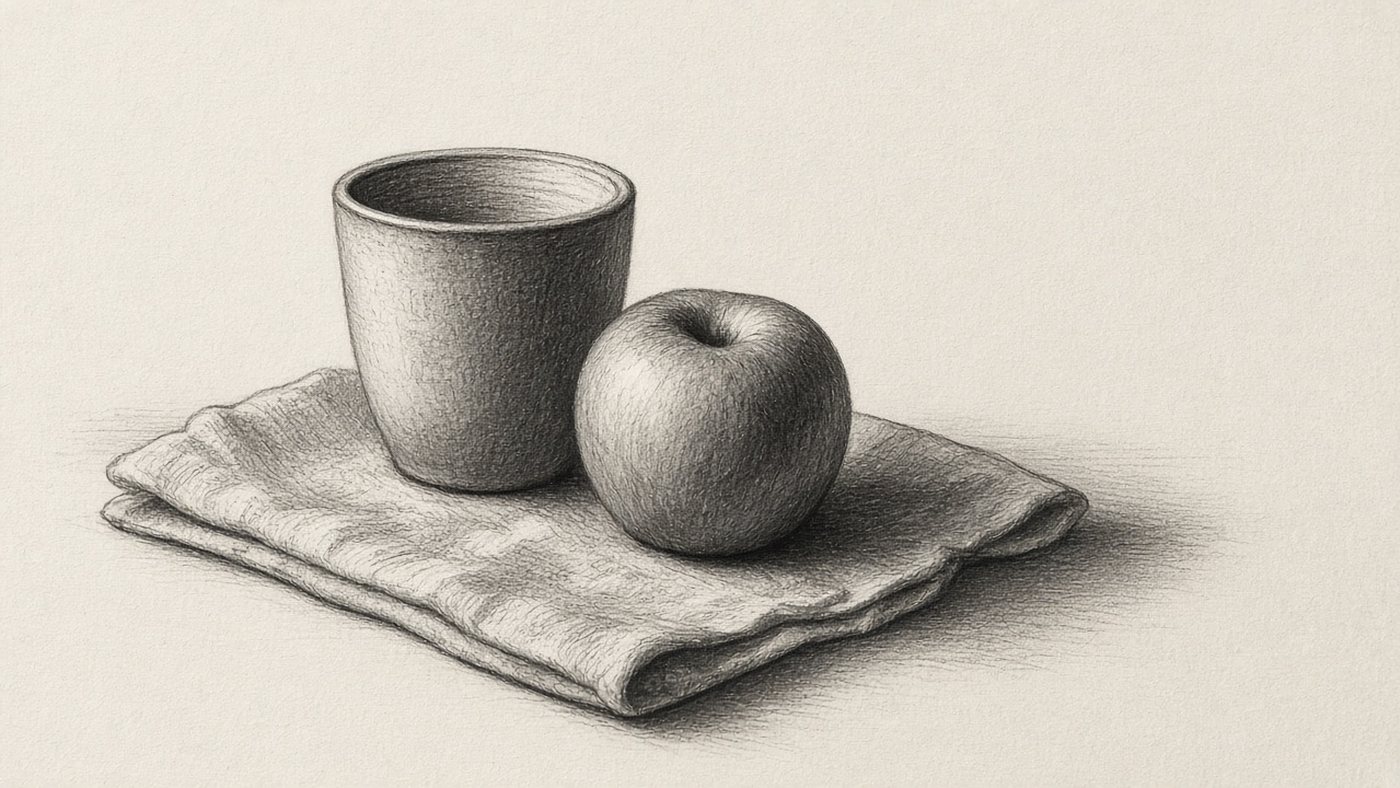
Assignments 16–18: still life
- Assignment 16. A still life of two objects in three values, with nothing in between.
- Assignment 17. The same still life, with drapery in the background.
- Assignment 18. A still life in backlighting: the light source is behind the objects.
Done if three separate value shapes still read when the image is shrunk to icon size. How to set one up is in the guide to still life for beginners.
Color assignments
Color spoils a piece faster than anything else, so do not reach for the full palette yet. Four assignments keep you inside hard limits.
Assignments 19–21: a limited palette
- Assignment 19. A piece in two colors plus white, twenty minutes.
- Assignment 20. One subject twice: once in a warm palette, once in a cool palette.
- Assignment 21. A landscape in which every color is sampled from a photo with the eyedropper.
Done if the colors have not turned into gray mud, and you can tell where the light is coming from.
Assignment 22: recolor a piece
Take an old piece of yours, duplicate the layer, and replace the palette completely. Turn day into evening. Done if the new version reads as clearly as the original, and the mood has changed.
Shortcut
Save every assignment as a file with the number in the name, such as "assignment-07." A month later you can find the piece in a minute and compare it with a second pass.
Creative assignments
The last three assignments test whether you can invent. Count one session for each.
Assignments 23–25: your own composition and a character
- Assignment 23. A composition from three random words, for example "lighthouse, kettle, fog."
- Assignment 24. A character from a one-line description, with three different silhouettes to choose from.
- Assignment 25. A finished piece from sketch to final, across three sessions.
Done if a person who was not there describes the subject the same way you intended it.
How to make them harder
Do the second round with less time, and the third from memory, with no references. After that, add conditions: one color, one brush, a mirrored angle. A ready calendar for the month is in the 30-day learning plan, and staying on the schedule is easier with the guide to the habit of drawing every day.
Time to draw, not just read
Theory fades in a couple of days if you never use it. Open the editor and spend 15 minutes on what you just read. That is enough for the skill to stick.
Try it now
A free online editor: brushes, layers, a palette, and a shared canvas. No install and no sign-up.
Start drawingTopics in this guide
- assignments for artists
- drawing homework
- what to draw for practice
- drawing exercises
- a list of assignments
← Drawing from memory: how to learn to draw without a reference Digital sketchbook: how to keep an album and not quit →