What Value Is
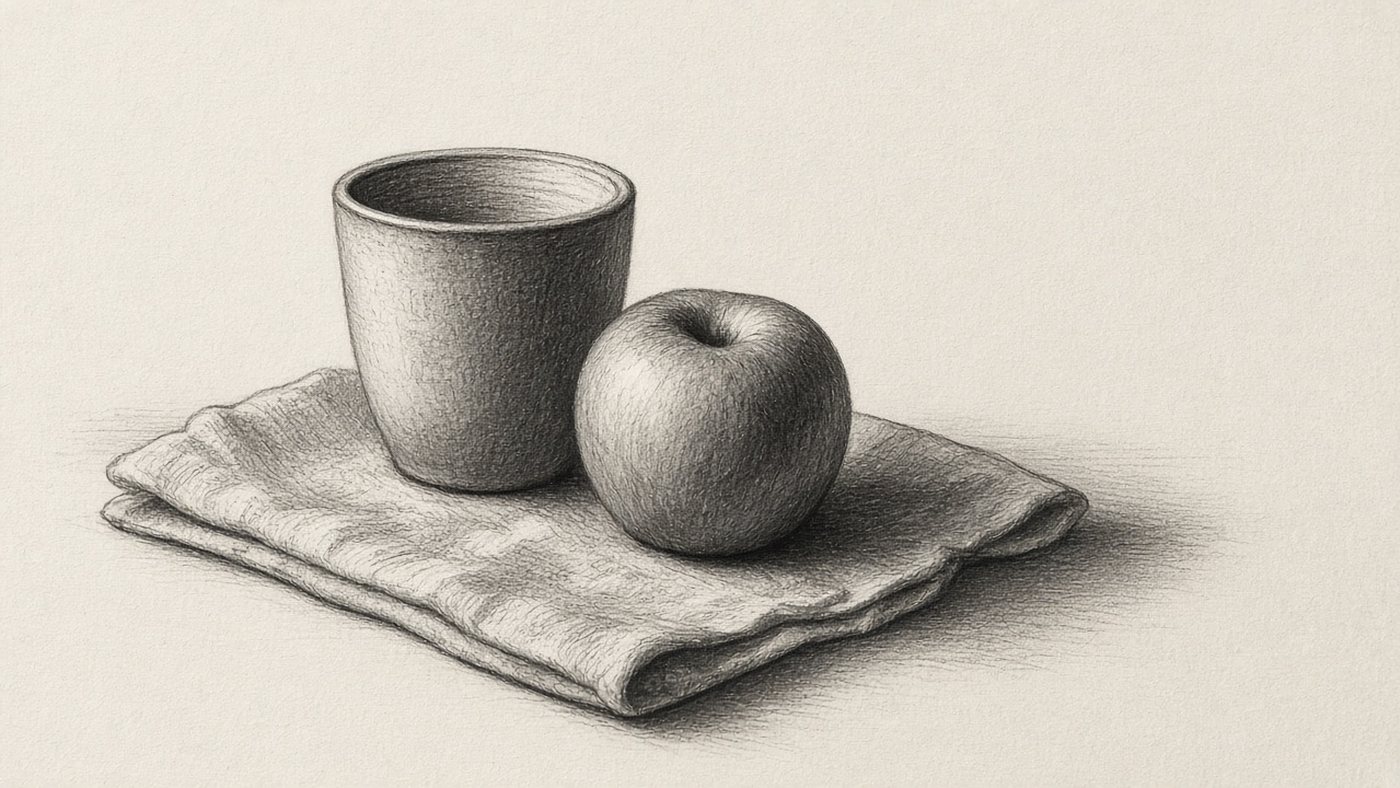
Value is how light or dark a shape is, from white to black. Value is what creates volume and makes a drawing readable. Color only adds mood. A drawing with the right values still works in black and white.
Value Versus Color
A bright yellow and a pale blue can share the same value, even though they look completely different. That is why a colorful piece sometimes falls apart: the colors are there, and the lightness is the same. The difference between these properties is covered in the article on color theory.
Checking in Black and White
Convert your piece to black and white. In an editor, that is a desaturate adjustment layer. If the objects melt into one muddy mass, the values are not built. Check this way every 20 minutes of work, not only at the very end.
A Value Scale
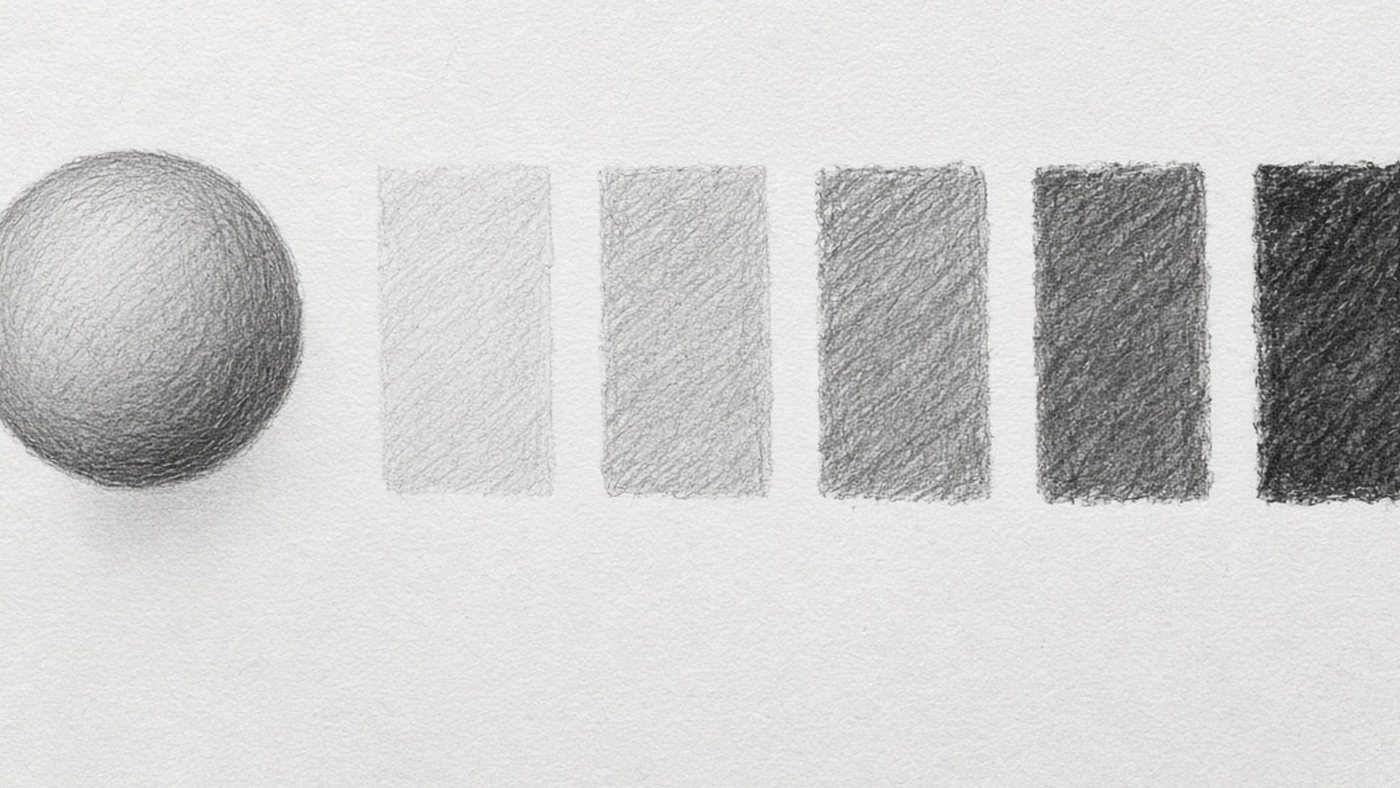
A scale is a ruler for value. Without one, you guess. With one, you compare.

Five Steps to Start
Draw a strip 10 by 2 cm and divide it into five cells. The first stays white, the last is as black as you can make it, and three even steps sit between them. Keep this scale next to the drawing and hold it up against the shapes.
Ten Steps for Control
When five steps come easily, make ten on a strip 20 by 2 cm. This is where pressure problems show up: the middle usually collapses. Scan the scale and check it in the editor. Neighboring cells should differ by about 10 percent in brightness.
Check
Squint and look at the scale from a distance. If one step pops out, or two of them merge, the transitions are uneven. A correct scale looks like a smooth gradient when you squint.
How to Make a Value Blend
A blend is a smooth transition from white to black with no steps. Take an HB pencil and a strip 15 by 3 cm, and set a timer for 15 minutes.
A Smooth Increase in Pressure
- Start at the light end, holding the pencil almost horizontal.
- Lay the strokes in tight rows, increasing the pressure a little every 2 cm.
- When you reach the dark end, go back to the start and pass over it again.
- Switch to a 4B pencil only for the last 3 cm.
- Step two meters back and find the places where the transition breaks.
Layering Strokes Instead of Pressing
Dark value comes from the number of layers, not from how hard you press. Paper that has been dented shines and will not take more graphite. Lay down 4-5 light layers, changing the stroke direction by 30 degrees. That is how the basics of hatching work on a blend too.
Common Mistakes
Almost every problem with a blend comes down to two things: rushing, and an uneven rhythm in the hand.
Black Too Early
Beginners bear down on the pencil in the first seconds and hit the limit within 3 cm. There is nothing left to blend, and the second half of the strip comes out the same. Start so light that you can barely see the stroke.
Bands and Zebra Stripes
Bands appear when the hand makes strokes of different lengths, with pauses between them. Move from the shoulder and carry each stroke past the edge of the strip, then trim the extra later. Turning the page 90 degrees after each pass helps.
A Value Blend in Digital
In an editor you can make a gradient with one button, but the thing to train is your hand. Turn the gradient tool off and work with a brush.
Pressure and the Pressure Curve
Check that the brush responds to pen pressure, not only to speed. If the value jumps from a light touch, soften the pressure curve in the settings. The finer points of setup are covered in the piece on pressure and line stabilization.
A Soft Brush and Low Opacity
Settings that work for a blend in the editor:
- a round soft brush with no texture;
- opacity at 15-20 percent;
- a size of about 60 pixels on a 2000-pixel canvas;
- a separate layer for the blend, so you can erase without losing anything.
Build the value with many light passes, the way a pencil builds it on paper.
Time to draw, not just read
Theory fades in a couple of days if you never use it. Open the editor and spend 15 minutes on what you just read. That is enough for the skill to stick.
Try it now
A free online editor: brushes, layers, a palette, and a shared canvas. No install and no sign-up.
Start drawingTopics in this guide
- value scale drawing
- value in drawing
- tonal scale
- how to shade smoothly
- pencil pressure control
← See Like an Artist: 6 observation exercises Color Wheel: how to pick color combinations without guessing →