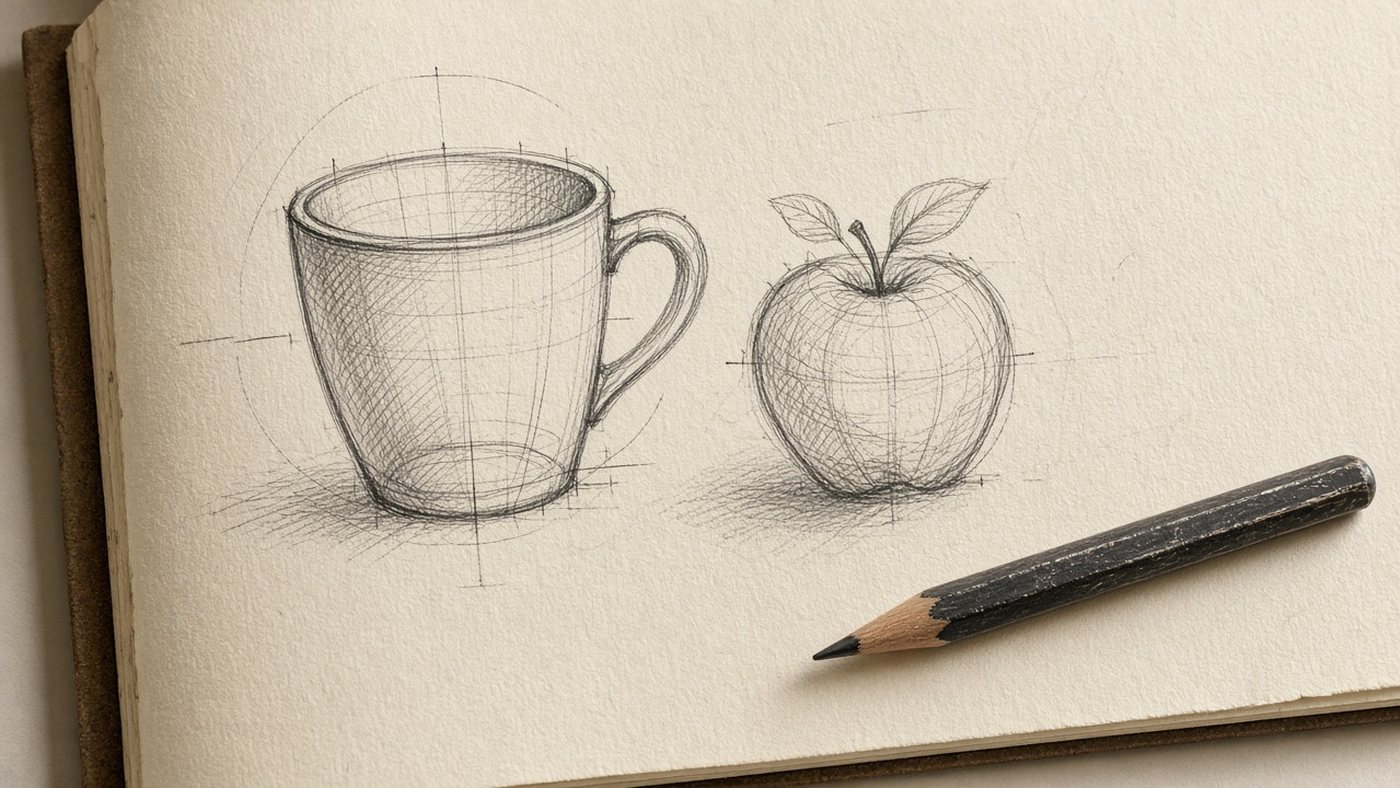
Why We Draw Symbols
The eye sees a complex shape, and the hand draws a diagram learned at age seven. The brain does not want to spend energy on every line, so it slips in a ready-made label. A drawing comes out looking childish because of that swap, not because of the hand.
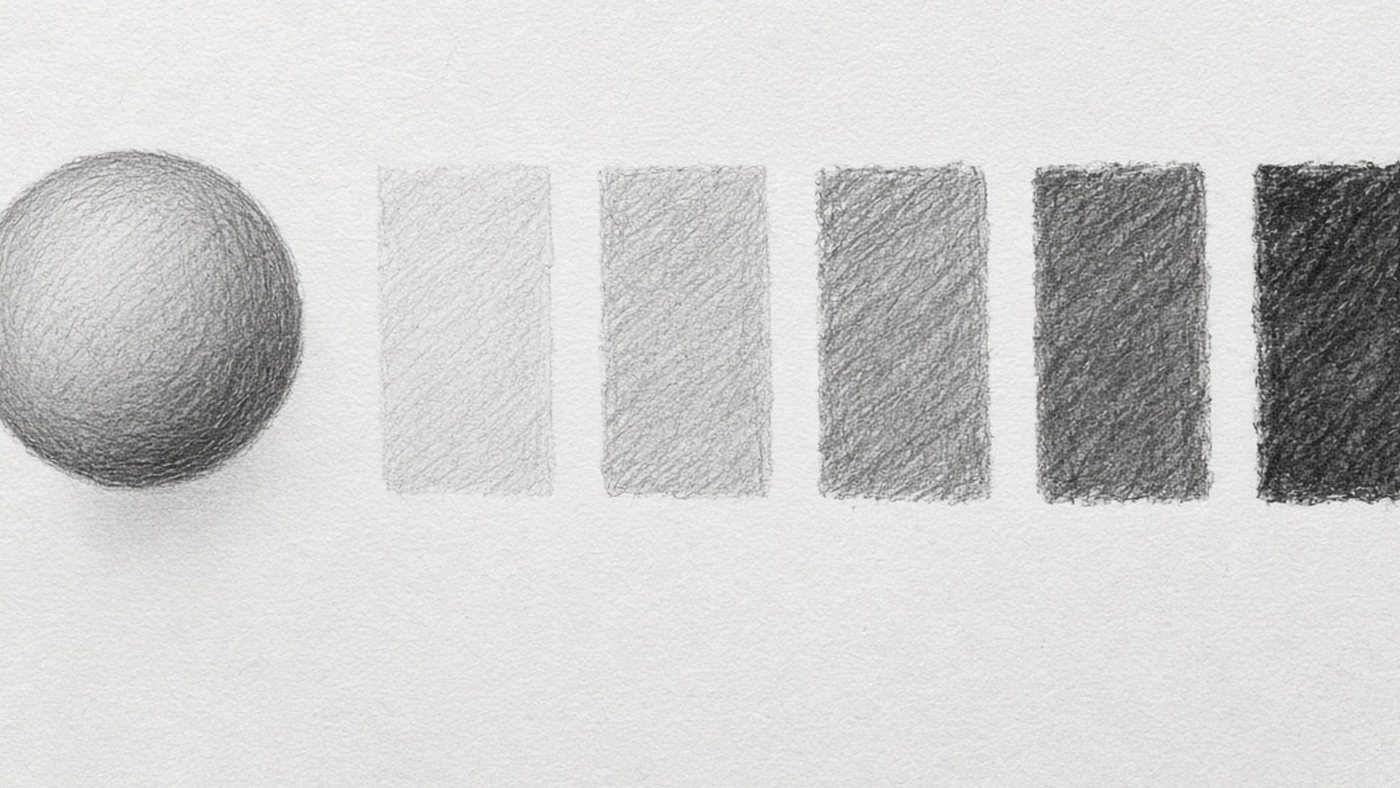
The Brain Likes Labels
Ask anyone to draw a house and you get a square, a triangular roof, and a chimney. The eye, meanwhile, is looking at a real house with four windows of different heights. The brain recognized the object, tagged it as a house, and stopped looking.
How to Tell You Are Drawing from Memory
Simple signs show that you have slipped into a diagram:
- you look at the page more often than at the reference;
- the eyes came out identical, even though they sit at different angles in the photo;
- you draw the correct way, not the way you see it;
- the object is recognizable, but it does not look like this specific thing.
Exercises That Switch You Over
It is easier to trick the habit than to fight it. Take away the brain's chance to recognize the object, and observation switches on.
Drawing from an Upside-Down Reference
The brain does not recognize a nose or an ear in an upside-down picture, so it copies what is actually there.
- Open or print a portrait photograph.
- Turn it upside down and do not turn it back.
- Draw only lines and shapes, without naming them to yourself.
- After 25 minutes, turn the page over. The likeness usually surprises you.
Blind Contour Without Looking at the Page
Place your left hand in front of you and trace its contour without lifting the pencil and without looking at the paper. Move your eye along the edge of the palm very slowly, in sync with your hand. The result will be crooked, and this is the exercise that builds attention to shape.
Shortcut
Do a blind contour for exactly 5 minutes before every drawing session. It is a warm-up for the eye, not the hand: the drawing that follows is noticeably more accurate.
Working with Shape
Once the brain stops naming objects, shapes and proportions are what remain. Those are much easier to work with.
Silhouette Only
Fill the object with one black shape and not a single line inside it. A cat, a chair, a kettle: each one becomes a flat figure. If the silhouette is recognizable, the shape is right.
Negative Space
Draw the gaps between the chair legs and the chair back, not the chair itself. Empty space has no name, so the brain cannot slip in a template. The method also fixes proportions. More on that is in the article on measuring proportions.
Working with Value and Color
Light works the same way. We know that snow is white and shadow is gray, and we paint from that knowledge instead of from what we see.
A Drawing in Three Values
Allow yourself only white, middle gray, and near-black. No in-between values. Squint at the object and decide which of the three groups each shape belongs to. The exercise sits well on top of a value scale.
The Eyedropper Instead of Guesses
Open a photo in an online editor and click the eyedropper on the skin of a face, on snow in shadow, and on a white wall. You will see green, violet, and ocher hues where you expected gray. Take 8-10 samples like that and line them up in a strip. That is your real set of colors, not the one you imagined.
How to Make Observation a Habit
The ability to see depends on doing it regularly. Five minutes every day does more than a three-hour marathon once a month.
Five Minutes of Looking a Day
Pick one object and simply look at it for 5 minutes without a pencil. Notice where the edge is sharp and where it is soft, and where the darkest piece of shadow falls. That kind of looking pairs well with drawing from memory right afterward.
A Shape Journal
Keep a notebook and sketch one object three ways every day: as a silhouette, as a contour, and in three values. In a month you will have 90 sketches and a visible record of progress. Write the date and the lighting, so you can see what started to come out better.
Time to draw, not just read
Theory fades in a couple of days if you never use it. Open the editor and spend 15 minutes on what you just read. That is enough for the skill to stick.
Try it now
A free online editor: brushes, layers, a palette, and a shared canvas. No install and no sign-up.
Start drawingTopics in this guide
- how to see like an artist
- observation exercises for drawing
- upside-down drawing
- blind contour drawing
- negative space drawing
← Geometric Shapes: a base for any object Value Scale: a basic exercise for value control →