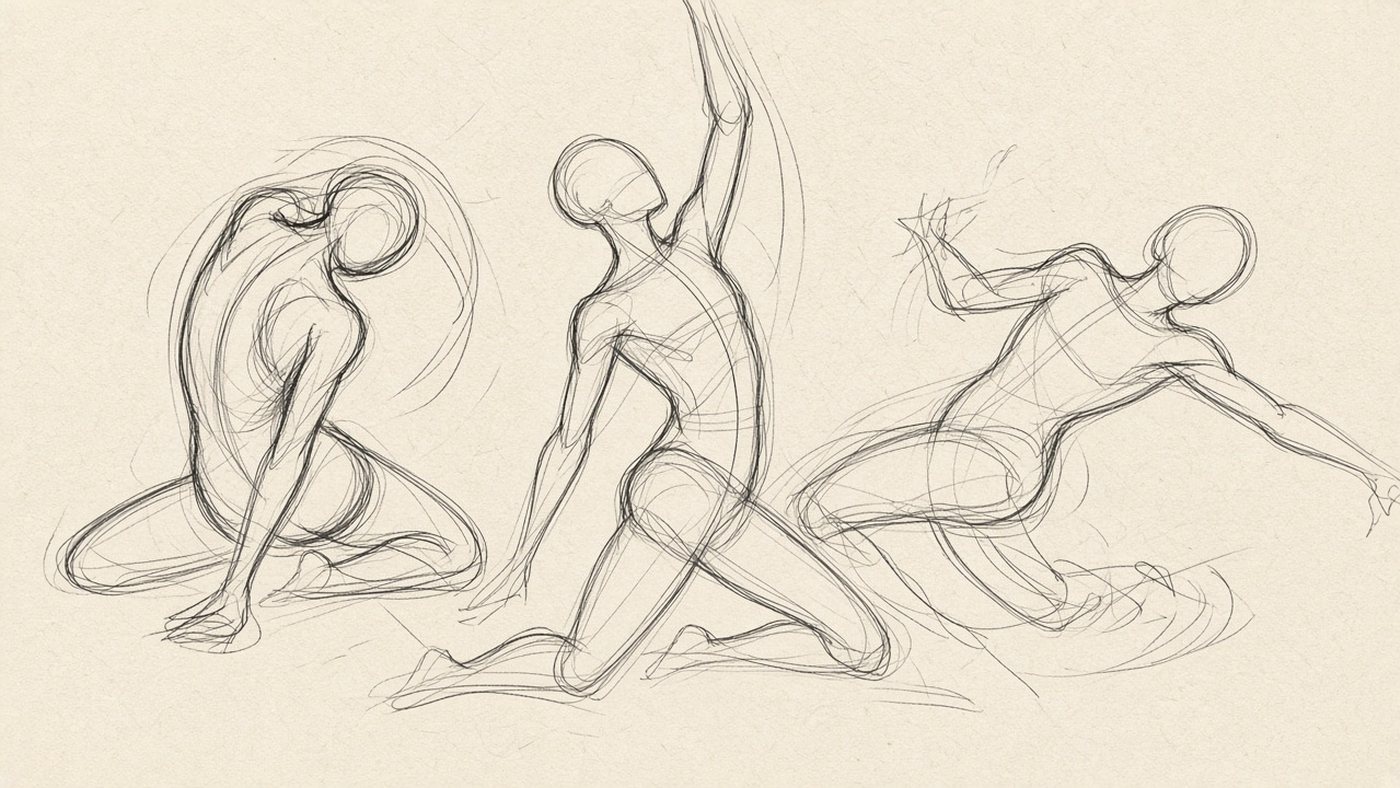
What proportions are in a drawing
Proportions are the size relationships between parts, not the sizes themselves. A drawing can be half the size of the subject and still be completely accurate, if every relationship is kept.
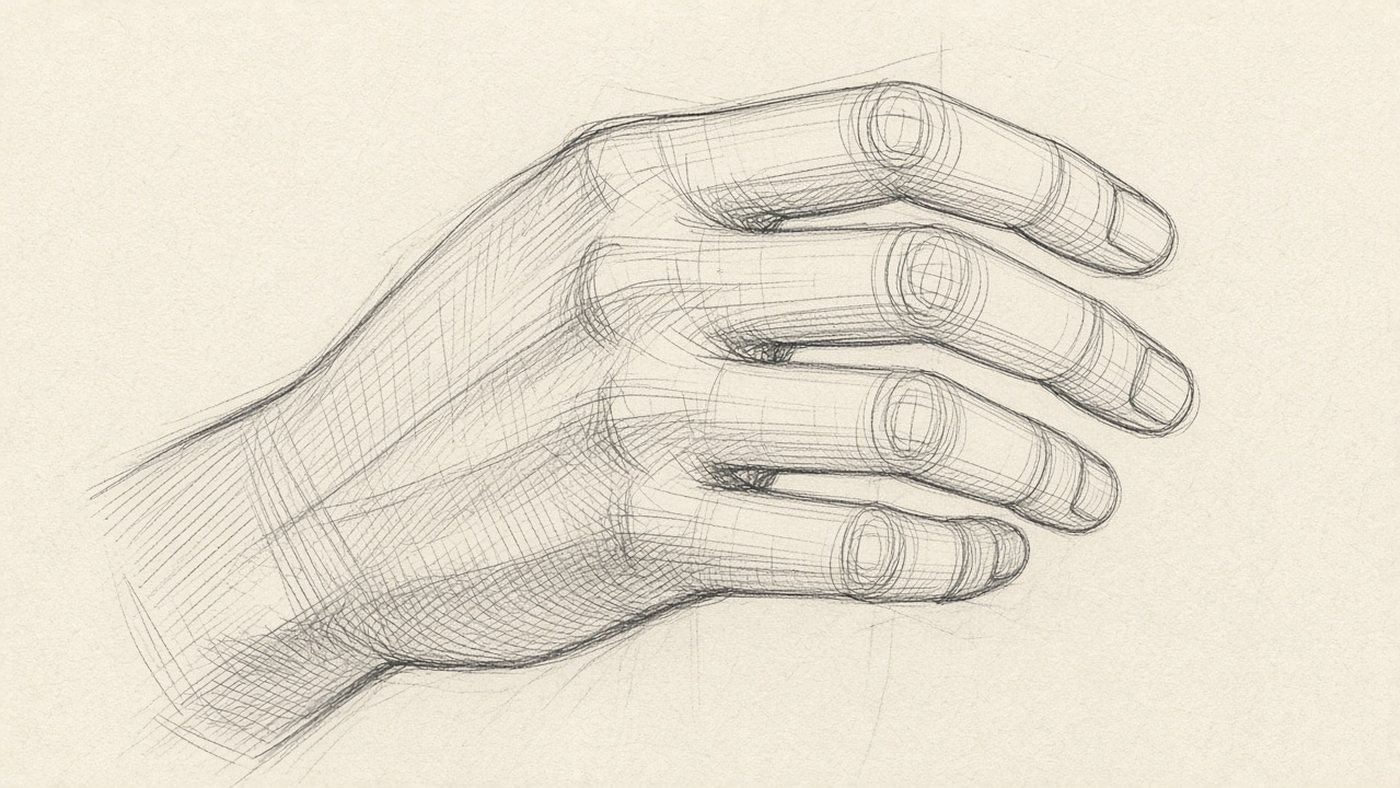
Relationships, not sizes
The question "how many centimeters is this cup" is useless. A different question works: "how many times wider is the cup than it is tall." Comparisons like that transfer to a page of any size with no conversion.
Choosing a unit of measure
Pick one element and measure everything else with it. On a human figure that is the head. On a face it is the distance between the eyes. In a still life it is the smallest object. Choose the unit once, and do not change it until the drawing is done.
The pencil method
The fastest way to check yourself is to measure the subject with a pencil at arm's length. The method takes 5 seconds, and it saves you from skewed tables and oversized heads.
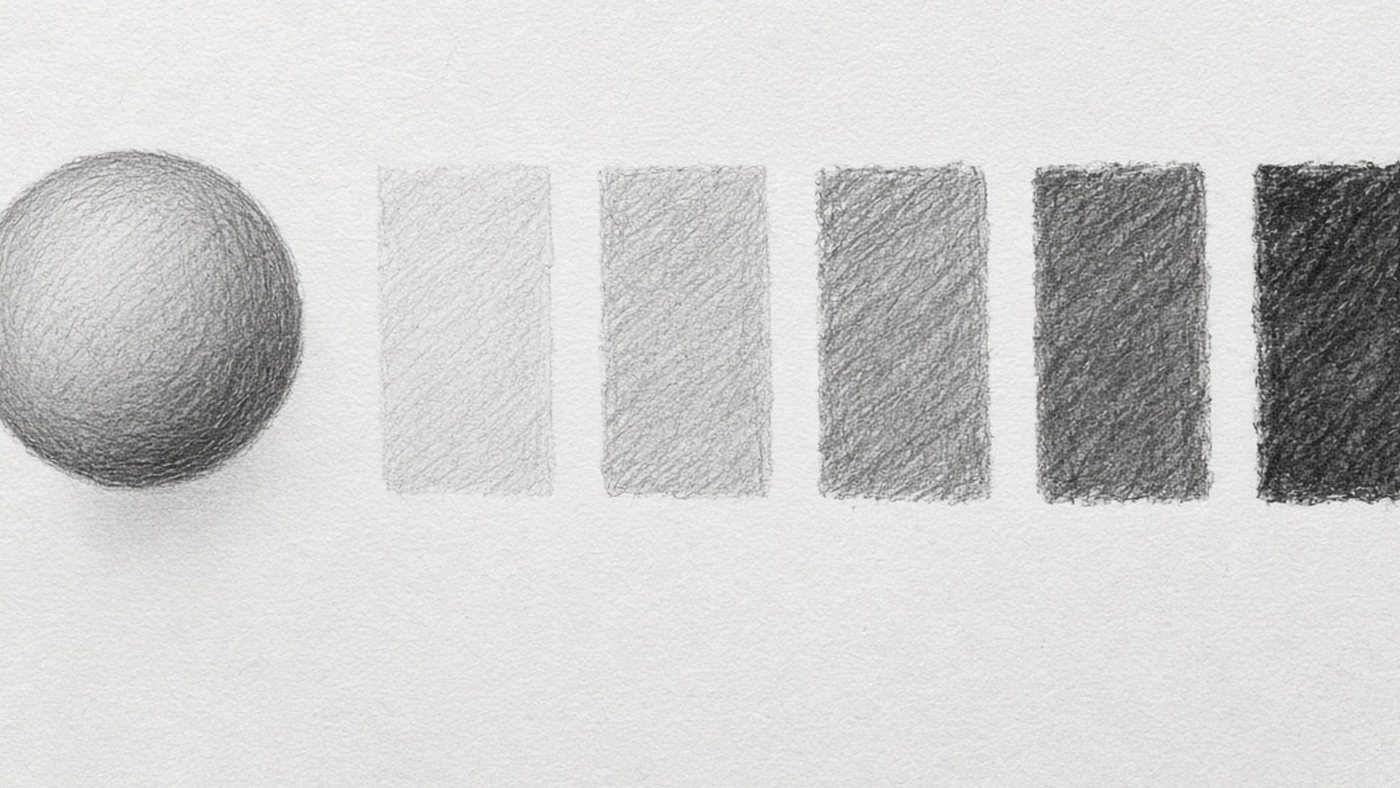
How to hold your arm
The elbow has to be fully straight, and the same way on every measurement: if the arm bends, the scale changes and every number drifts. Hold the pencil perpendicular to your line of sight, not at a tilt. Do not move your head between measurements either.
Transferring the measurement to the page
- Measure the height of the object: pencil tip at the top, thumb at the bottom.
- Without changing your grip, turn the pencil horizontal and hold it against the width.
- Remember the relationship, for example "the width is two heights minus a little."
- Lay down the height on the page at any size that suits you.
- Build the width from it, using that same relationship.
Negative space
The brain knows how a hand "should" look, and it substitutes a familiar diagram for the real form. It does not know the empty space around the object, and it stops inventing.
Draw the empty space around the object
Find the gap between the arm and the body, between the chair legs, between the leaves. Draw those shapes as objects in their own right, without thinking about the thing itself. When every empty space is in place, the object appears on its own, and in the right proportions.
Why the brain stops inventing
Empty space has no name and no memorized image, so the eye has to look at the real angles and distances. Other observation exercises use the same mechanism. A set of them is in the article on how to see like an artist.
Checking for mistakes
Check proportions every 10-15 minutes of work, not at the end. A mistake found while the lines are still a sketch is fixed in one stroke.
A horizontal flip
Flip the drawing: one button in the editor, and on paper an ordinary mirror, or a look through the back of the sheet held up to the light. The eye stops recognizing the familiar picture, and the skew jumps out at once. The method catches skewed proportions and a tipped composition equally well.
A look from far away, and a squint
- step back 2-3 meters and look at the work for 5 seconds;
- squint so the details disappear and the shapes remain;
- compare the drawing and the subject, shifting your gaze quickly, back and forth;
- shrink the image to thumbnail size on the screen.
Check
Photograph the drawing and the subject from the same spot, then place the photos side by side and shrink both to 5 centimeters. At that size, large proportion mistakes show in a second, and small details do not distract you.
Proportions of the figure and the face
The figure and the head come with ready measurements. They are not strict rules. They are a starting point you depart from while you look at a specific person.
Figure measurements
An adult is about 7.5-8 heads tall, the pelvis line splits the figure in half, the elbow falls at waist level, and the knee falls halfway between the pelvis and the floor. How these measurements connect to the body's frame is covered in the piece on anatomy for artists.
A face diagram without a template look
The eyes sit at about the middle of the head's height, not in the upper third. That is a beginner's first mistake. Another eye fits between the eyes, and the base of the nose sits halfway between the eyes and the chin. Then forget the diagram and measure the specific face: one person has wider eyes, another has a longer chin. What separates a living portrait from a mannequin is exactly those departures.
Time to draw, not just read
Theory fades in a couple of days if you never use it. Open the editor and spend 15 minutes on what you just read. That is enough for the skill to stick.
Try it now
A free online editor: brushes, layers, a palette, and a shared canvas. No install and no sign-up.
Start drawingTopics in this guide
- proportions in drawing
- how to measure proportions
- pencil measuring method
- negative space
- proportion mistakes
← Straight Lines: A Warm-Up and Exercises Without a Ruler Hatching: 7 Techniques That Give Volume and Texture →