Stylization Is Simplification
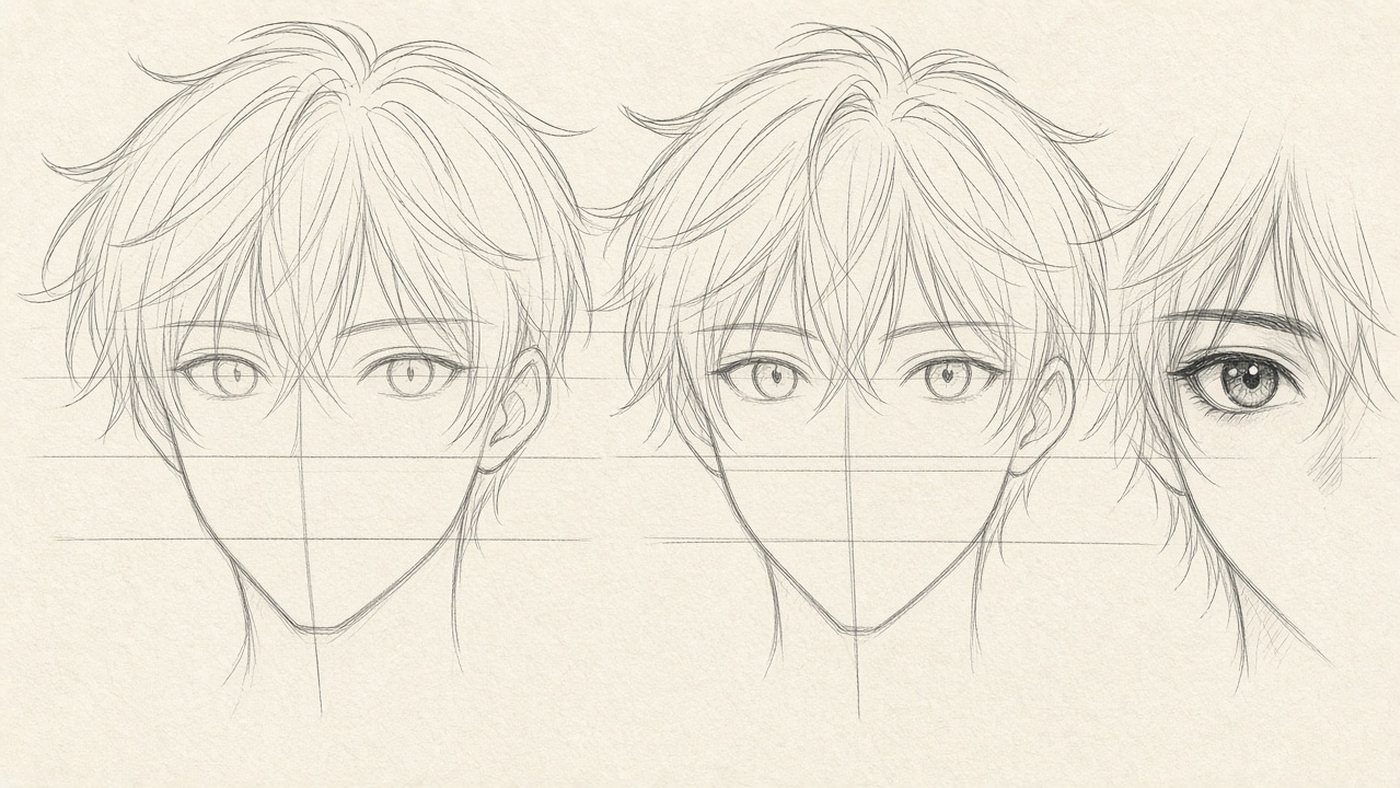
Anime grew out of real anatomy: artists removed what was extra and pushed what mattered. A face built on the right skull proportions reads as anime. A face drawn by eye reads as a mistake.
What Anime Leaves Out
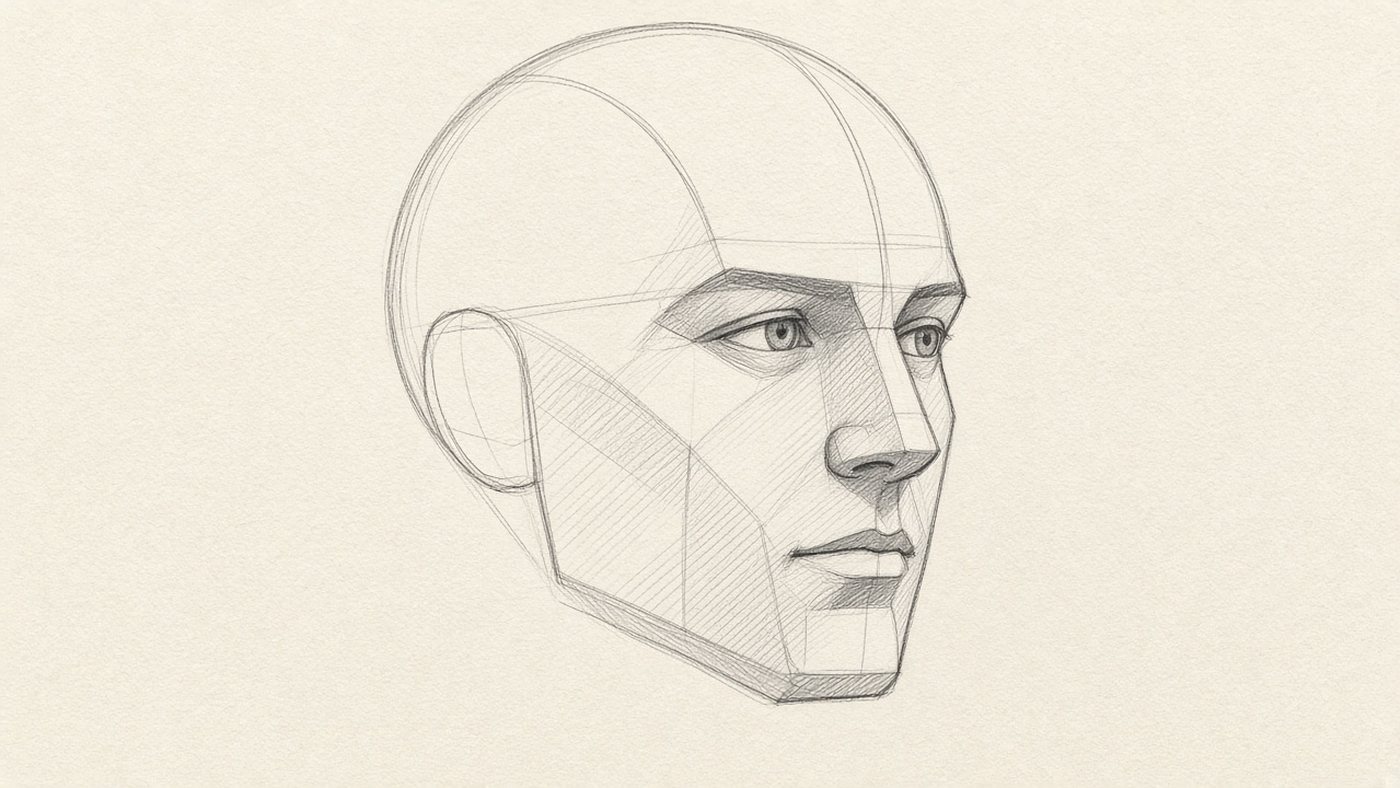
The small form transitions go: lid folds, the wings of the nose, nostrils, the rolls of the lips. The nose shrinks to a short dash or a triangular shadow. The mouth becomes a line with no volume. Cheekbones and jaw simplify to a pair of arcs.
What Anime Exaggerates
The eyes get bigger, the forehead gets taller, and the chin gets smaller. Those are a child's proportions, and the brain reads them as cute. Hair becomes large, shiny masses. Expressions get exaggerated: surprise lifts the brows above the hairline.
Building the Face
An anime head is built from the same sphere with a cut side plane as a realistic head. The only difference is where the features land.
Circle, Axis, and Chin
The order from the circle to a finished face:
- Draw the circle of the cranium.
- Cut the side plane with an oval and mark the ear on it.
- Draw a vertical centerline through the circle.
- Drop the chin a third of the radius below the circle.
- Connect the temples to the chin with two soft arcs.
- Draw the eye line along the lower third of the circle.
- Place the eyes, a tiny nose, and the mouth, then build the hair.
The Eye Line and Feature Height
In realism the eyes sit at the middle of the head's height. In anime they sit lower, around 55–60%. The distance between them stays the same: exactly one eye. The nose goes halfway between the eye line and the chin. The mouth goes halfway between the nose and the chin. A comparison with realism is in the article on how to draw a portrait.
Profile and Three-Quarter View
In profile the forehead projects forward, and the nose comes out of it with almost no bridge. That is the signature anime line. In a three-quarter view the far eye is about a third narrower than the near eye and shifts toward the edge of the face. When the head turns, the centerline bends into an arc.
Eyes in Anime Style
Here the eye carries the character, and it takes half the working time. Even simplified, it is still a sphere under a lid that has thickness.
Shape, Highlights, and Lashes
The upper lid is a thick dark arc. The lower lid is a thin line, or you leave it out. The iris fills almost the full height of the eye, and the pupil is stretched vertically. Place a large highlight on the light side and a small one on the opposite side. The structure is covered in the guide on how to draw eyes.
Eye Types for Different Characters
- large and round, with a high highlight: a naive, kind hero;
- narrow, with the outer corner dropped: tired or sly;
- the outer corner lifted: bold and hot-tempered;
- a small iris with a lot of white: fear or madness;
- an upper lid half closed: calm and confidence.
Hair in Strands
In anime, hair is the most recognizable part of the silhouette. Draw it as ribbons and blocks, not as separate hairs.
Large Masses Instead of Hairs
Split the hairstyle into three to five big groups: bangs, side locks, and the back mass. Each strand is a ribbon with a sharp tip, and it has a front face and a side. One layer of strands has to overlap another, or the hair goes flat.
The Part and Volume at the Roots
Hair grows out of the skull, so there is always a gap of one to two centimeters between the hairline and the outer contour of the hairstyle. Strands fan out from the part, and right at the part they drop into a deep shadow.
Expressions and Emotion
Same-face characters come from identical expressions, not from the style. Change the brows and the shape of the eye, and the characters become different people.
Eyebrows Do Half the Emotion
Brows pulled together and down toward the bridge mean anger. Inner ends lifted mean sadness and pleading. One brow raised means doubt. Test it on one face: draw four copies and change only the brows. The mouth adds the other half. The eyes add the shade of feeling.
Manga Conventions
Manga has collected symbols that read instantly: a sweat drop at the temple means embarrassment, a cross-shaped vein on the forehead means irritation, and vertical lines on the face mean horror. Shadow over the eyes gives grim resolve. Blank white eyes mean shock.
Common mistake
Every character comes out as the same face because only the hair changes. Separate them by jaw shape, forehead height, the distance between the eyes, and neck thickness.
The Figure and Body Proportions
In anime the body is measured in heads, and the count sets the character's age and genre.
How Many Heads Tall
An adult hero is 7–8 heads tall, a teenager is 6–7, and a child is 5. Two- and three-head proportions give you chibi, and there is a separate breakdown of cute characters. The waistline falls at about the third head from the top. The crotch sits exactly at mid-height. The structure under the stylization is covered in the article on anatomy for artists.
Dynamic Poses
Start the pose with a line of action: one arc from the crown to the supporting foot. The shoulders and the pelvis tilt in opposite directions. If the right shoulder is higher, the right hip is lower. That pose still reads when the silhouette is filled solid black.
Time to draw, not just read
Theory fades in a couple of days if you never use it. Open the editor and spend 15 minutes on what you just read. That is enough for the skill to stick.
Try it now
A free online editor: brushes, layers, a palette, and a shared canvas. No install and no sign-up.
Start drawingTopics in this guide
- how to draw anime
- anime face construction
- how to draw anime eyes
- manga style
- anime character for beginners
← How to Draw a Portrait: Building the Face Without the Scary Mistakes Fantasy Art for Beginners: How to Invent Creatures and Worlds →