Why "no talent" is a weak explanation
Talent is how fast you learn, not a permit to begin. Someone who has drawn for five years has simply moved a hand across paper hundreds of times more than you have.
What actually keeps you from starting
What gets in the way is an unclear first step, the fear of ruining the page, and the urge to produce a masterpiece right away. Take the masterpiece off this month's plan. What matters now is the amount of practice.
Skill instead of a gift
A drawing breaks down into six skills, and each one is trained with its own exercise.
- line: the hand lands on the point you want;
- form: the object reads as volume;
- proportions: the sizes match the subject;
- value: light and dark sit on the form;
- color: the hues do not turn to mud;
- a trained eye: you can see why a piece is strong.
Skill 1: line and a steady hand
A shaky line gives a beginner away faster than anything else. Speed fixes it: a fast stroke is straighter than a slow one. The mechanics are in the article on straight lines without a ruler.
The "line grid" exercise
Place two points 15 cm apart and connect them in one motion, looking at the second point. Thirty lines across, thirty lines down: 5 minutes a day.
Draw from the shoulder, not the hand
Short strokes come from the fingers. Long ones come from the shoulder. Draw the line with your whole arm, and turn stabilization off in the editor during warm-up.
Skill 2: simple form
While you trace the outline, the object stays a flat shape. Build it from volumes, and the volume shows up on its own.
Cube, sphere, cylinder, cone
These four forms cover almost everything. Draw ten of each in different turns and add a shadow. The order of work is in the article on drawing form.
How to break any object into forms
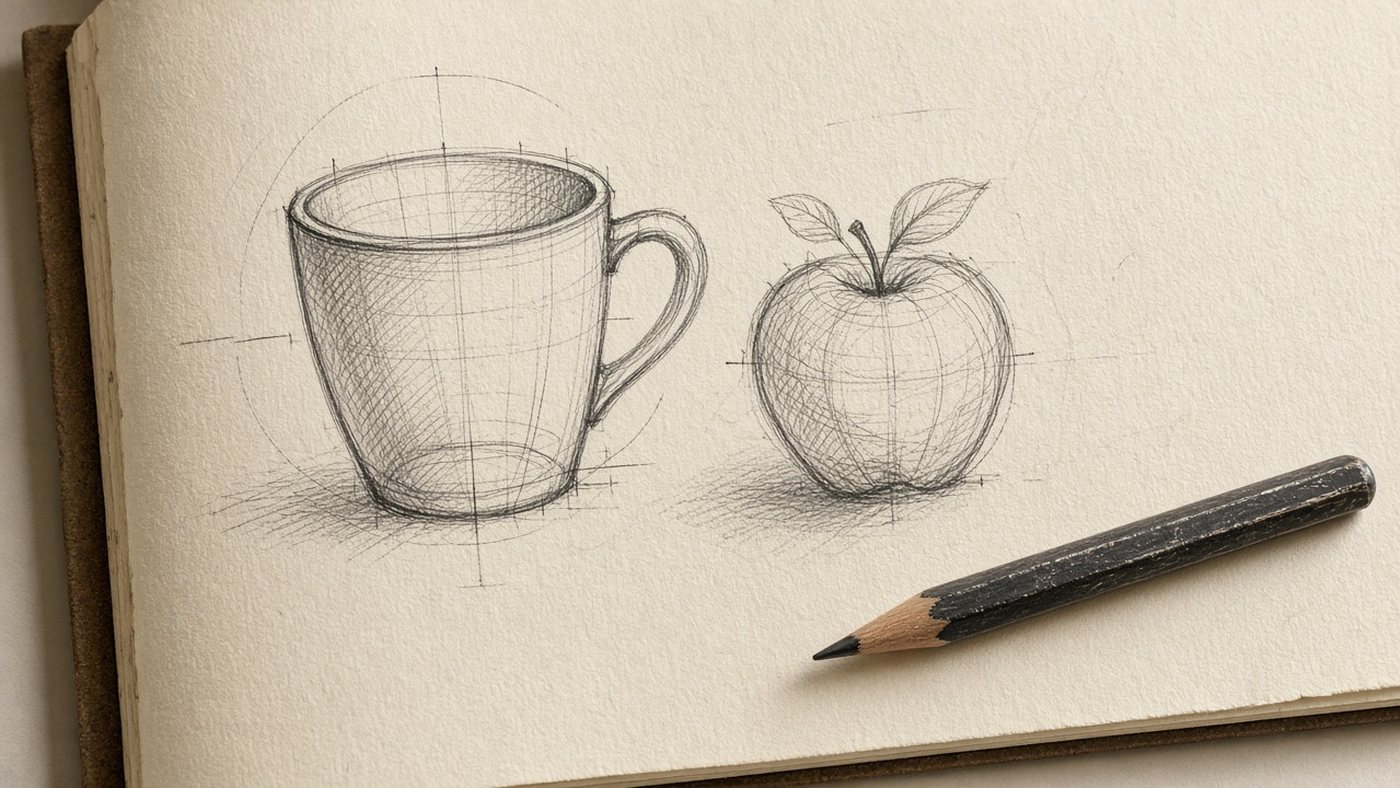
Take a mug and mentally erase the handle. A cylinder is what remains. A phone is a flat box. A head is a sphere with the sides cut off.
Skill 3: proportions and measuring
Proportions are relationships, not centimeters. A head is not "ten centimeters." It is "one fifth of the height," and you check that by measuring.
The pencil method
- Hold your arm out with a pencil, elbow straight.
- Line the tip up with the top of the object, and your thumb with the bottom.
- Without changing your grip, count how many of those lengths fit across the width.
- Transfer that relationship onto the page.
Checking with negative space
Look at the empty space around the object, not at the object: the gap between the chair legs, the triangle between the arm and the body. Empty space has no template, and the brain stops inventing.
Skill 4: light and shadow
Light makes the volume, not the outline. Put a desk lamp to the left of a mug and draw the mug three times: light from the side, from above, and from behind.
Five zones of light
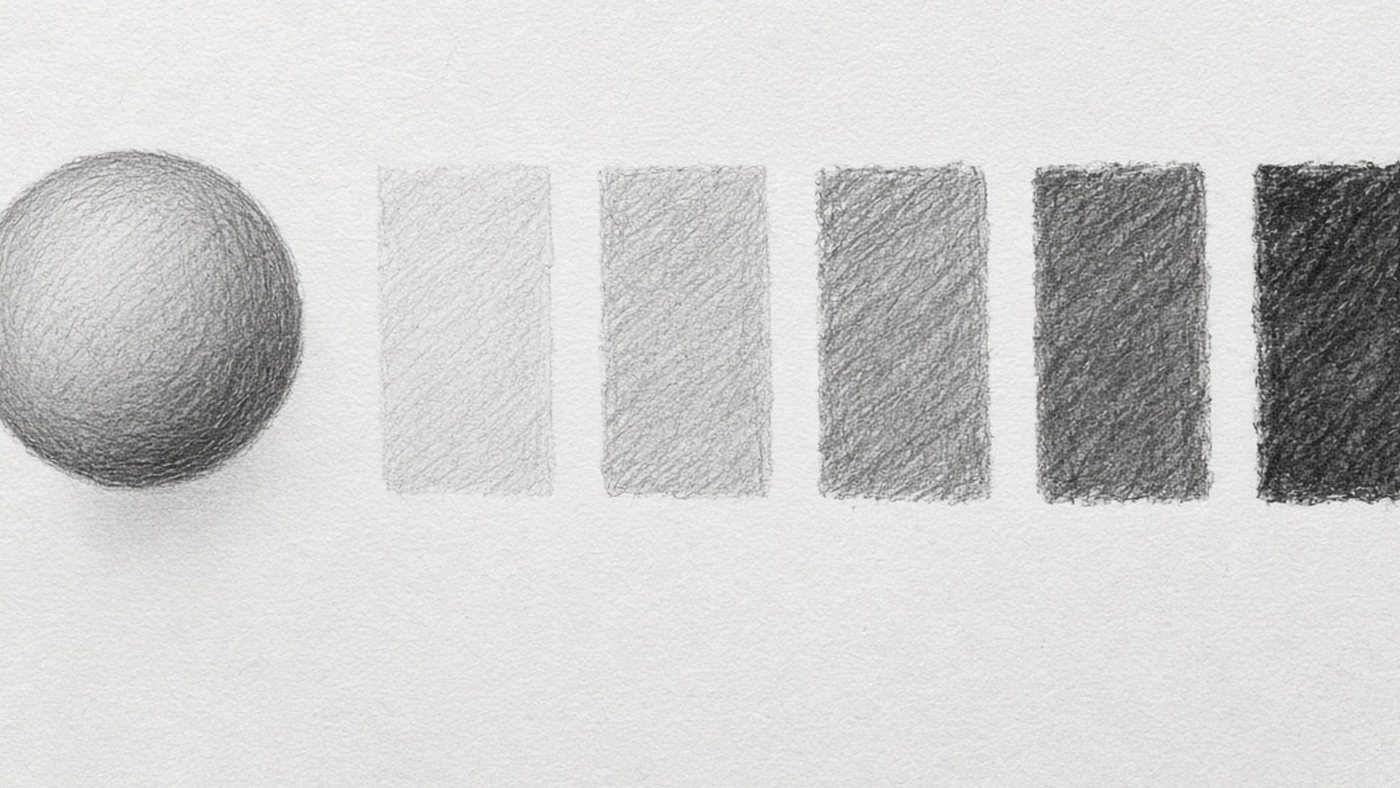
A sphere has a highlight, light, a halftone, a form shadow, and reflected light, and the table has a cast shadow. Each zone is covered in the article on light and shadow.
A five-step value scale
Draw five squares: white, light gray, middle, dark, almost black. Fill them with hatching, without blending with a finger: 5 minutes a day.
Tip
Photograph the drawing and convert the photo to black and white. If the object disappears against the background, the difference between light and shadow is too small.
Skill 5: color without mud
Mud does not come from cheap paint. It comes from mixing without control. Describe a color with three properties, and the picture becomes predictable.
Three properties of color
Hue is the color name, saturation is how vivid it is, and lightness is whether that color is lighter or darker than gray. In an editor, those are three sliders.
A limited palette
Take three colors plus white and paint the whole study with them. The hues will belong together, and the piece will look unified.
Skill 6: a trained eye
The eye is trained apart from the hand. If you cannot see what is wrong in a piece, you cannot fix it.
References and an inspiration folder
Collect 50 pieces you like, and write one sentence on each: "a dark silhouette against a light sky."
Copying as a study tool
Copy in parts: today the value shapes, tomorrow the palette with the eyedropper, the day after the composition. Tracing the whole picture is useless.
A plan for the first 30 days
Fifteen minutes a day does more than three hours once every two weeks. A written version is in the 30-day learning plan.
Weeks 1-2: line and form
The first 5 minutes are a line grid and ten ellipses. Then spend 10 minutes on three household objects: construction only, no details.
Weeks 3-4: value and color
Three minutes on a value scale, then 12 minutes on one object in directional light. For the last three days, add color with three hues.
Time to draw, not just read
Theory fades in a couple of days if you never use it. Open the editor and spend 15 minutes on what you just read. That is enough for the skill to stick.
Try it now
A free online editor: brushes, layers, a palette, and a shared canvas. No install and no sign-up.
Start drawingTopics in this guide
- drawing basics
- learn to draw from scratch
- how to learn to draw
- drawing lessons for beginners
- drawing fundamentals