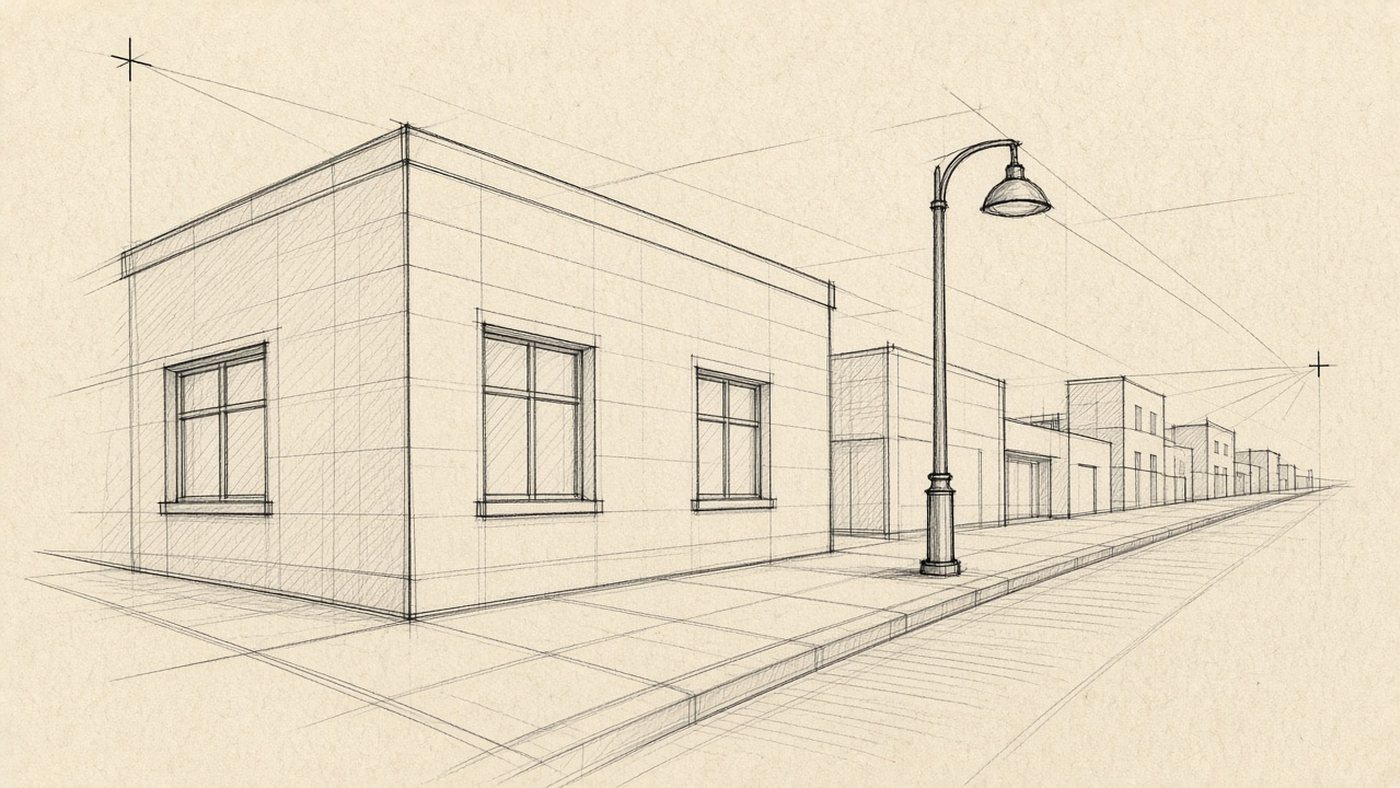
Why Distance Gets Lighter
Several kilometers of air, with dust and moisture in it, hang between you and a distant mountain. That layer scatters light and works like a translucent whitish curtain. The farther the object, the more curtains sit between you and it.
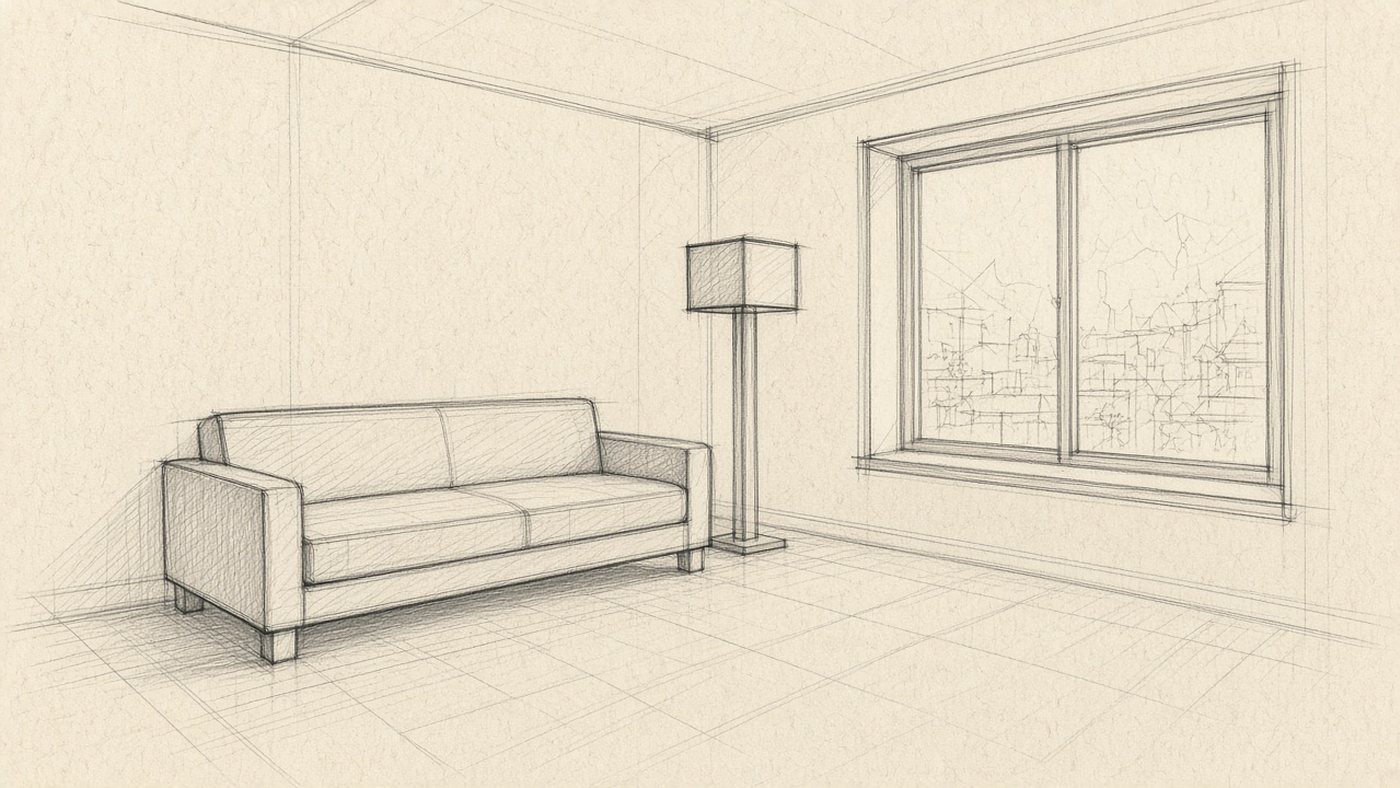
A Layer of Air Between You and the Object
The effect shows even over a short distance. Stand at the end of a long street: the near house is sharp and high in contrast, and a house a kilometer away is already pale. In fog or in heat, the same distance swallows even more color.
Why Distant Shadows Turn Blue
Particles in the air scatter the blue part of the spectrum better than the rest. That is also why the sky is blue. Distant shadows therefore shift toward blue and lilac, not gray. Keep that in mind when you mix color: add a little blue into the distance, not white.
Three Planes in a Landscape
A landscape is easier to build in layers, like scenery in a theater. Three planes give you depth even in a five-minute sketch.
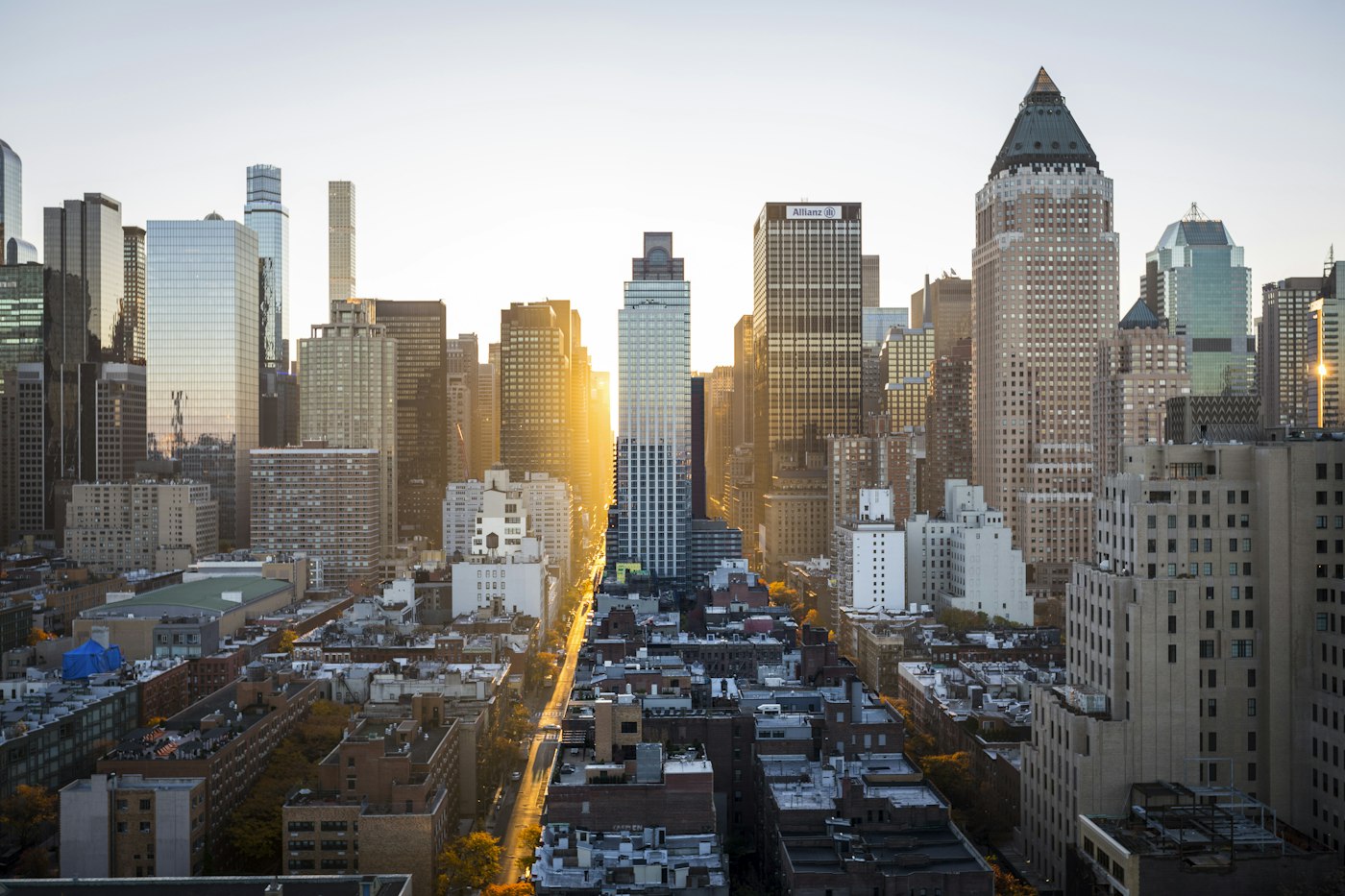
Foreground, Middle Ground, Background
- foreground: the darkest and highest in contrast, with the most detail and texture;
- middle ground: the main subject of the scene, medium contrast, a readable form;
- background: light, cool, almost no detail, only a silhouette.
What to Leave Out on Each Plane
On the background, do not draw separate trees. Draw the forest as one mass. On the middle ground, keep the large groups and leave out the leaves and branches. Save every bit of texture, every crack, and every blade of grass for the foreground. The method works together with linear perspective, not in place of it.
Common mistake
Distant mountains are often drawn lighter, but just as saturated. You end up with cotton wool, not distance. Lower the saturation at the same time as the lightness. Then the plane really moves back.
Four Depth Controls
You can build depth on purpose by turning four controls. Use all of them at once. One control on its own does not produce the effect.
Contrast and Saturation
In the foreground, the gap between light and shadow is at its widest, all the way to pure black. In the background, that gap shrinks to two or three neighboring gray values. Saturation drops by the same logic: bright green up close turns gray-blue in the distance. These properties come from color theory.
Detail and Edge Sharpness
A near edge is crisp and hard. A far edge is soft and blurred. That is the fastest way to show distance: one soft horizon line sends the eye kilometers away. Do not make every edge sharp, or the picture becomes a flat paper cutout.
Fog, Rain, and Smoke
Fog is atmospheric perspective turned all the way up. Distances compress, and at twenty meters an object already loses its color.
Soft Transitions
Fog has no crisp boundaries, so forget the contour line. Build everything from shapes of different lightness, with soft edges. It helps to limit yourself to three or four values. Accuracy matters more here than the number of shades, as in a value scale.
Light in Fog
A lantern or a headlight in fog makes a visible cone of light and a soft halo around the source. Draw the halo as a circle that loses brightness smoothly toward the edges, with no hard boundary. Everything inside that cone becomes lighter and warmer than what surrounds it.
How to Do This in an Editor
Digital work makes the planes much simpler: each plane lives on its own layer and can be edited on its own.
A Layer with a Translucent Haze
The haze takes four steps, and running a stack of layers is described in the article on layers.
- Put the foreground, the middle ground, and the background on separate layers.
- Create a new layer above the background and fill it with a light blue-gray.
- Set its opacity to 20-30 percent.
- Repeat for the middle ground, at about 10 percent opacity.
Blurring the Background
Apply a light blur only to the background layer, with a radius of 2-4 pixels on a 2000-pixel canvas. Leave the foreground completely sharp. Spend 10 minutes and paint one landscape twice, with the blur and without it. The difference in depth is obvious right away.
Time to draw, not just read
Theory fades in a couple of days if you never use it. Open the editor and spend 15 minutes on what you just read. That is enough for the skill to stick.
Try it now
A free online editor: brushes, layers, a palette, and a shared canvas. No install and no sign-up.
Start drawingTopics in this guide
- atmospheric perspective
- how to draw distance
- planes in a landscape
- depth in a landscape
- how to draw fog
← Color Wheel: how to pick color combinations without guessing Rhythm and Balance: how to lead the eye through a drawing →