Mistakes of Seeing
The first three mistakes live in the head, not in the hand. As long as the brain substitutes familiar diagrams for what is actually there, technique will not save the drawing.
Drawing a Symbol Instead of the Object
You look at a face and draw the childhood symbol of two eyes, a nose, and a mouth. The fix is exercises that keep the brain from recognizing the object: an upside-down reference, and a blind contour. The full set is in the article on how to see like an artist.
Skipping the Proportion Check
The second miss is drawing by eye and never measuring. Make it a rule to check proportions three times: after the sketch, in the middle, and before you add detail. Measuring methods are covered in the piece on proportions.
Technical Mistakes
You can see these three points in any beginner's work from a meter away. A specific exercise fixes each one.
Contour Instead of Form
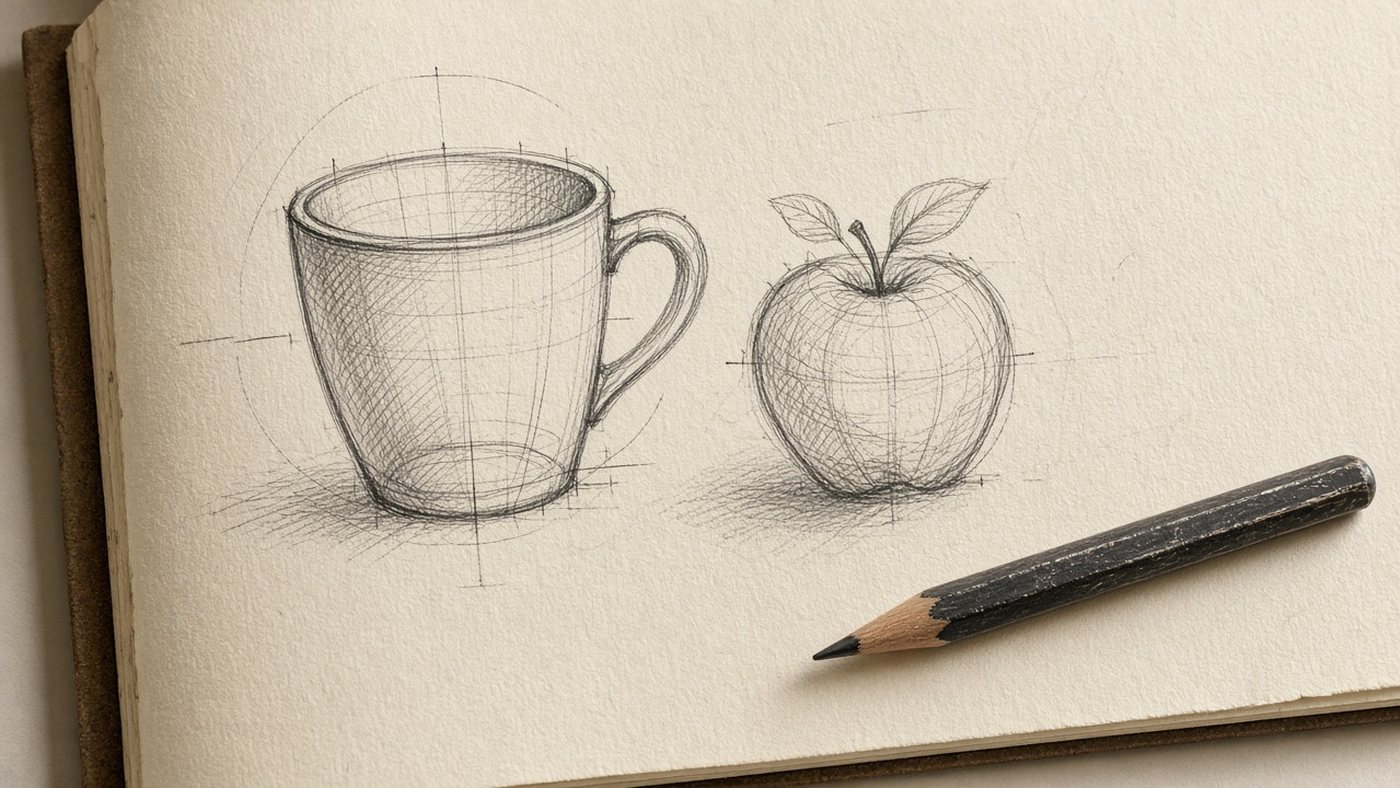
A traced contour turns the object into a flat sticker. Build the volume: the basic shape first, then the axes, and the edge only at the end. Try drawing a mug with no outer line at all, using only patches of value.
Gray Shadows and Weak Contrast
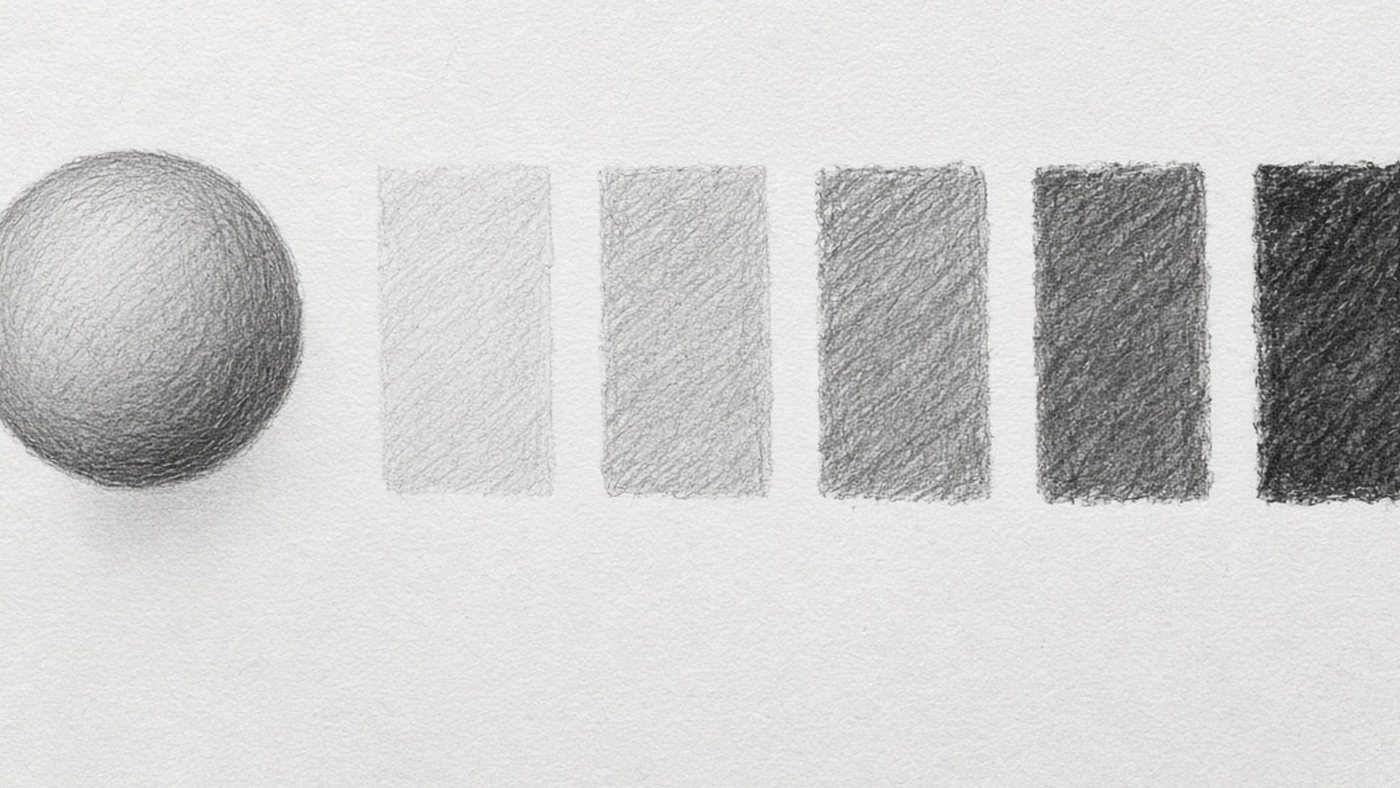
A piece looks washed out when every value is stuck in the middle of the scale. Find the darkest place and the lightest place in the drawing and push both to the limit. You train this with a value blend, 15 minutes a day.
Drawing from the Fingers
Moving only the fingers makes short, broken lines 3-4 cm long. Lock the wrist and drive the arm from the elbow and the shoulder. Draw 50 lines across the whole page in one sweep. The difference shows up by the thirtieth.
Common mistake
Fear of the eraser. Many people are afraid to erase, and they drag a crooked sketch all the way to the end. The first lines are a draft. Erase freely. An eraser costs less than three hours of ruined work.
Mistakes in the Process
This is not about skill. It is about the order of what you do. The right sequence saves hours.
Detail Too Early
The classic case: an hour and a half on one eye, and then the head turns out crooked. Work from the whole to the parts, and do not pick up a thin brush until the large masses are ready. A simple limit: for the first 20 minutes, draw only with a brush the size of a fingernail.
One Drawing for a Whole Month
One overworked drawing teaches less than thirty quick ones. Progress comes from the number of attempts and from a variety of problems. Make this a rule: for every large piece, ten sketches of 10 minutes each.
Digital Mistakes
A graphics tablet does not draw for you, but the wrong settings can really get in the way.
One Layer for Everything
When the sketch, the color, and the shadows sit on top of each other, any fix breaks the neighbor. Split the work into at least four layers: sketch, fill, shadows, and light. How to build a stack like that is described in the article on layers.
Full Opacity and a Hard Brush
A hard brush at 100 percent makes plastic edges and harsh patches. Set the opacity to 30-40 percent and build the value in layers, the way you would with a pencil. Turn line stabilization on at 20-30 percent, and no higher, or the stroke starts to drift behind the cursor.
Mistakes in How You Study
The mistakes that sting the most are not in the drawing. They are in how you study. They are why people quit after a month.
No Plan and No Feedback
- you draw whatever comes along, instead of one topic for the week;
- you show the work to nobody and stew in your own mistakes;
- you do not save old drawings, so you cannot see your progress;
- you watch lessons for hours and never open the canvas.
Comparing Yourself with Professionals
Comparing your first month with someone else's ten years is a sure way to quit. Compare yourself only with yourself from a month ago. This trap is covered in the piece on how to stop comparing yourself with other people.
A Self-Check List
Run through these questions before you call a piece finished. Five minutes of checking replaces an hour of someone else's critique.
Five Questions for the Piece
- Does the drawing still read when you flip it horizontally?
- Does it have a darkest spot and a lightest spot?
- From two meters away, is it clear what matters here?
- Do the proportions match the reference when you measure them?
- Do all the shadows come from one light source?
What to Do After the Review
Do not rework an old piece forever. Write the two misses you found in a notebook. Start the next drawing from those two points, and keep them in front of you. In a month you will close 6-8 mistakes instead of one overworked picture.
Time to draw, not just read
Theory fades in a couple of days if you never use it. Open the editor and spend 15 minutes on what you just read. That is enough for the skill to stick.
Try it now
A free online editor: brushes, layers, a palette, and a shared canvas. No install and no sign-up.
Start drawingTopics in this guide
- beginner drawing mistakes
- common mistakes in drawing
- how to fix a drawing
- drawing tips for beginners
- what gets in the way of drawing
← Reflected Light: why a shadow is never gray Negative Space: How to Draw the Emptiness Around an Object →