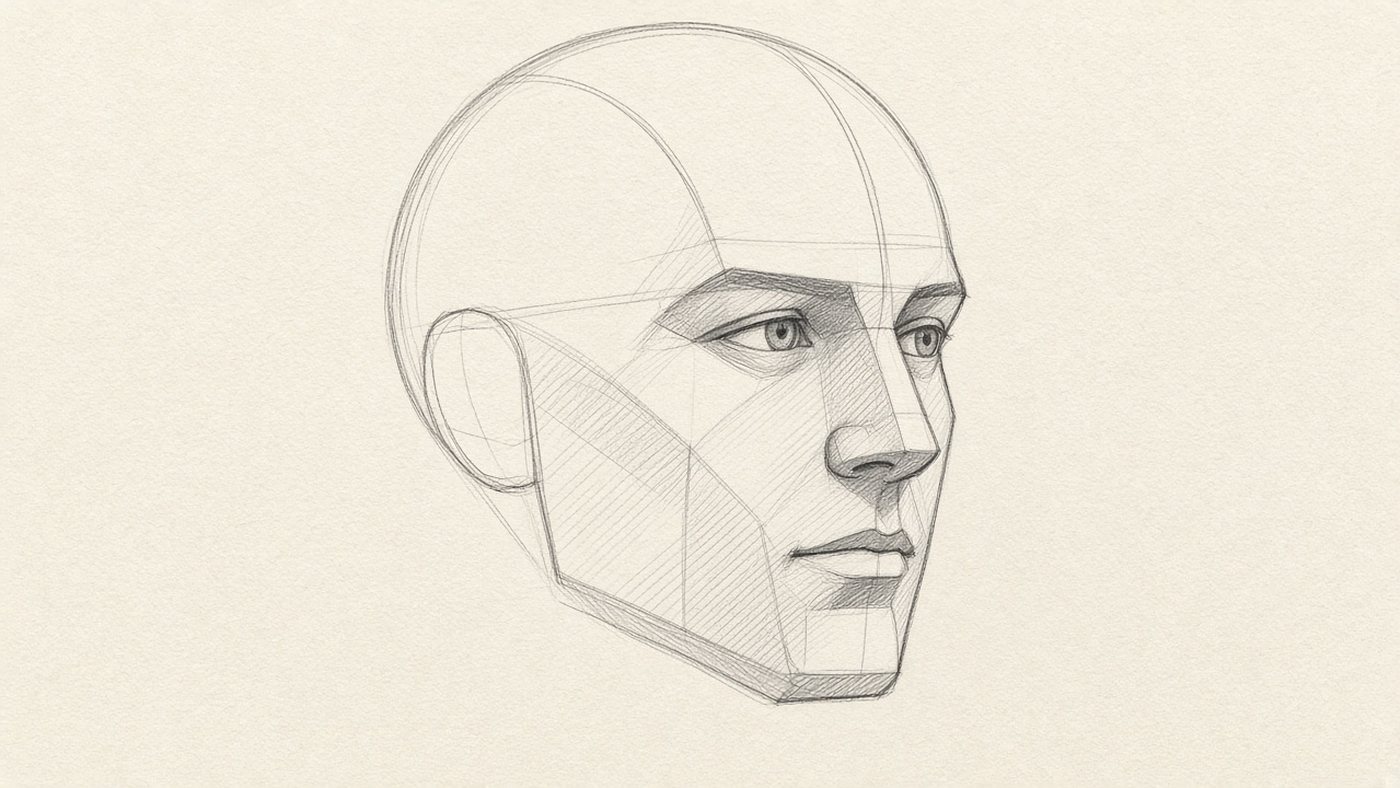
Face framework
A face without a frame turns into a "doll": symmetrical eyes, button nose, line mouth. The frame is an oval, a vertical axis, and three horizontals. Everything else hangs on them; detail comes last.
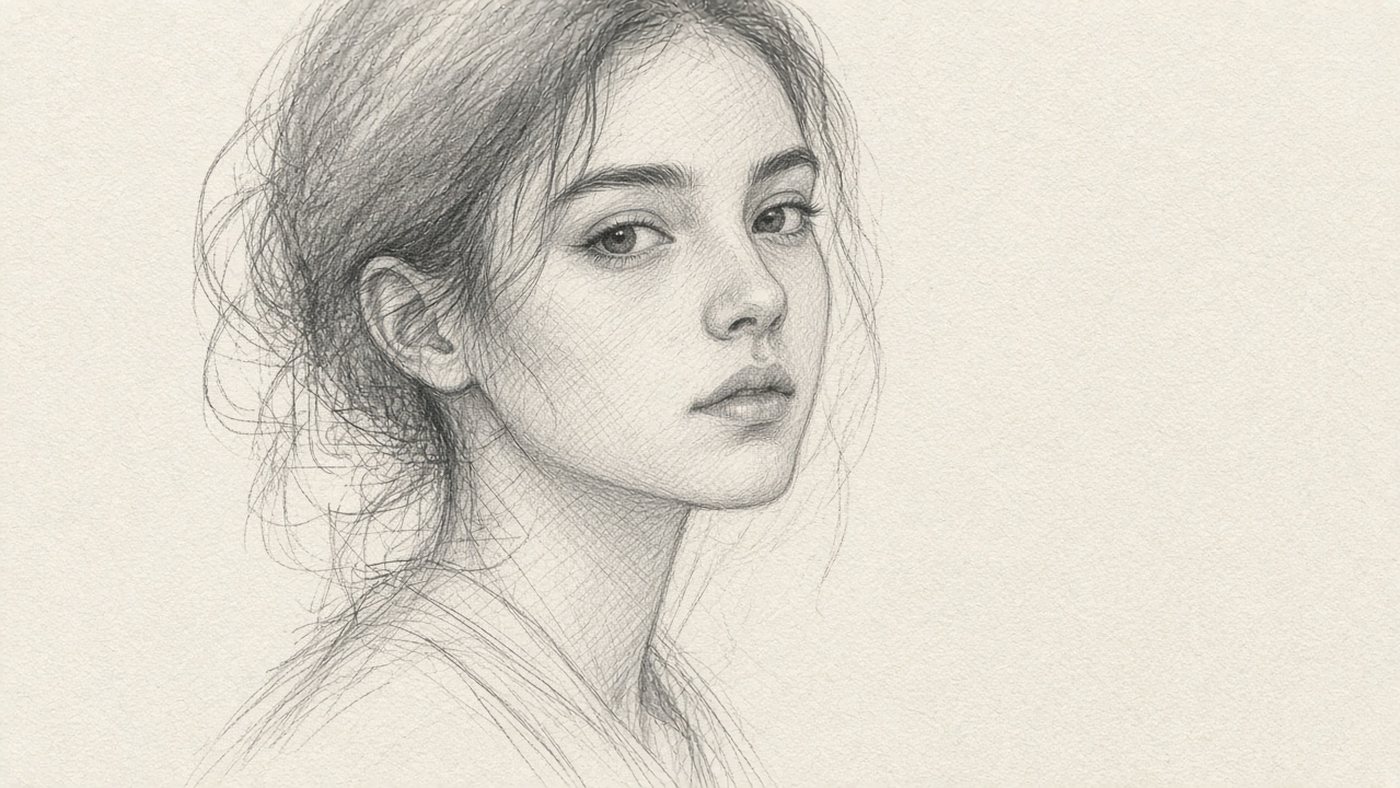
Oval and axis of symmetry
Block in an egg-shaped oval: wider at the cheekbones, narrower toward the chin. Run a light vertical through the center—the axis of symmetry. When the head turns, the axis curves but stays the anchor: compare left and right relative to it.
Three horizontals: hair, eyes, nose–mouth
Hairline (or brow line), eye line, base of nose and mouth—three rails. Chin to nose is often equal to nose to brows; to the hair line a bit less or the same, depending on face type. Lines only at first—no features yet.
Front-view proportions
Front view forgives the least: asymmetry shows immediately. Keep the head in one plane—no tilt until you know the scheme.
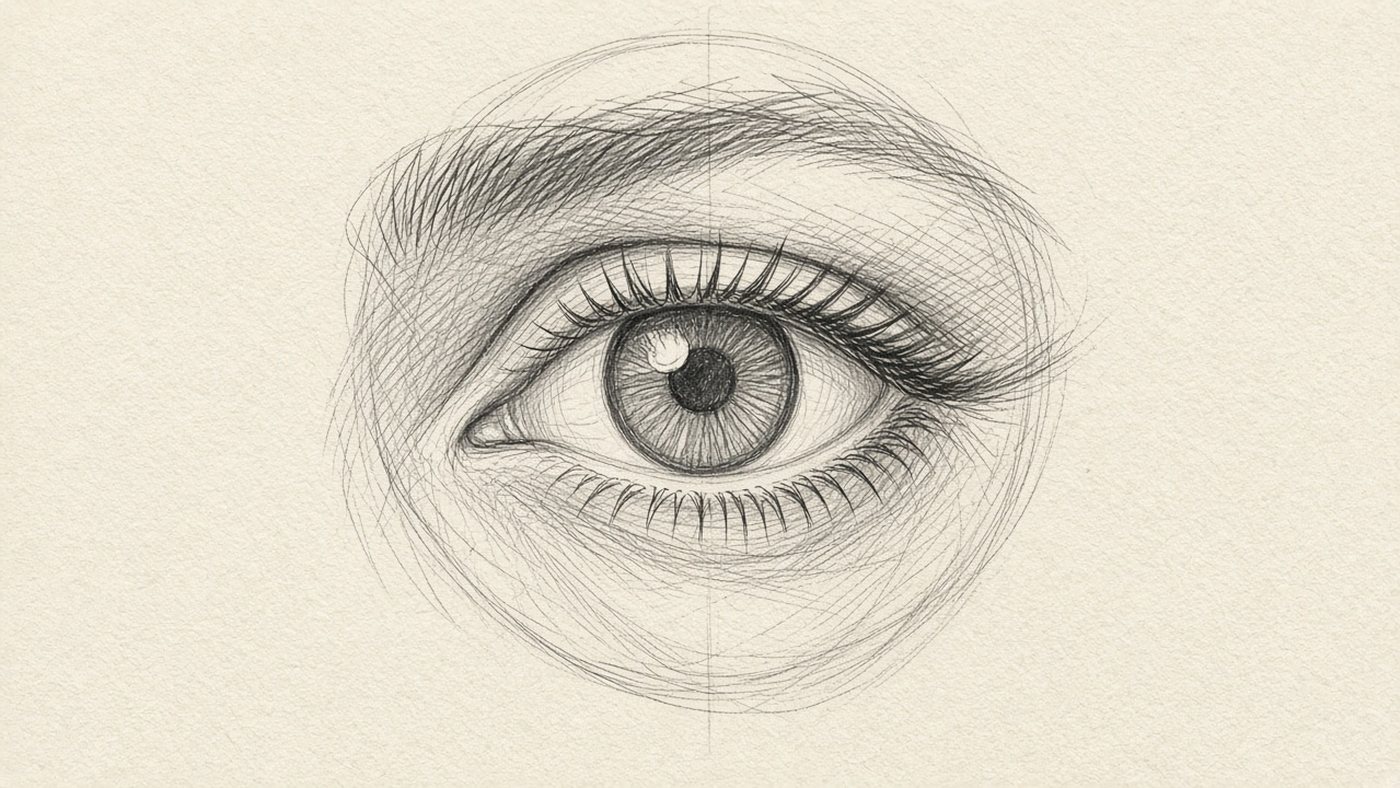
Eye width and space between the eyes
- between the eyes—one eye width;
- outer corner to ear—about one eye;
- nostril width often matches the space between the eyes;
- mouth narrower than the cheekbones; corners often under the pupils.
Measuring and the "one eye as a ruler" method are in the guide to proportions—apply them to the face oval.
Where the chin ends
The bottom of the oval is not "whatever happens"—it is one third of the face from chin to brows if you split height into three equal parts (hair–brows, brows–nose, nose–chin). A short chin or high forehead breaks the scheme—check the three divisions first, then the model's individual traits.
Three-quarter turn
Three-quarter is when one cheek shows more and the far eye is partly hidden by the nose. The frame compresses on one side—not "shrink the eye" but squeeze the whole oval in perspective.

Compressing one side
The far half of the oval is narrower, the near half wider. The eye line is an arc, not a straight line: the near eye sits higher on the page. Distance from the axis to the near cheekbone is less than to the far one—check with a pencil on reference.
The nose line as a pointer
From bridge to tip, the nose plane shows the turn. The tip shifts toward the near cheek; the nearer nostril reads larger. If the nose line stays vertical during a turn—the head "breaks"; tilt it toward the near edge of the oval.
Features without detail
At the framework stage the nose is not a button and the mouth is not teeth. Simple planes hold the turn; you add detail when the silhouette matches.
Nose as a triangle
Triangle: base at the inner eye corners, apex at the tip. Two small triangular nostrils—just a hint. Do not outline the wings heavily: half-tone under the bridge and along the sides builds volume better than contour.
Mouth as a plane
Lips sit on a cylinder: upper arc, lower slightly fuller. The opening is a soft S, not a straight line. No teeth at this stage—a dark slit between lips is enough. You can push eye expression later in the dedicated guide—see how to draw eyes.
Common mistake
Large "anime" eyes on a small oval. In realism pupils are rarely wider than one fifth of face width. Place eyes on the scheme, shrink until they read comfortably, then add highlights and lashes.
Checks and common mistakes
Check the face with a mirror, inversion, and reference—not by gut feel alone.
Mirror and inversion
Hold the drawing to a mirror: asymmetry and eye skew show at once. In an editor, invert the canvas—the unfamiliar angle reveals where one cheek is "puffed." Fix the frame, not the lashes.
Eyes that are too big
- Compare one eye width to the space between the eyes—they should match.
- Check whether the eye line dropped too low—"cute" age and a mistake look alike.
- Shrink the sclera: often the problem is extra white, not the pupil.
- Photograph the sketch and overlay semi-transparent reference—proportions only, not tracing.
Time to draw, not just read
Theory fades in a couple of days if you never use it. Open the editor and spend 15 minutes on what you just read. That is enough for the skill to stick.
Try it now
A free online editor: brushes, layers, a palette, and a shared canvas. No install and no sign-up.
Start drawingTopics in this guide
- how to draw a face
- face construction
- face proportions
- face front view
- portrait drawing from scratch
← The Golden Ratio in Composition: Practice Without Mystique Foreshortening: How to Draw Limbs Shortened by Perspective →