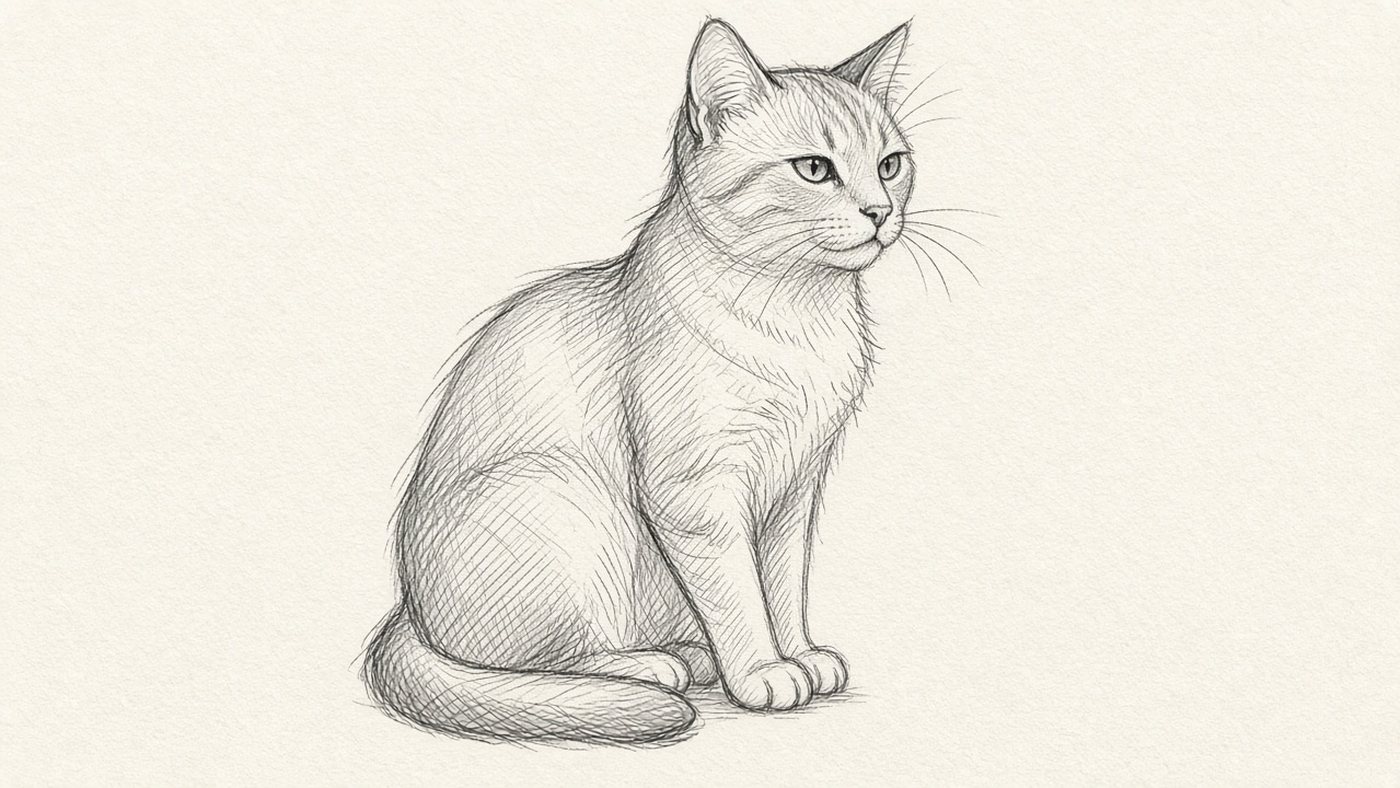
A Cat from Simple Forms
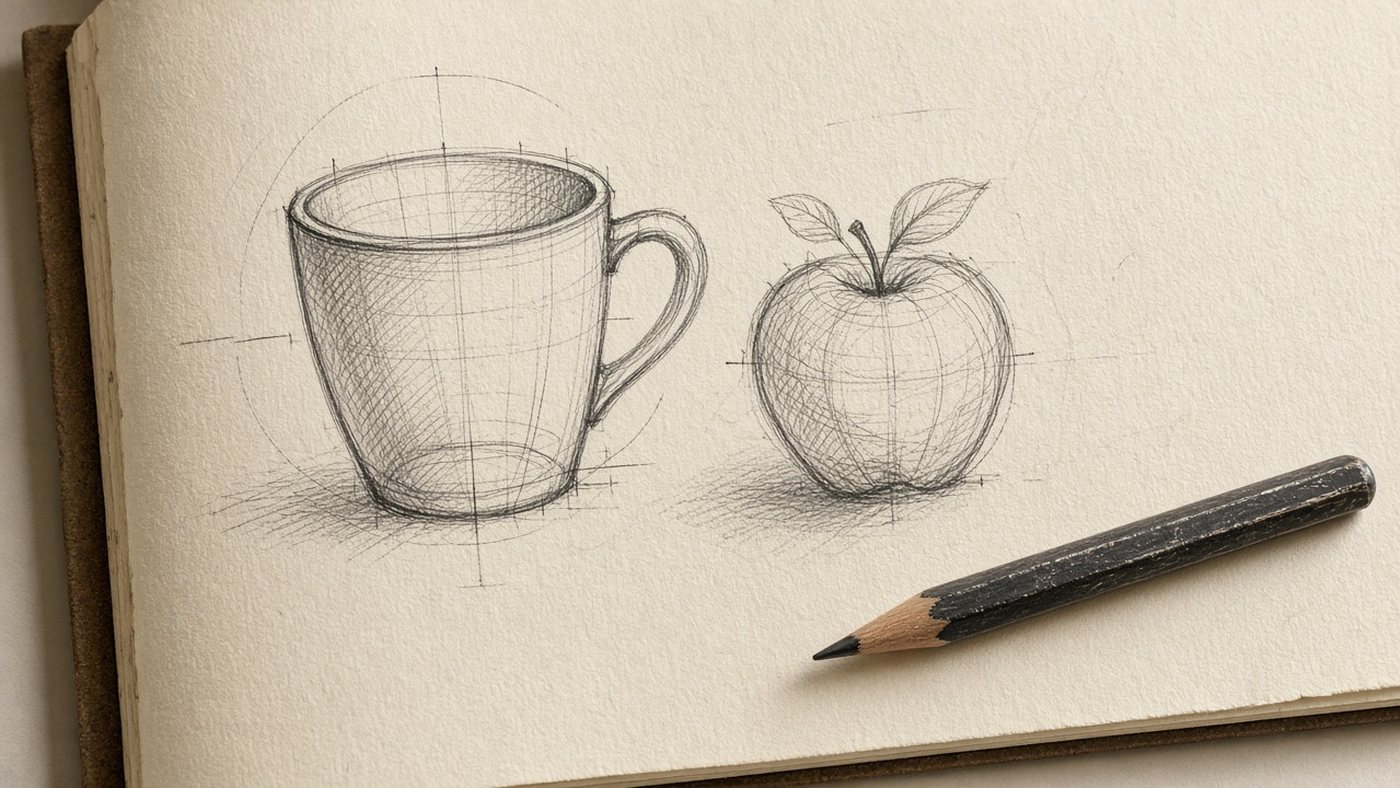
Build the cat from a circle and an oval before you touch the fur. Until the volumes are standing, whiskers only get in the way.
A Circle for the Head and an Oval for the Body
The head is a circle. The body is an oval one and a half to two times longer, slightly narrowed toward the hips. On a sitting cat the oval stands upright. On a lying cat it lies flat. The neck is short: the gap between the circle and the oval is a quarter of the head's radius. The legs are cylinders. The tail is a flexible tube. The same assembly from solid forms is covered in the article on drawing form and volume.
Axes and the Line of Action
Draw a vertical and the horizontal of the eyes through the muzzle. Through the body, draw one arc from the back of the head to the tip of the tail. On a sleeping cat the arc curls into a ball. On a stalking cat it sags. On a frightened cat it rises into a hump. The same gesture line is in the guide on sketching for beginners.
Head and Muzzle
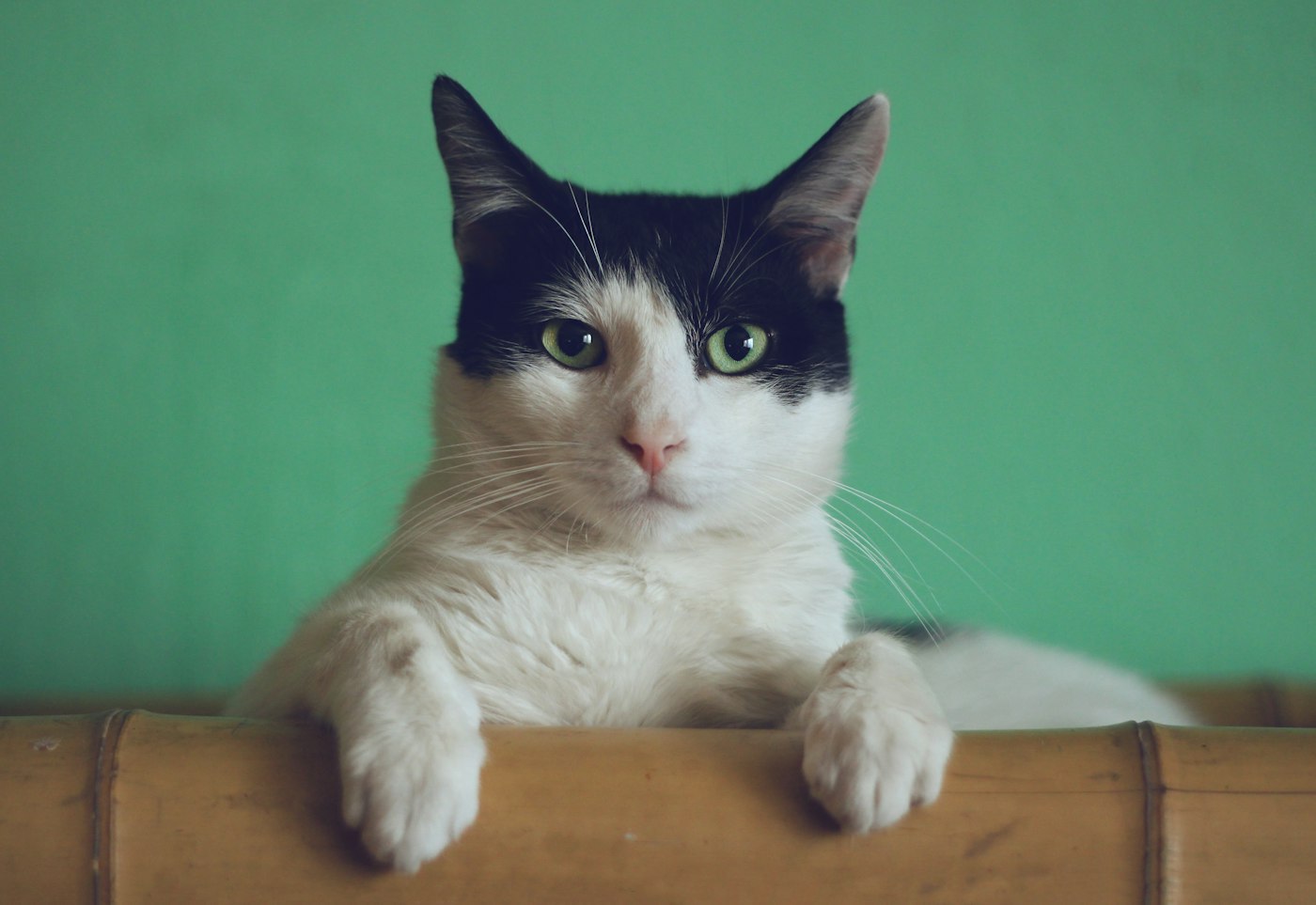
The muzzle rests on three points: the eyes, the nose, and the mouth. The ears sit on the upper third of the circle, not across the whole crown.
Proportions: Eyes, Nose, Ears
The eyes sit at the middle of the circle's height, and another eye fits between them. The nose is a small inverted triangle at two-thirds of the head's height. Down from it runs a Y or a W for the mouth. The ears are triangles about as tall as the distance from the eye to the crown.
Angles: Profile and Three-Quarter View
In profile the muzzle is a short wedge, the eye becomes a lens, and the far ear hides. In a three-quarter view the far eye is narrower than the near eye, and the far ear sits closer to the axis. Don't mirror the front view. Build it on the axes. Eyes as spheres are covered in the article on how to draw eyes.
Body, Legs, and Tail
A cat has a shoulder, an elbow, and a wrist. In back it has a hip, a knee, and a heel. The bends are not where memory puts them.

- Mark the circle of the head and the oval of the body, and join them with a short neck.
- Draw the line of action from the back of the head into the tail.
- Place the axes of the muzzle and the triangles of the ears.
- Mark the shoulders and hips as circles about a third of the body's height.
- Drop the legs: the front ones nearly straight, the back ones with a break.
- Add the tail along the arc of the pose, and fur along the edge of the silhouette.
Where the Legs Actually Bend
The front elbow points backward, and the wrist sits a little above the paw. The back knee points forward, and the heel is often high off the ground. A cat walks almost on its toes. On a sitting cat the thighs become two ovals at the sides. A knee "like a person's" breaks the pose.
The Tail as a Continuation of the Pose
The tail continues the line of the back. It is not glued on at the side. At rest it is a ring or a soft arc. On the hunt it is horizontal. In fright it stands straight up. At the base it is as thick as the neck, and it tapers by half toward the tip.
Tip
Photograph the cat from above and from the side in the same pose. From above you see the width of the shoulders and hips. From the side you see the real joint angles.
Fur and Texture
Fur is a broken edge on the silhouette and a direction that follows the form, not thousands of hairs all over the body.
A Silhouette with a Fluffy Edge
A hard contour makes the cat look rubbery. Break the edge with short strokes in the direction of growth: sideways on the cheeks, downward on the chest, along the tail. Inside the shape, put almost no texture.
Fur Direction That Follows the Form
On the forehead the strokes spread from the center. On the cheeks they run toward the ears. On the back they run from the withers to the tail. Stripes wrap the shoulder and the hip. They do not lie as a flat pattern. The same principle of masses is in the breakdown on how to draw hair.
Character and Stylization
Character is in the pose and the gaze, not in the number of whiskers. Two accurate gestures beat a detailed coat.
A Cartoon Cat
- the head is almost as big as the oval of the body;
- the eyes are large, on the lower third of the muzzle, and the nose is tiny;
- the ears are two soft triangles with no inner ear;
- the legs are shorter and thicker, and the toes are three ovals;
- the whiskers are three arcs on each side, not a bundle of twenty lines.
A Portrait of Your Own Pet
What makes a cat recognizable is the set of the ears, the width of the muzzle, and the pattern of the markings. Photograph a front view and a profile in daylight, and measure how far the eyes sit above the nose. A scar, a white bib, or a bent ear is worth a dozen "correct" cats. Whiskers come at the very end.
Time to draw, not just read
Theory fades in a couple of days if you never use it. Open the editor and spend 15 minutes on what you just read. That is enough for the skill to stick.
Try it now
A free online editor: brushes, layers, a palette, and a shared canvas. No install and no sign-up.
Start drawingTopics in this guide
- how to draw a cat
- cat step by step
- drawing animals
- how to draw fur
- cat drawing for beginners
← How to Draw Hair: Strands, Volume, and Shine Instead of a Cap How to Draw Flowers: From a Simple Form to a Living Bouquet →