Hair as Volume on the Skull
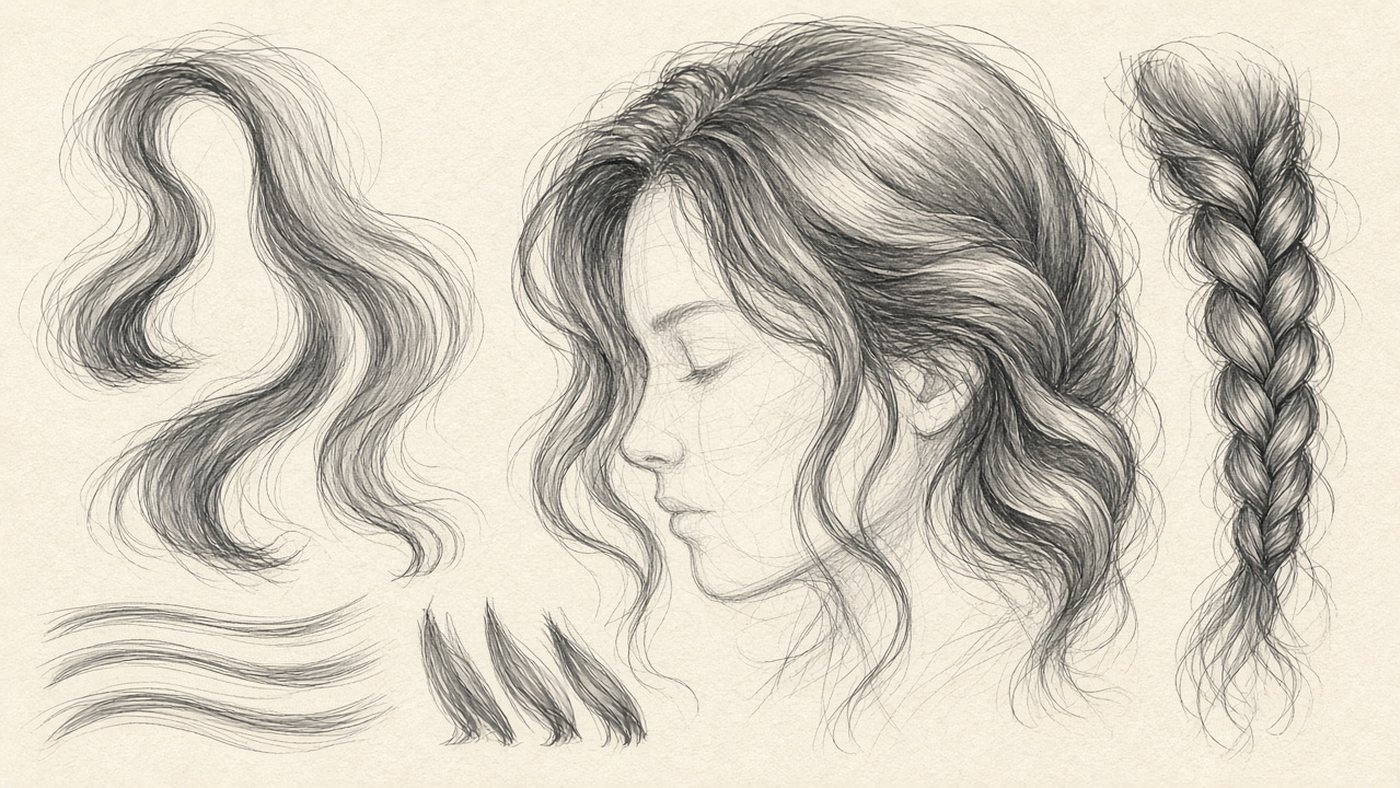
Hair grows out of the skull and repeats its shape. The head as a volume comes first. The hairstyle comes second, like a helmet with a gap at the roots.
The Silhouette of the Whole Hairstyle
Cover the face with your hand and look only at the outer contour. A bob is a helmet-like hemisphere. A ponytail is a sphere plus a cylinder. Block the silhouette in as one shape: it should still read when filled solid black. The head under the hair is covered in the article on how to draw a portrait.
The Hairline and the Part
The hairline runs in a wedge across the forehead and in arcs at the temples. Leave a gap of 1–2 cm from it to the outer contour. That is the volume at the roots. The part is a groove, and the strands fan out from it. Right at the part, the value is the darkest.
Working in Strands
A strand is a ribbon with a start at the skin, a middle, and a tip. Three to five large groups cover the whole hairstyle.

- Build the skull and mark the hairline.
- Draw the silhouette of the hairstyle with a gap at the roots.
- Split the volume into 3–5 masses: bangs, sides, and the back of the head.
- Inside each mass, draw the direction of growth as ribbons.
- Refine the tips and a couple of strands that have escaped.
- Place a highlight that follows the shape of the head, and deepen the shadows between strands.
Large Masses First
Bangs, two side masses, and the back mass are the base of most haircuts. The masses overlap like shingles. Until they sit in layers, don't break them into locks. You will get straw.
Strands as Ribbons in a Volume
A ribbon has a front face and an edge. On a turn, the edge goes dark and the front face catches the light. The ribbon narrows toward the tip. At the temple it lies against the head. At the shoulder it lifts away and falls under its own weight.
Tips and Flyaways
Make the tips different lengths, turn some of them outward, and knock a couple of strands out of the silhouette. A short cut sticks out in angles. Long hair falls in wedges. An even arc all the way around the edge looks like a wig.
Light and Shine
Shine is a band of light that wraps the skull, not a white lightning bolt. Shadow lives in the grooves between strands.

A Highlight That Follows the Head
Light from above puts a horseshoe highlight on the upper quarter of the skull. On straight hair the band is long. On waves it breaks up along the ridges. Don't paint it pure white. Leave the value a little lighter than the local color. Light zones are covered in the guide on light and shadow.
Deep Shadow Between Strands
The gaps between ribbons are the darkest value in the hairstyle. Darken the grooves, not the strands themselves. At the part and under the bangs the shadow is nearly black: light does not get in there.
Tip
Squint. You should still see a light crown, a middle value on the masses, and dark gaps. If it all merges, take out the individual hairs and go back to the masses.
Different Hair Types
Hair type changes the bend of the ribbon, not the order of work. The silhouette and the masses stay.
Straight and Wavy
Straight hair falls in planes, and the highlight on it is continuous. Wavy hair travels as an S-shaped ribbon: the ridge is lighter, the hollow is darker. Draw a repeating ribbon, not a sine wave made of one line. Toward the ends the wave usually gets larger.
Curls and Afro Texture
Curls are springs gathered into clouds: the silhouette first, then a few turns along the edge. An afro is a hemisphere with a jagged edge and a soft, wide highlight. Separate strands are barely visible.
Stylization
In stylization there are fewer strands, and each one has a stronger character. Masses first, then ribbons, then one or two hairs on the contour.
Anime and Cartoon Style
Anime builds a hairstyle from large wedges with a sharp tip and one highlight on the mass. The bangs are three to five ribbons. The back is two or three blocks. The wedges are covered in the article on how to draw anime.
Hair in Line Art
- the silhouette contour is thicker than the lines inside;
- inside a mass, use 2–4 lines for direction;
- a break in the line on the lit side gives shine without a fill;
- tips end in a wedge, not a blunt cut;
- one stray hair at the temple livens the edge.
Line weight is covered in the guide on line art and minimalism.
Time to draw, not just read
Theory fades in a couple of days if you never use it. Open the editor and spend 15 minutes on what you just read. That is enough for the skill to stick.
Try it now
A free online editor: brushes, layers, a palette, and a shared canvas. No install and no sign-up.
Start drawingTopics in this guide
- how to draw hair
- hair in strands
- shine on hair
- hair volume in a drawing
- a hairstyle in a drawing
← How to Draw Hands: A Diagram That Works How to Draw a Cat: Step by Step from a Circle to the Fur →