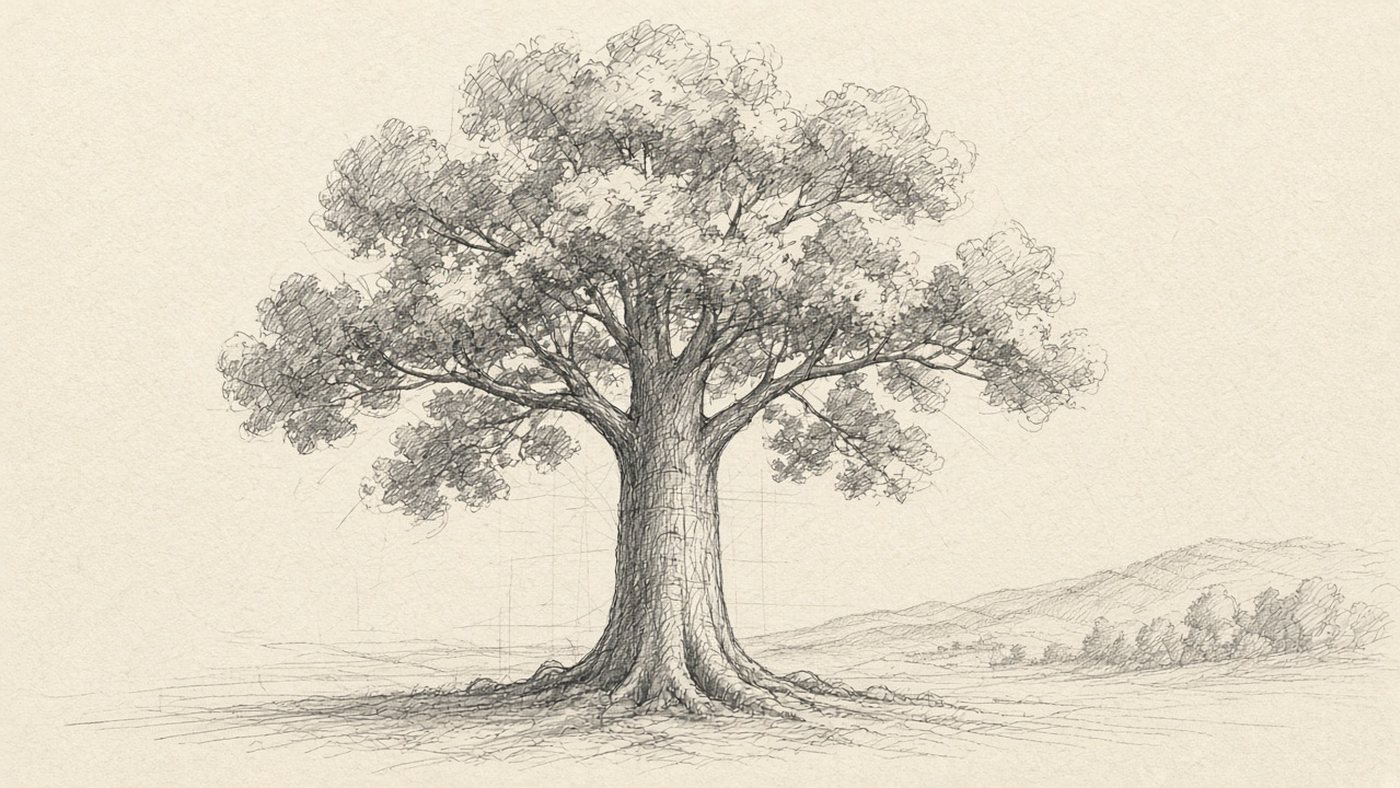
A tree as a silhouette
You recognize a tree by its silhouette, not by its leaves. One patch for the crown and one column for the trunk, and it is already clear whether this is an oak or a pine.
The overall crown shape
Fit the crown into a sphere, an egg, an umbrella, or a cone. An oak is a wide cushion, a birch is a tall oval, and a spruce is a triangle. The edge of the patch is ragged: bumps alternate with notches, or you get broccoli. If the silhouette is dull at arm's length, it is too early to break the foliage into pieces.
Trunk and crown proportions
On a deciduous tree the crown is two thirds of the height, and the trunk is one third. Thickness at the ground is about 1/12 of the tree's height, and by the first branches the trunk has narrowed by a third. A thin stick under a huge cap will not stand. Roots widen the base a little, but do not turn them into a paw unless this is the foreground.
Foliage in masses
Foliage is several "clouds," not a scatter of dots. A single leaf belongs only on the edge of the foreground.
- Block in the crown silhouette and set the trunk on the axis.
- Split the crown into 4–6 masses of different sizes.
- Cut 3–5 gaps of sky between the masses.
- Lighten the top of each mass, and darken the bottom of the crown.
- Place the cast shadow on the ground at the roots.
- In the foreground, add a few leaves along the edge.
Groups of foliage "clouds"
Large clumps sit on top and in the light, and smaller ones sit below and deeper in. They overlap like cumulus clouds. One clump should not repeat its neighbor. The logic of masses is the same as in the guide on how to draw sky and clouds.
Gaps of sky through the crown
A solid crown looks like a sticker. Cut windows of different shapes: larger near the trunk, smaller toward the edge. In the gaps, the sky is a little duller than in the open. Leave a dense core and a ragged edge. Do not punch holes through the crown at even spacing.
Light on top, shadow below
The top of a mass is two steps lighter than the bottom. The deepest shadow is inside the crown, above the trunk. The cast shadow on the ground repeats the silhouette and is darker than the grass: without it, the tree floats. How air quiets a distant forest is covered in the article on atmospheric perspective.
Trunk and branching
A child branch is thinner than its parent, and the angle of growth repeats. Chaos is allowed at the tips, not at the trunk.

A branch is thinner than the trunk
Two branches together are about equal to the trunk they grew from. A thread coming out of a thick column is unconvincing. Narrow the branch toward its end by half or more. Large branches go up and out. Only thin ones go down.
Forks and the direction of growth
On deciduous trees a fork is often 30–50 degrees. Do not draw branches as an umbrella from one point. Stagger the height where they leave the trunk. Start with a skeleton of five to seven large branches, then the small stuff. A winter tree shows the whole skeleton. A summer tree hides it in the masses.
Tip
Draw the tree upside down. The silhouette and the forks show up without the habit of "I know what a tree looks like." Flip it back and fix whatever drifted apart.
Bark and texture
Bark lives on a cylinder, not on a flat board. Put texture only in the foreground.
Texture that follows the cylinder
Grooves wrap the trunk: in the middle, facing you, they are wider and lighter, and toward the edges they pack together. Stroke along the trunk. There is less texture in the light and more in the midtone. That is how the cylinder reads without extra hatching.
Only in the foreground
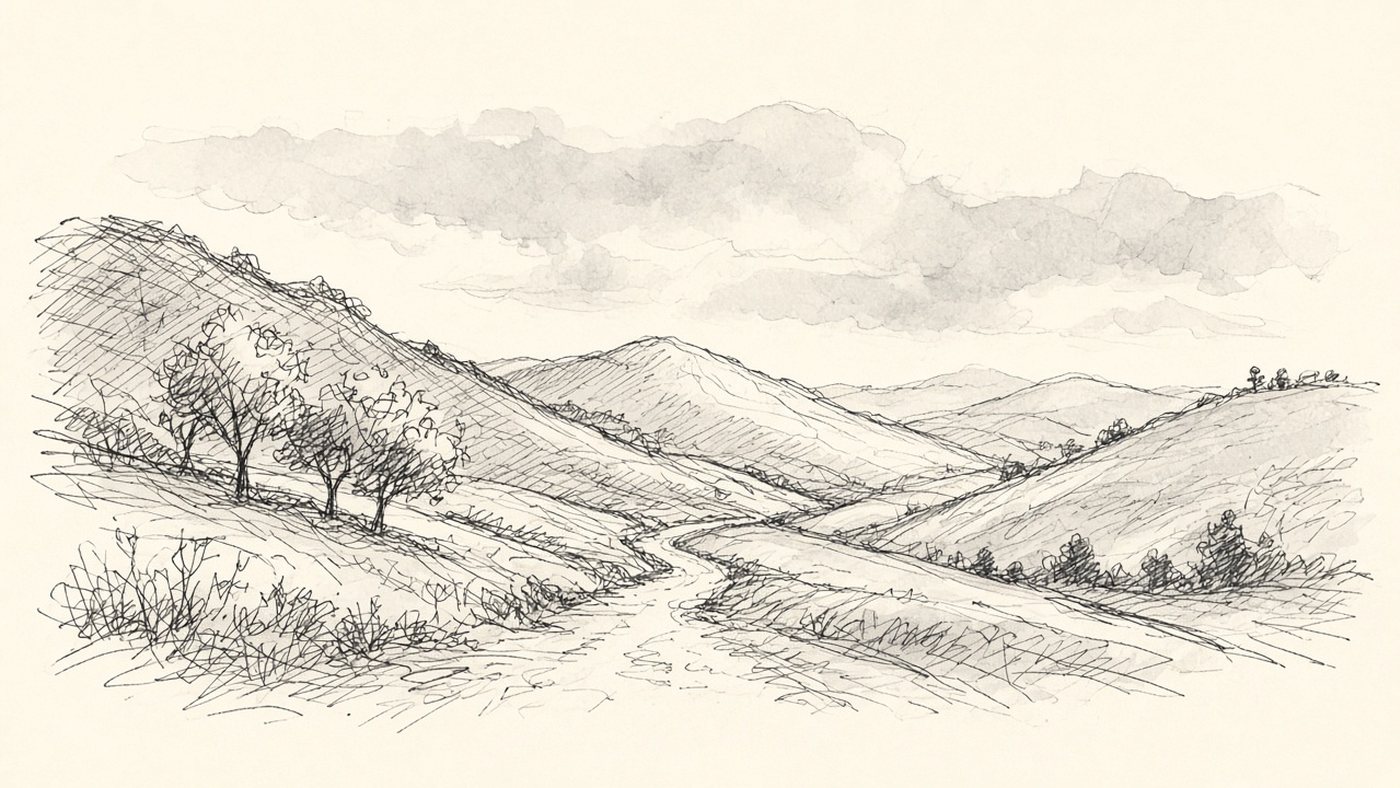
Save bark and individual leaves for the nearest tree. The middle ground is masses and a trunk without texture. The distance is one pale patch. The order of planes is covered in the article on how to draw a landscape.
Different species
Species changes the silhouette and the branching. Four schemes, and a forest stops being a set of green ovals.
Oak and birch
An oak has a short, powerful trunk and a wide, ragged crown, and the branches are almost horizontal. A birch has a thin, light trunk, a taller and lighter crown, drooping branch tips, and more gaps of sky. On a birch, use light horizontal strokes on the trunk. On an oak, use vertical grooves only on the front.
Pine and spruce
A pine holds an umbrella crown on a bare column. Needles are dark cushions at the ends of the branches, not needles one by one. A spruce is a cone of tiers, each lower tier wider than the one above. The spruce trunk is almost hidden. You see it at the ground and in the occasional window.
A tree in winter
- the silhouette is built from the branch skeleton, with no foliage masses;
- thick branches read all the way out, and thin ones read as bundles;
- three orders of branching are enough. Do not draw every twig;
- snow sits on top of the forks, and the underside of a branch is dark;
- distant winter trees are gray bristles with no trunks.
Time to draw, not just read
Theory fades in a couple of days if you never use it. Open the editor and spend 15 minutes on what you just read. That is enough for the skill to stick.
Try it now
A free online editor: brushes, layers, a palette, and a shared canvas. No install and no sign-up.
Start drawingTopics in this guide
- how to draw trees
- tree crown drawing
- how to draw foliage
- trunk and branches
- trees in a landscape
← How to Draw Sky and Clouds: Gradient, Volume, and Sunset How to Draw Cities and Architecture: A Street in Perspective →