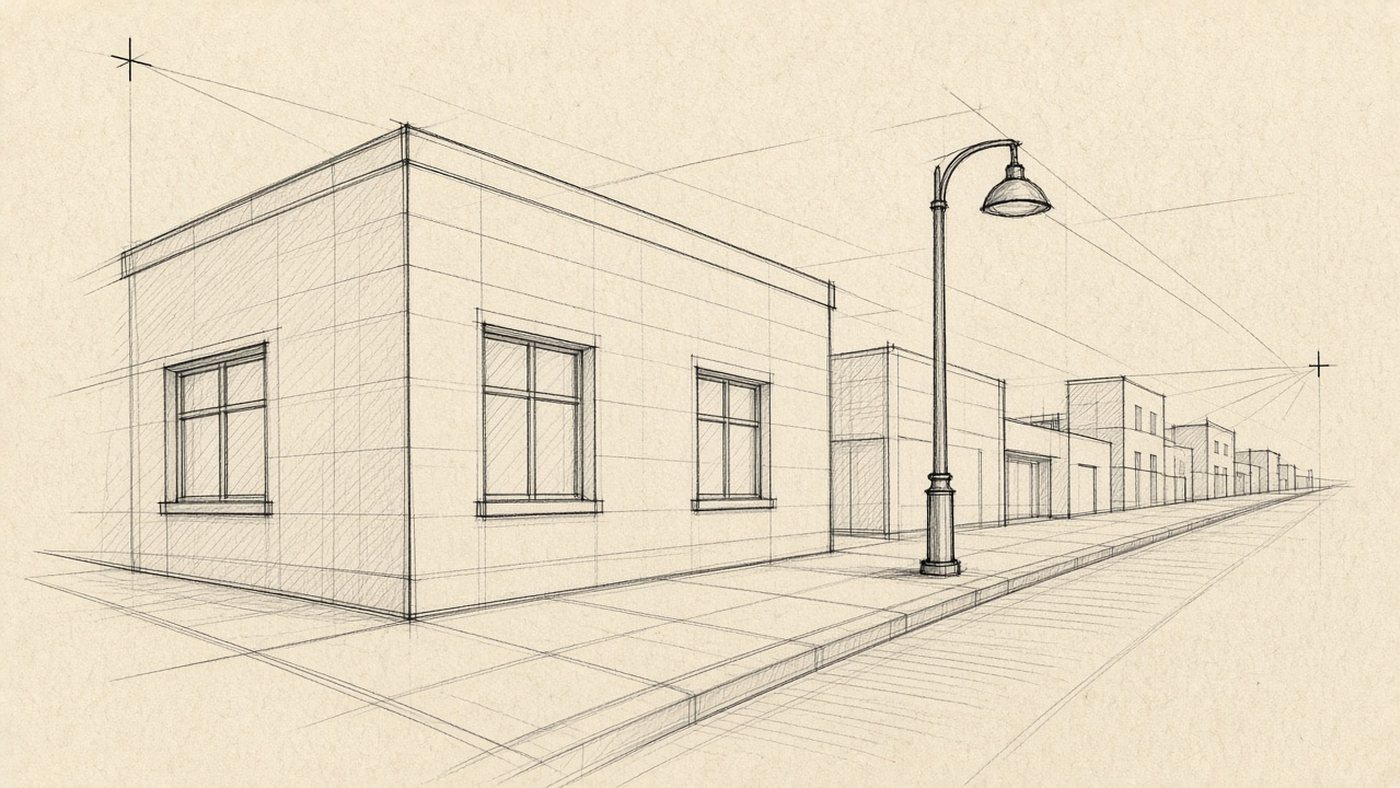
City perspective
A street stands on vanishing points and the horizon line. Until those are in place, the windows will drift.
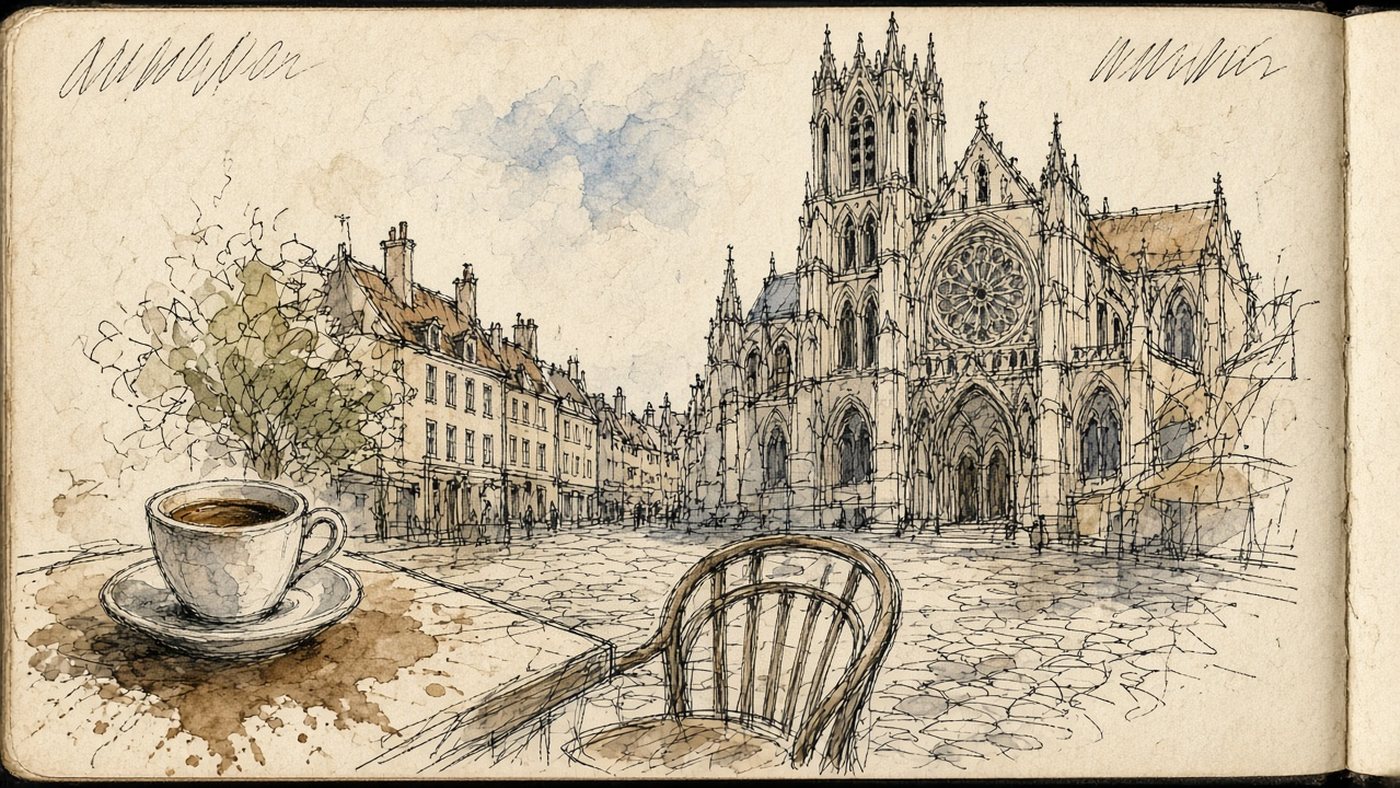
One vanishing point for a street
If you look down a street, cornices, plinths, and sidewalks meet at one point on the horizon. Place that point on a third of the page width, not in the center. Wall verticals stay vertical. A full breakdown of the axes is in the article on perspective in a drawing.
Two points for a corner building
A building with its corner toward you needs two points on the same horizon line: the left wall runs left, and the right wall runs right. The points often land past the edge of the page. Carry them out into the margin. Points that are too close squash the building.
The horizon line is eye level
The horizon is the height of your eyes. On a sidewalk it cuts the first floors at about head height. From a balcony it rises, and at cobblestones it almost sits on the ground. Windowsills above the horizon are seen from below, and windowsills below it are seen from above.
A building as a box
A building is a box with a rhythm of windows. Overall size first, then floors, and only then cornices.
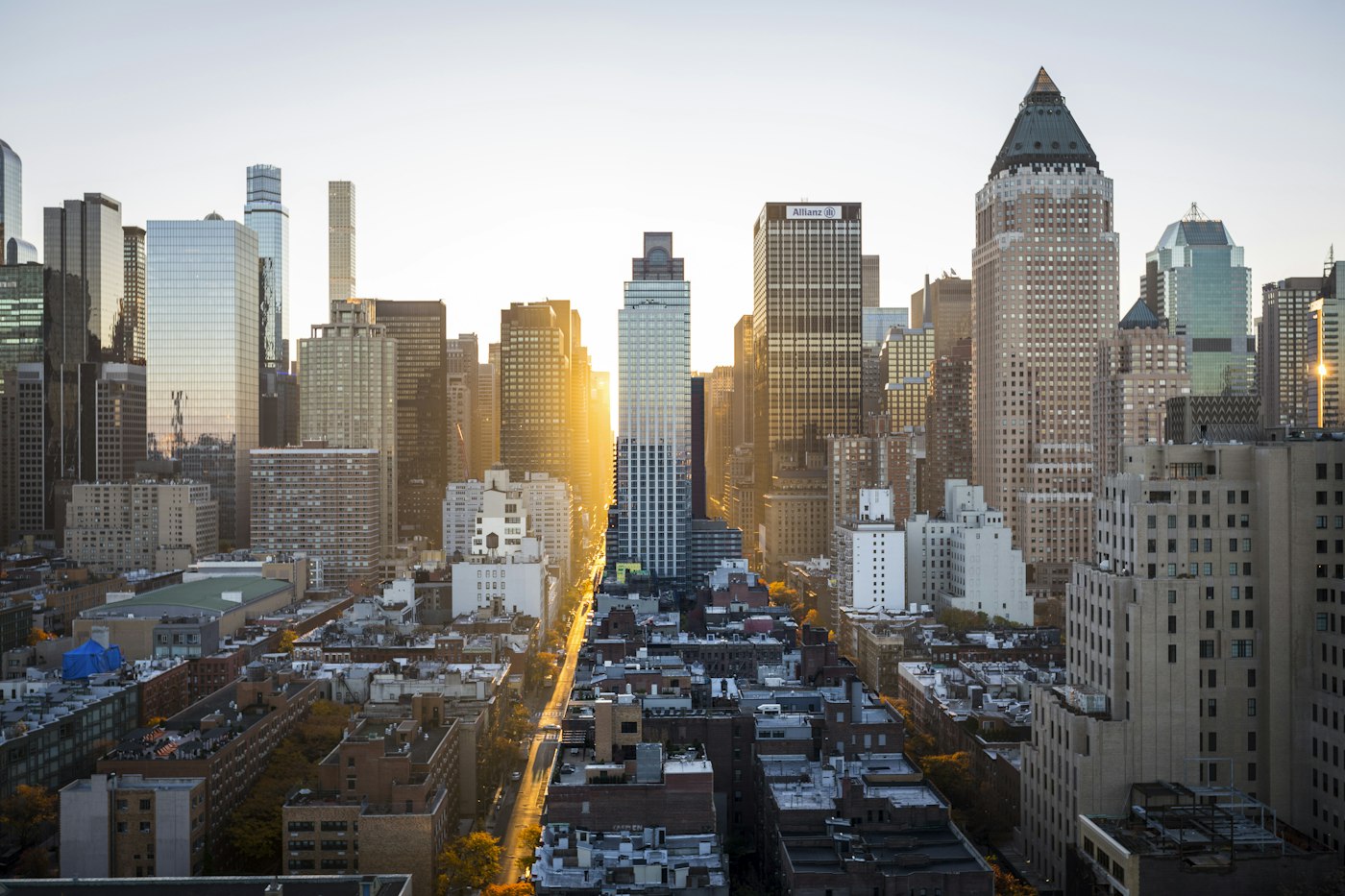
- Draw the horizon and place one or two vanishing points.
- Block in the box: height, width, and depth along the rays.
- Divide the facade into floors, bands that narrow in perspective.
- In each band, mark the windows in one rhythm.
- Fill the openings darker than the wall, and add a cornice and a plinth.
- Place people, cars, and streetlights for scale.
Overall size and proportions
A city building is 4–6 floors, a floor is about 3 meters, and a window is about half that height. By eye, a floor is a little taller than a person. Set the width by the number of windows: five to seven bays feel calm, three feel cramped, and twelve with no pause is a barracks.
Dividing floors in perspective
Do not divide the facade with a ruler into equal strips of the page. Mark the height of the first floor, draw a diagonal of the box, and space the rest along it. The plinth is a little taller than a living floor, and the attic is lower. Distant floors pack together.
Windows and rhythm
A break in the window rhythm shows up sooner than a mistake in the cornice. Draw the openings in series.

Matching windows that shrink
Windows on one floor share one height. Toward the vanishing point they get narrower and closer together. Draw the outer ones first, then the middle one, then the rest. Draw frames only in the foreground: leave distant openings as dark rectangles.
Dark openings for volume
An opening is two or three steps darker than the wall, or the building stays flat. The sill and the jamb give thickness: the inner edge is a little lighter than the hole. Do not outline every window with a black frame of one thickness.
Tip
Squint: the facade should fall into bands of floors and a grid of dark holes. If the grid dances, go back to the vanishing rays, and leave the signs for later.
Details and scale
Without people, you cannot tell a three-story building from a toy block. Figures set the scale.
People, cars, streetlights
A person's height is about a third of the first floor, or a little more. The heads of people standing on the same pavement sit almost on the horizon if the horizon is at eye level. A car is a little shorter than a person, and its length is two figures. Two or three figures on the sidewalk bring a street to life more than twenty windows.
Signs and wires
A sign on the end of a building collapses into a narrow rectangle and runs to the vanishing point. Wires are soft, sagging arcs, not strings. Three wires read. Twelve turn the sky into a grid.
A quick urban sketch
Fifteen minutes from a photo teaches you to choose what matters better than an evening spent on one cornice.
15 minutes from a photo
The first three minutes: horizon, vanishing point, boxes. Seven: floors and windows as patches. Five: people, one sign, a couple of wires. Do not zoom the photo in to the bricks. The same limit is in the article on sketching for beginners.
What to simplify
- distant buildings as one silhouette, with no windows;
- glass as a dark patch, with no curtains;
- ornament as a couple of cornices;
- a crowd as three or four figures;
- the sky as a gradient or an empty field.
Shift the main building off center: a corner or a doorway closer to an intersection on the rule of thirds.
Time to draw, not just read
Theory fades in a couple of days if you never use it. Open the editor and spend 15 minutes on what you just read. That is enough for the skill to stick.
Try it now
A free online editor: brushes, layers, a palette, and a shared canvas. No install and no sign-up.
Start drawingTopics in this guide
- how to draw a city
- urban sketch
- architecture drawing
- street perspective
- how to draw buildings
← How to Draw Trees: The Crown in Masses, Not Leaf by Leaf Pixel Art for Beginners: How to Draw Your First Sprite →