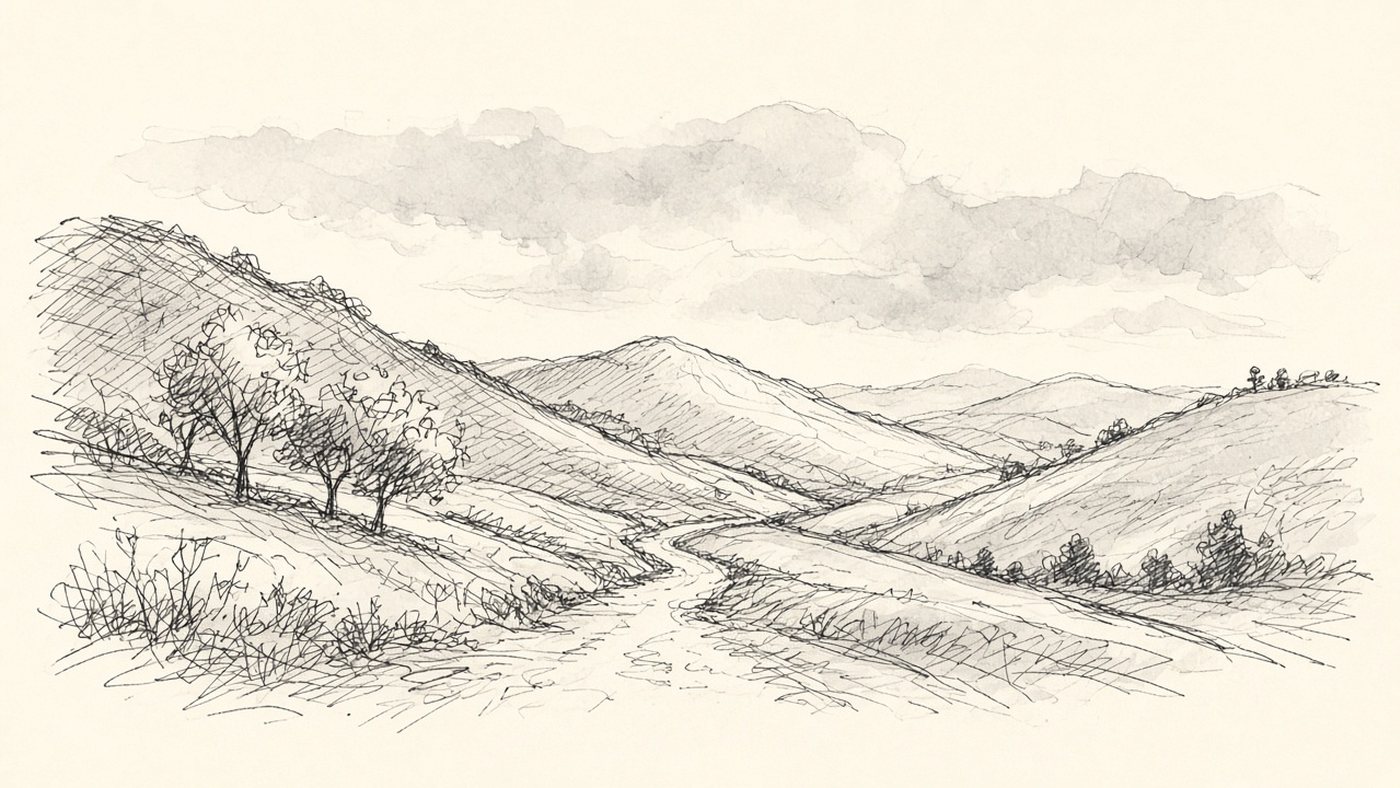
The sky gradient
The sky is not a flat fill of one ultramarine. From the zenith to the horizon, value and temperature change, and that stretch sets the depth of the landscape.
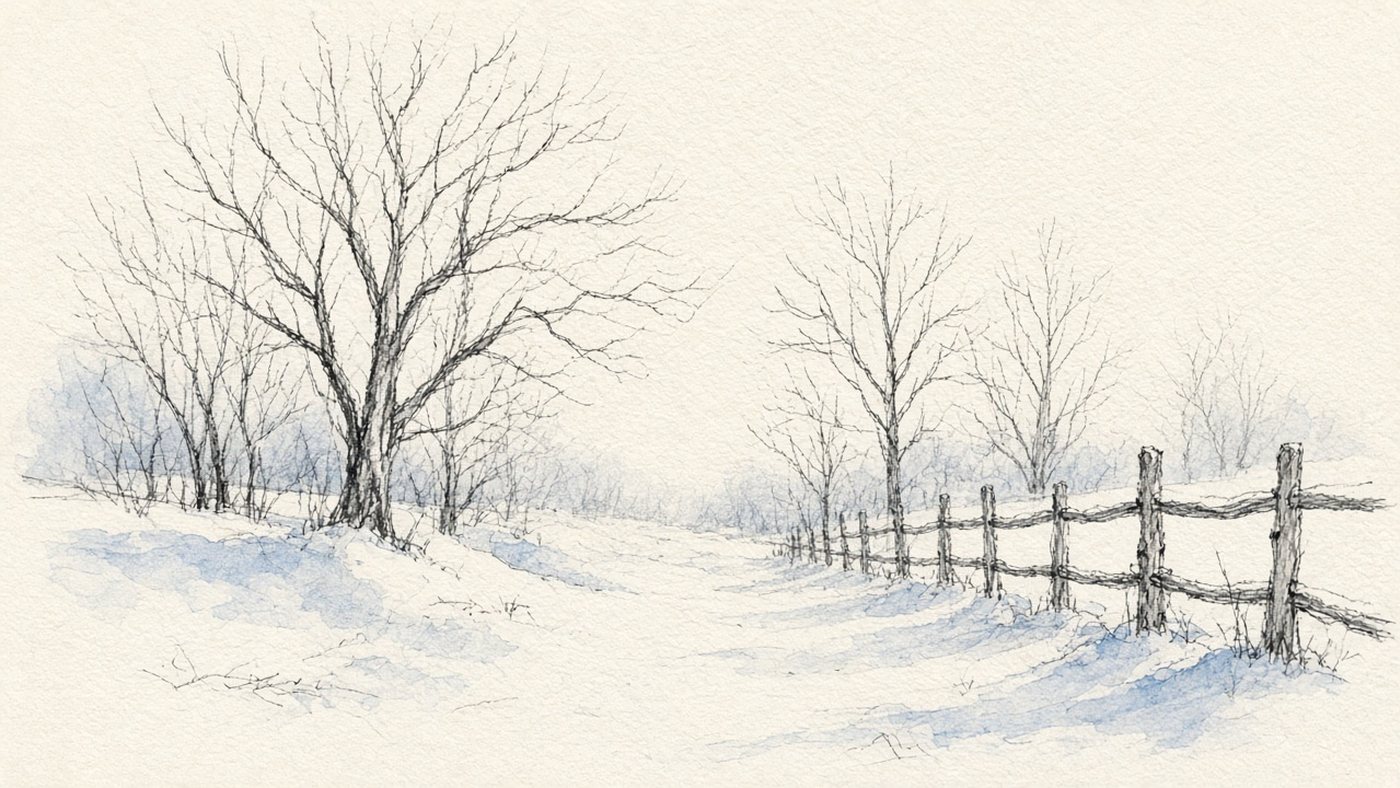
Darker at the top, lighter at the horizon
At the zenith the sky is two or three steps darker, and at the horizon it pales. Give the top third the darkest value and build the gradient in horizontal bands. In an editor, lay the transition at 20–30% opacity. If the top and bottom are the same value, the page is flat.
A cool zenith and a warm horizon
Shift the top toward blue-violet, and the bottom toward a pale warm: yellowish by day, pinkish in the evening. Even at noon there is warmth at the edge of the earth from dust. This is the same atmospheric perspective without mountains: air lightens the distance.
Types of clouds
Choose the type before the first patch. Cumulus holds the volume, cirrus holds the wind, and stratus holds an overcast mood.
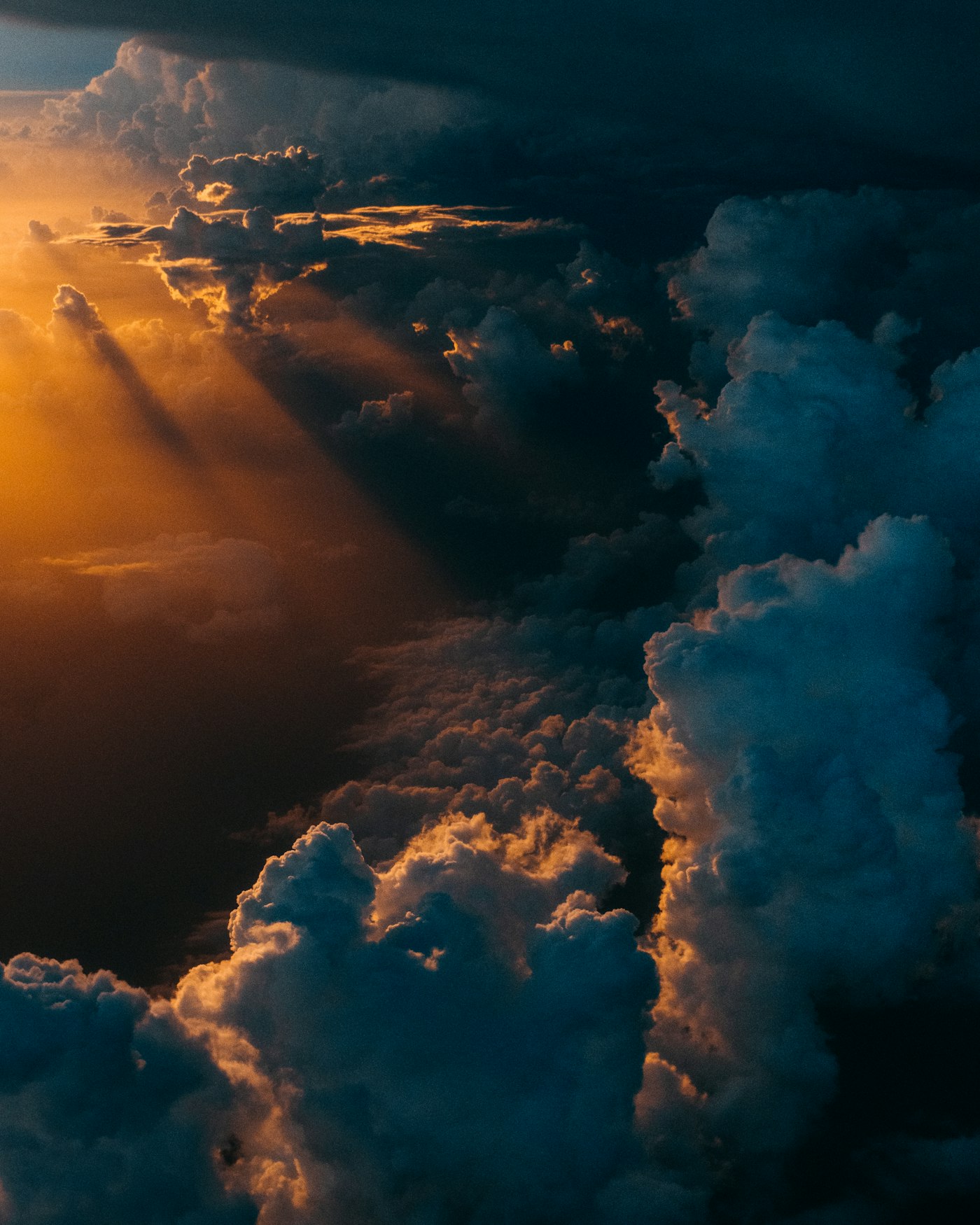
Cumulus: volume and "bubbles"
A cumulus cloud is a pile of hemispheres on a flat base. Block in a cushion and cut the top into 5–7 bubbles: one large, two medium, and the rest small. Hide some bubbles behind their neighbors. Three clouds of different sizes beat ten identical ones.
Cirrus: thin strokes
Cirrus clouds are feathers and threads at a great height. Lay them in long strokes along the wind, almost in white over the finished gradient. They need no contour and no shadow of their own: they are too thin.
Stratus and storm clouds
Stratus clouds are even bands with no shaped edge, and the contrast is weak. Storm clouds are heavier: the bottom is ragged, and the value is leaden. Lay the patch wide, and punch gaps through it with the eraser. The closer to the horizon, the smaller and denser the cloud.
Light and shadow in a cloud
A cloud has the same zones as a sphere: light, midtone, base, reflected light. A white blob with a gray outline will not give you volume.
- Fill the sky with a gradient: darker and cooler at the top.
- Block in the cloud's silhouette in one middle value.
- Lift the top and the nearest bubbles with a light mass.
- Mark the base with a flat dark value.
- Leave a break of light at the edge if the sun is behind or to the side.
- Soften the distant clouds and take the contrast off them.
The lit top
The lightest part is not the whole top. It is the planes turned toward the sun. Leave a near-white value with a slight warmth. The sides of the bubbles drop into midtone by one or two steps. A couple of soft dents inside the light describe the form better than even chalk.
A flat dark base
The bottom of a cumulus cloud is nearly flat and cooler than the top: gray-violet, not a dirty gray. The plane is parallel to the ground. Without a dark base, the cloud hangs like smoke. At the horizon, the difference from the sky almost disappears.
A break of light and an edge glow
If the sun is behind the cloud, the edge flares into a narrow rim a few millimeters wide, and the inside of the patch stays dark. Draw the rim only where the cloud is thinnest. In an editor, put the glow on a layer with low opacity.
Tip
Convert the piece to black and white. The sky should stay a gradient, and the clouds should stay patches of different lightness. If a cloud merges with the sky, the base or the top is missing.
Sunset and sunrise
At sunset the gradient is shorter and brighter: the cool top stays, and the bottom flares. Build the palette before you paint.
A palette of warm and cool
Warm: yellow, orange, pink. Cool: ultramarine, violet. Warm colors live around the sun, and cool colors live at the zenith and in the cloud shadows. Let one pole lead. The pairs are covered in the article on color theory.
Sky color around the sun
Around the sun the sky is lightest: a white center, a ring of yellow, then orange and pink, then blue. The sun is a soft halo, not a hard circle. The warm bottom reflects in the water. That is covered in the article on how to draw the sea and waves.
The sky in an editor
Keep the sky separate from the ground, so you can fix the gradient without touching the trees.
A gradient on its own layer
Put a "sky" layer under the landscape and fill it with a gradient from zenith to horizon. Reveal the ground with a mask or an eraser. If the gradient misses, only this layer changes.
A soft brush and low opacity
- a round brush, hardness 0–20%, opacity 15–25%;
- horizontal strokes, like bands of air;
- clouds on a separate layer above the gradient;
- an eraser of the same softness cuts the gaps;
- do not raise the opacity "to go faster." Spots will appear.
Time to draw, not just read
Theory fades in a couple of days if you never use it. Open the editor and spend 15 minutes on what you just read. That is enough for the skill to stick.
Try it now
A free online editor: brushes, layers, a palette, and a shared canvas. No install and no sign-up.
Start drawingTopics in this guide
- how to draw the sky
- how to draw clouds
- sky gradient
- cumulus clouds drawing
- sunset in a drawing
← How to Draw the Sea and Waves: Water That Moves How to Draw Trees: The Crown in Masses, Not Leaf by Leaf →