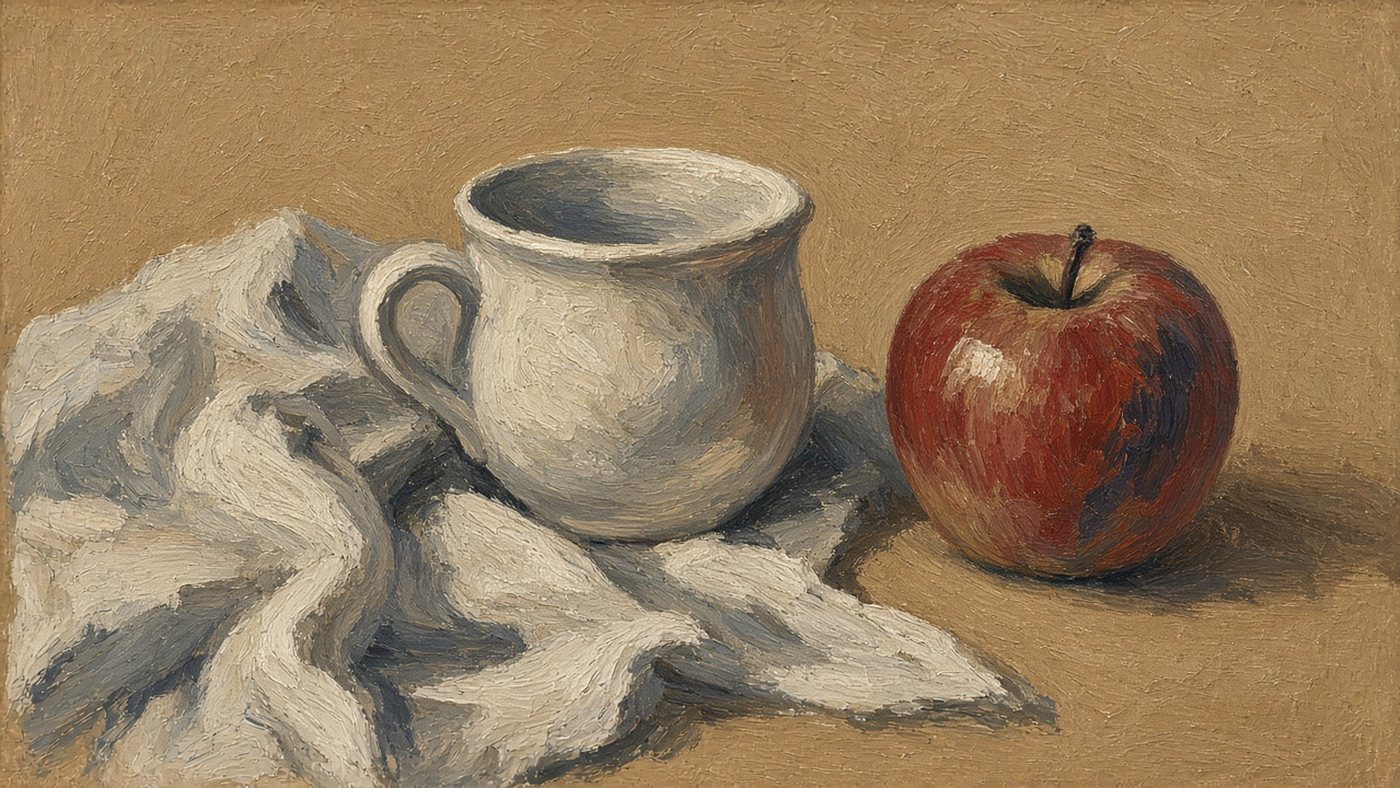
Why three colors are enough
Three paints limit the number of accidental mixes. Two of them make a middle tone. The third darkens or warms it. Twelve tubes make middle tones too, and also mud that nobody ordered. The wheel you choose the three from is in the color wheel.
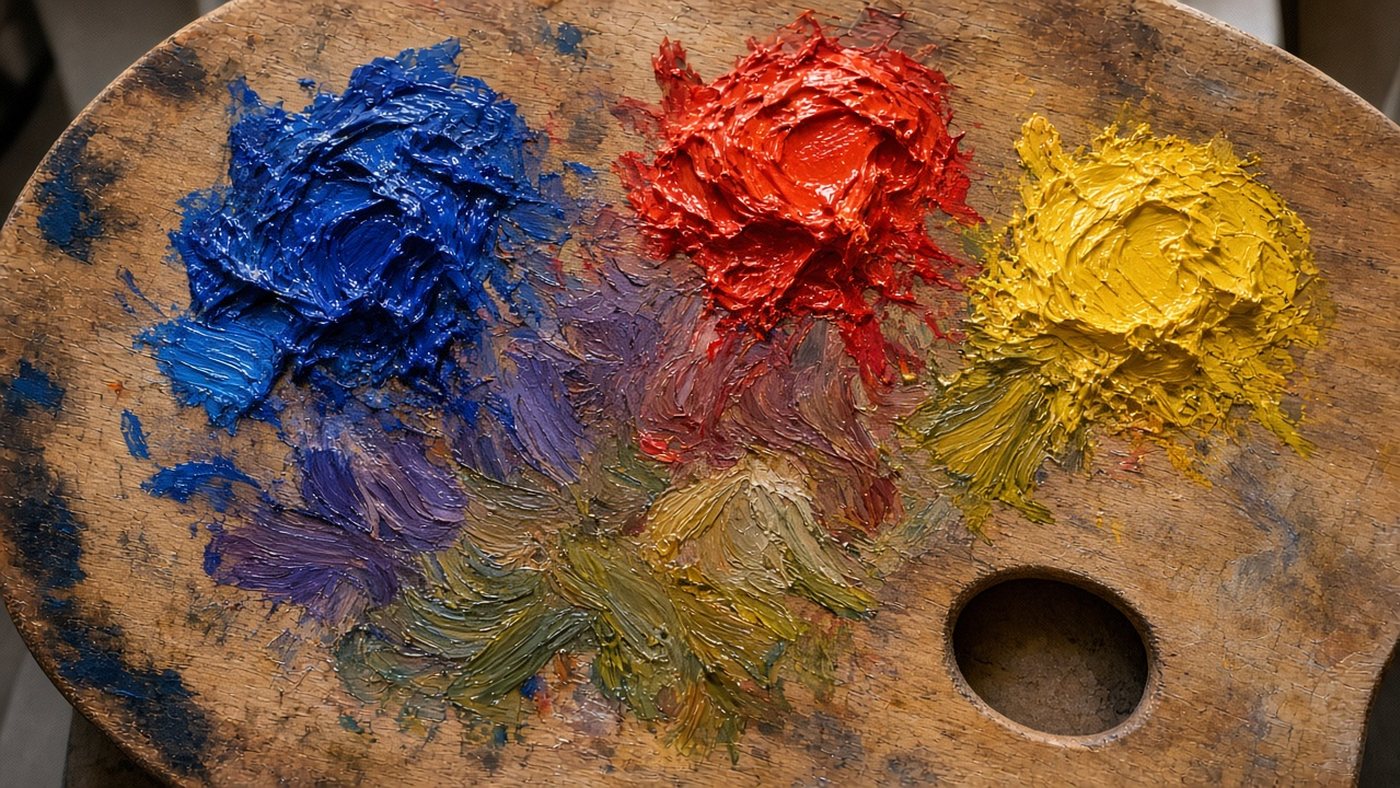
Mixes make the middle tones
A middle tone is not its own paint. It is a mix of two of the three, sometimes with white. If you squeeze a new tube for every middle, the study falls into unrelated colors. Note in the margin which pair makes the green or the violet, and do not hunt for a fourth tube.
Less mud
Mud is three or more pigments in one stroke, plus extra white. When only three paints exist, even a bad mix stays inside one family. You can use it in a shadow. In an open box the same soup belongs to no object.
- Choose three tubes before the first stroke.
- Mix the three pairs on the palette.
- Find the darkest mix without a new color.
- Start the study with the middle tone, not with white.
How to choose the three
A useful trio covers warmth, coolness, and a way into the dark.
One warm, one cool, one dark
Ochre, ultramarine and burnt umber, for example. Or a red, a dull green and ivory black. The names matter less than the roles. If all three are warm, there is nothing to cool a shadow. If none is dark, the shadow has to be built from white and mud.
White stays separate
White lightens. It does not replace the third color. Do not count it as one of the three, or you are left with two paints and chalk. Put white in the lights, not into every mix. The basic choice of color is in color theory.
Mixing order
Order matters more than the set. Start with whatever covers most of the canvas.
The middle tone first
The middle tone is the sky, the wall, half of a face. Mix a large pile of it. Small batches come out different each time, and the plane falls apart. Take shadow and light from that pile, not from the pure tubes.
The accent last
Save the purest color for a small place: lips, the edge of an apple, a window. If you paint half the canvas with pure color at the start, there is no accent left. The limit works when pure color is rare.
- Roles: warm, cool, dark.
- White is not a substitute for the third paint.
- A large pile of the middle tone.
- Pure color only in the accent.
Check
Cap two tubes and try to finish the shadow with what is still open. If you cannot, the third paint was not dark. It was another middle color.
Where the limit breaks
The limit breaks from a bad choice and from a fourth paint added quietly, not from poverty.
Colors that are too close
Two ochres and a yellow are one paint in three jars. The mixes go neither cool nor truly dark. Separate the roles: one noticeably cooler, one noticeably darker than the others.
A fourth paint for the eyes
“Just for the eyes” quickly becomes the paint for the lips, then for the background. The study stops being limited halfway through, and there is nothing left to compare. If the eyes really fail, paint them smaller with the same three, and leave the fourth tube for the next sheet.
Time to draw, not just read
Theory fades in a couple of days if you never use it. Open the editor and spend 15 minutes on what you just read. That is enough for the skill to stick.
Try it now
A free online editor: brushes, layers, a palette, and a shared canvas. No install and no sign-up.
Start drawingTopics in this guide
- limited palette
- three-color study
- mixing three paints
- palette for a study
- muddy paint