
Portfolio goal
A beginner's portfolio is not an archive of life, but a showcase of eight strong works for a specific purpose: study, freelance or personal brand.
School
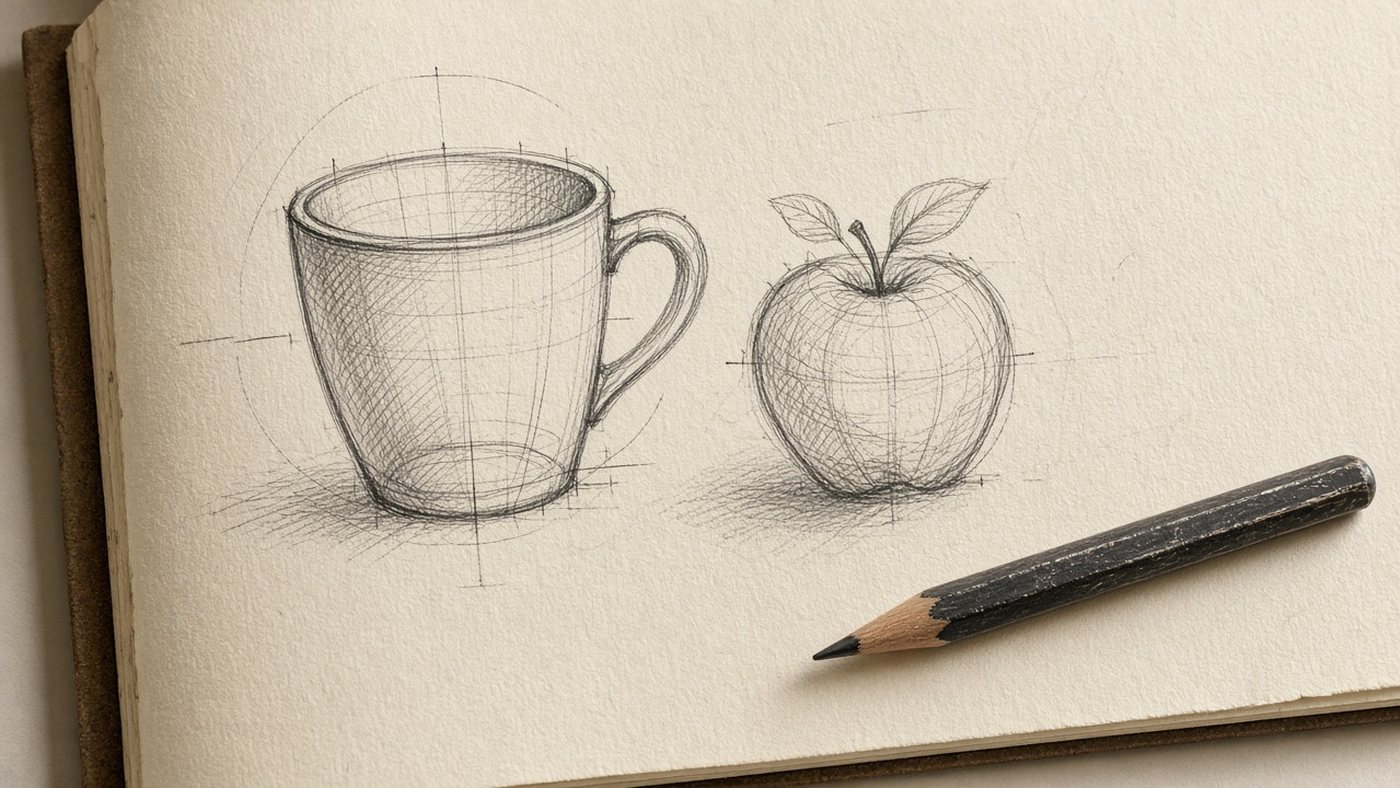
The admissions committee looks at the observation, construction, series. Add still life and nature, not just characters.
The portfolio for the training application is shorter than the full archive of the year — select the top eight, the rest in the "process" folder.
- still life from life — at least two works;
- head/figure — at least two;
- a series of three household sketches;
- without AI without a signature — it is better not to include.
"School" rarely produces a pretty page the first time—but it quickly shows where you rush or freeze up over mistakes. I ask students to mark the calendar after a session, not grade quality: repetition matters more than impressing a viewer, especially when time is short.
If "School" will not click, cut the task to one parameter: contour only, shadow only, or one corner of the composition. Your brain stops treating the drill like an exam and curiosity comes back—without that, long learning plans fall apart and short sessions turn into procrastination.
Write one sentence: what felt easier today than a month ago, even if you dislike the drawing. "School" over ten repeats changes motor skills and attention; compare sheets only to your own past work, not to someone else's feed where they posted a final after ten hours of fixes.
Before "School," close extra tabs and notifications: a five-minute slot does not forgive switching. One tool, one timer, one page—that trains how you enter work, instead of collecting half-started files you shame-close in a "drafts" folder.
After "School," leave the tool visible, not in a drawer: tomorrow you will again have "no time," and a visible pencil or open editor tab beats motivational quotes. Small setup often beats willpower.
If you keep a sketchbook or progress journal, label the page with one word about your state—"tired," "rushed," "curious." In a month "School" stops being abstract: you see when the line is stronger and adjust the schedule instead of blaming your character.
Reminder: "School" is not proof of talent, it is observation and movement technique. Pros return to simple drills between big projects too; the difference is they do not post about it in stories—they just do it.
Freelance
The client needs a style that you will repeat tomorrow. The series in the same style beats ten different genres.
Show that you are bringing the work to the deadline: in the signature, indicate "sketch 2 hours" or "illustration 5 days" — without excuses, only facts.
For the first orders, works fromcompetitions for beginners: they discipline and give a deadline.
"Freelance" rarely produces a pretty page the first time—but it quickly shows where you rush or freeze up over mistakes. I ask students to mark the calendar after a session, not grade quality: repetition matters more than impressing a viewer, especially when time is short.
If "Freelance" will not click, cut the task to one parameter: contour only, shadow only, or one corner of the composition. Your brain stops treating the drill like an exam and curiosity comes back—without that, long learning plans fall apart and short sessions turn into procrastination.
Write one sentence: what felt easier today than a month ago, even if you dislike the drawing. "Freelance" over ten repeats changes motor skills and attention; compare sheets only to your own past work, not to someone else's feed where they posted a final after ten hours of fixes.
Before "Freelance," close extra tabs and notifications: a five-minute slot does not forgive switching. One tool, one timer, one page—that trains how you enter work, instead of collecting half-started files you shame-close in a "drafts" folder.
After "Freelance," leave the tool visible, not in a drawer: tomorrow you will again have "no time," and a visible pencil or open editor tab beats motivational quotes. Small setup often beats willpower.
If you keep a sketchbook or progress journal, label the page with one word about your state—"tired," "rushed," "curious." In a month "Freelance" stops being abstract: you see when the line is stronger and adjust the schedule instead of blaming your character.
Reminder: "Freelance" is not proof of talent, it is observation and movement technique. Pros return to simple drills between big projects too; the difference is they do not post about it in stories—they just do it.
Personal brand
Instagram and Behance are a showcase, not a warehouse. Update regularly, seesharing art on social media.
"Personal brand" rarely produces a pretty page the first time—but it quickly shows where you rush or freeze up over mistakes. I ask students to mark the calendar after a session, not grade quality: repetition matters more than impressing a viewer, especially when time is short.
If "Personal brand" will not click, cut the task to one parameter: contour only, shadow only, or one corner of the composition. Your brain stops treating the drill like an exam and curiosity comes back—without that, long learning plans fall apart and short sessions turn into procrastination.
Write one sentence: what felt easier today than a month ago, even if you dislike the drawing. "Personal brand" over ten repeats changes motor skills and attention; compare sheets only to your own past work, not to someone else's feed where they posted a final after ten hours of fixes.
Before "Personal brand," close extra tabs and notifications: a five-minute slot does not forgive switching. One tool, one timer, one page—that trains how you enter work, instead of collecting half-started files you shame-close in a "drafts" folder.
After "Personal brand," leave the tool visible, not in a drawer: tomorrow you will again have "no time," and a visible pencil or open editor tab beats motivational quotes. Small setup often beats willpower.
If you keep a sketchbook or progress journal, label the page with one word about your state—"tired," "rushed," "curious." In a month "Personal brand" stops being abstract: you see when the line is stronger and adjust the schedule instead of blaming your character.
Reminder: "Personal brand" is not proof of talent, it is observation and movement technique. Pros return to simple drills between big projects too; the difference is they do not post about it in stories—they just do it.
Selection: the minus-50% rule
Series vs singles
Three works of one series ("cafe", "rooms") show maturity better than three random pictures.
"Series vs singles" rarely produces a pretty page the first time—but it quickly shows where you rush or freeze up over mistakes. I ask students to mark the calendar after a session, not grade quality: repetition matters more than impressing a viewer, especially when time is short.
If "Series vs singles" will not click, cut the task to one parameter: contour only, shadow only, or one corner of the composition. Your brain stops treating the drill like an exam and curiosity comes back—without that, long learning plans fall apart and short sessions turn into procrastination.
Write one sentence: what felt easier today than a month ago, even if you dislike the drawing. "Series vs singles" over ten repeats changes motor skills and attention; compare sheets only to your own past work, not to someone else's feed where they posted a final after ten hours of fixes.
Before "Series vs singles," close extra tabs and notifications: a five-minute slot does not forgive switching. One tool, one timer, one page—that trains how you enter work, instead of collecting half-started files you shame-close in a "drafts" folder.
After "Series vs singles," leave the tool visible, not in a drawer: tomorrow you will again have "no time," and a visible pencil or open editor tab beats motivational quotes. Small setup often beats willpower.
If you keep a sketchbook or progress journal, label the page with one word about your state—"tired," "rushed," "curious." In a month "Series vs singles" stops being abstract: you see when the line is stronger and adjust the schedule instead of blaming your character.
Reminder: "Series vs singles" is not proof of talent, it is observation and movement technique. Pros return to simple drills between big projects too; the difference is they do not post about it in stories—they just do it.
Process or final only
A study portfolio can show one process spread plus the final. A client portfolio is usually the final only.
"Process or final only" rarely produces a pretty page the first time—but it quickly shows where you rush or freeze up over mistakes. I ask students to mark the calendar after a session, not grade quality: repetition matters more than impressing a viewer, especially when time is short.
If "Process or final only" will not click, cut the task to one parameter: contour only, shadow only, or one corner of the composition. Your brain stops treating the drill like an exam and curiosity comes back—without that, long learning plans fall apart and short sessions turn into procrastination.
Write one sentence: what felt easier today than a month ago, even if you dislike the drawing. "Process or final only" over ten repeats changes motor skills and attention; compare sheets only to your own past work, not to someone else's feed where they posted a final after ten hours of fixes.
Before "Process or final only," close extra tabs and notifications: a five-minute slot does not forgive switching. One tool, one timer, one page—that trains how you enter work, instead of collecting half-started files you shame-close in a "drafts" folder.
After "Process or final only," leave the tool visible, not in a drawer: tomorrow you will again have "no time," and a visible pencil or open editor tab beats motivational quotes. Small setup often beats willpower.
If you keep a sketchbook or progress journal, label the page with one word about your state—"tired," "rushed," "curious." In a month "Process or final only" stops being abstract: you see when the line is stronger and adjust the schedule instead of blaming your character.
Reminder: "Process or final only" is not proof of talent, it is observation and movement technique. Pros return to simple drills between big projects too; the difference is they do not post about it in stories—they just do it.
Old work
If a piece is more than two years old and you would not make it again today, leave it out.
An old sketch with broken anatomy belongs in the archive, not on Behance.
"Old work" rarely produces a pretty page the first time—but it quickly shows where you rush or freeze up over mistakes. I ask students to mark the calendar after a session, not grade quality: repetition matters more than impressing a viewer, especially when time is short.
If "Old work" will not click, cut the task to one parameter: contour only, shadow only, or one corner of the composition. Your brain stops treating the drill like an exam and curiosity comes back—without that, long learning plans fall apart and short sessions turn into procrastination.
Write one sentence: what felt easier today than a month ago, even if you dislike the drawing. "Old work" over ten repeats changes motor skills and attention; compare sheets only to your own past work, not to someone else's feed where they posted a final after ten hours of fixes.
Before "Old work," close extra tabs and notifications: a five-minute slot does not forgive switching. One tool, one timer, one page—that trains how you enter work, instead of collecting half-started files you shame-close in a "drafts" folder.
After "Old work," leave the tool visible, not in a drawer: tomorrow you will again have "no time," and a visible pencil or open editor tab beats motivational quotes. Small setup often beats willpower.
If you keep a sketchbook or progress journal, label the page with one word about your state—"tired," "rushed," "curious." In a month "Old work" stops being abstract: you see when the line is stronger and adjust the schedule instead of blaming your character.
Reminder: "Old work" is not proof of talent, it is observation and movement technique. Pros return to simple drills between big projects too; the difference is they do not post about it in stories—they just do it.
Structure of 8 slots
Hero first
Slot 1 is your strongest piece, not a childhood favorite.
People decide in about 40 seconds whether to keep scrolling.
- slot 1 is the hero piece;
- slots 2–6 are different jobs at one level;
- slot 7 is process, and it is optional;
- slot 8 is your second-strongest final.
"Hero first" rarely produces a pretty page the first time—but it quickly shows where you rush or freeze up over mistakes. I ask students to mark the calendar after a session, not grade quality: repetition matters more than impressing a viewer, especially when time is short.
If "Hero first" will not click, cut the task to one parameter: contour only, shadow only, or one corner of the composition. Your brain stops treating the drill like an exam and curiosity comes back—without that, long learning plans fall apart and short sessions turn into procrastination.
Write one sentence: what felt easier today than a month ago, even if you dislike the drawing. "Hero first" over ten repeats changes motor skills and attention; compare sheets only to your own past work, not to someone else's feed where they posted a final after ten hours of fixes.
Before "Hero first," close extra tabs and notifications: a five-minute slot does not forgive switching. One tool, one timer, one page—that trains how you enter work, instead of collecting half-started files you shame-close in a "drafts" folder.
After "Hero first," leave the tool visible, not in a drawer: tomorrow you will again have "no time," and a visible pencil or open editor tab beats motivational quotes. Small setup often beats willpower.
If you keep a sketchbook or progress journal, label the page with one word about your state—"tired," "rushed," "curious." In a month "Hero first" stops being abstract: you see when the line is stronger and adjust the schedule instead of blaming your character.
Reminder: "Hero first" is not proof of talent, it is observation and movement technique. Pros return to simple drills between big projects too; the difference is they do not post about it in stories—they just do it.
Variety
Slots 2–6 can change genre, but the quality stays level. No dip in the middle.
"Variety" rarely produces a pretty page the first time—but it quickly shows where you rush or freeze up over mistakes. I ask students to mark the calendar after a session, not grade quality: repetition matters more than impressing a viewer, especially when time is short.
If "Variety" will not click, cut the task to one parameter: contour only, shadow only, or one corner of the composition. Your brain stops treating the drill like an exam and curiosity comes back—without that, long learning plans fall apart and short sessions turn into procrastination.
Write one sentence: what felt easier today than a month ago, even if you dislike the drawing. "Variety" over ten repeats changes motor skills and attention; compare sheets only to your own past work, not to someone else's feed where they posted a final after ten hours of fixes.
Before "Variety," close extra tabs and notifications: a five-minute slot does not forgive switching. One tool, one timer, one page—that trains how you enter work, instead of collecting half-started files you shame-close in a "drafts" folder.
After "Variety," leave the tool visible, not in a drawer: tomorrow you will again have "no time," and a visible pencil or open editor tab beats motivational quotes. Small setup often beats willpower.
If you keep a sketchbook or progress journal, label the page with one word about your state—"tired," "rushed," "curious." In a month "Variety" stops being abstract: you see when the line is stronger and adjust the schedule instead of blaming your character.
Reminder: "Variety" is not proof of talent, it is observation and movement technique. Pros return to simple drills between big projects too; the difference is they do not post about it in stories—they just do it.
Strong finish
The last slot is your second-strongest piece, not filler.
Compare it with the general portfolio guide. That one takes a wider view. This one stays on a beginner’s first set of pieces.
"Strong finish" rarely produces a pretty page the first time—but it quickly shows where you rush or freeze up over mistakes. I ask students to mark the calendar after a session, not grade quality: repetition matters more than impressing a viewer, especially when time is short.
If "Strong finish" will not click, cut the task to one parameter: contour only, shadow only, or one corner of the composition. Your brain stops treating the drill like an exam and curiosity comes back—without that, long learning plans fall apart and short sessions turn into procrastination.
Write one sentence: what felt easier today than a month ago, even if you dislike the drawing. "Strong finish" over ten repeats changes motor skills and attention; compare sheets only to your own past work, not to someone else's feed where they posted a final after ten hours of fixes.
Before "Strong finish," close extra tabs and notifications: a five-minute slot does not forgive switching. One tool, one timer, one page—that trains how you enter work, instead of collecting half-started files you shame-close in a "drafts" folder.
After "Strong finish," leave the tool visible, not in a drawer: tomorrow you will again have "no time," and a visible pencil or open editor tab beats motivational quotes. Small setup often beats willpower.
If you keep a sketchbook or progress journal, label the page with one word about your state—"tired," "rushed," "curious." In a month "Strong finish" stops being abstract: you see when the line is stronger and adjust the schedule instead of blaming your character.
Reminder: "Strong finish" is not proof of talent, it is observation and movement technique. Pros return to simple drills between big projects too; the difference is they do not post about it in stories—they just do it.
Captions and context
Time and tool
“Graphite, 3 hours, from life” is enough. Skip the essay.
"Time and tool" rarely produces a pretty page the first time—but it quickly shows where you rush or freeze up over mistakes. I ask students to mark the calendar after a session, not grade quality: repetition matters more than impressing a viewer, especially when time is short.
If "Time and tool" will not click, cut the task to one parameter: contour only, shadow only, or one corner of the composition. Your brain stops treating the drill like an exam and curiosity comes back—without that, long learning plans fall apart and short sessions turn into procrastination.
Write one sentence: what felt easier today than a month ago, even if you dislike the drawing. "Time and tool" over ten repeats changes motor skills and attention; compare sheets only to your own past work, not to someone else's feed where they posted a final after ten hours of fixes.
Before "Time and tool," close extra tabs and notifications: a five-minute slot does not forgive switching. One tool, one timer, one page—that trains how you enter work, instead of collecting half-started files you shame-close in a "drafts" folder.
After "Time and tool," leave the tool visible, not in a drawer: tomorrow you will again have "no time," and a visible pencil or open editor tab beats motivational quotes. Small setup often beats willpower.
If you keep a sketchbook or progress journal, label the page with one word about your state—"tired," "rushed," "curious." In a month "Time and tool" stops being abstract: you see when the line is stronger and adjust the schedule instead of blaming your character.
Reminder: "Time and tool" is not proof of talent, it is observation and movement technique. Pros return to simple drills between big projects too; the difference is they do not post about it in stories—they just do it.
No apologies
Writing “I am only learning” under every piece cheapens the page. Use facts instead of apologies.
"No apologies" rarely produces a pretty page the first time—but it quickly shows where you rush or freeze up over mistakes. I ask students to mark the calendar after a session, not grade quality: repetition matters more than impressing a viewer, especially when time is short.
If "No apologies" will not click, cut the task to one parameter: contour only, shadow only, or one corner of the composition. Your brain stops treating the drill like an exam and curiosity comes back—without that, long learning plans fall apart and short sessions turn into procrastination.
Write one sentence: what felt easier today than a month ago, even if you dislike the drawing. "No apologies" over ten repeats changes motor skills and attention; compare sheets only to your own past work, not to someone else's feed where they posted a final after ten hours of fixes.
Before "No apologies," close extra tabs and notifications: a five-minute slot does not forgive switching. One tool, one timer, one page—that trains how you enter work, instead of collecting half-started files you shame-close in a "drafts" folder.
After "No apologies," leave the tool visible, not in a drawer: tomorrow you will again have "no time," and a visible pencil or open editor tab beats motivational quotes. Small setup often beats willpower.
If you keep a sketchbook or progress journal, label the page with one word about your state—"tired," "rushed," "curious." In a month "No apologies" stops being abstract: you see when the line is stronger and adjust the schedule instead of blaming your character.
Reminder: "No apologies" is not proof of talent, it is observation and movement technique. Pros return to simple drills between big projects too; the difference is they do not post about it in stories—they just do it.
One paragraph
Task, constraint, one output — three sentences maximum.
"One paragraph" rarely produces a pretty page the first time—but it quickly shows where you rush or freeze up over mistakes. I ask students to mark the calendar after a session, not grade quality: repetition matters more than impressing a viewer, especially when time is short.
If "One paragraph" will not click, cut the task to one parameter: contour only, shadow only, or one corner of the composition. Your brain stops treating the drill like an exam and curiosity comes back—without that, long learning plans fall apart and short sessions turn into procrastination.
Write one sentence: what felt easier today than a month ago, even if you dislike the drawing. "One paragraph" over ten repeats changes motor skills and attention; compare sheets only to your own past work, not to someone else's feed where they posted a final after ten hours of fixes.
Before "One paragraph," close extra tabs and notifications: a five-minute slot does not forgive switching. One tool, one timer, one page—that trains how you enter work, instead of collecting half-started files you shame-close in a "drafts" folder.
After "One paragraph," leave the tool visible, not in a drawer: tomorrow you will again have "no time," and a visible pencil or open editor tab beats motivational quotes. Small setup often beats willpower.
If you keep a sketchbook or progress journal, label the page with one word about your state—"tired," "rushed," "curious." In a month "One paragraph" stops being abstract: you see when the line is stronger and adjust the schedule instead of blaming your character.
Reminder: "One paragraph" is not proof of talent, it is observation and movement technique. Pros return to simple drills between big projects too; the difference is they do not post about it in stories—they just do it.
Platforms
Behance
A case of 8 images with a cover. Single preview size.
Link in the resume and in the social media header.
"Behance" rarely produces a pretty page the first time—but it quickly shows where you rush or freeze up over mistakes. I ask students to mark the calendar after a session, not grade quality: repetition matters more than impressing a viewer, especially when time is short.
If "Behance" will not click, cut the task to one parameter: contour only, shadow only, or one corner of the composition. Your brain stops treating the drill like an exam and curiosity comes back—without that, long learning plans fall apart and short sessions turn into procrastination.
Write one sentence: what felt easier today than a month ago, even if you dislike the drawing. "Behance" over ten repeats changes motor skills and attention; compare sheets only to your own past work, not to someone else's feed where they posted a final after ten hours of fixes.
Before "Behance," close extra tabs and notifications: a five-minute slot does not forgive switching. One tool, one timer, one page—that trains how you enter work, instead of collecting half-started files you shame-close in a "drafts" folder.
After "Behance," leave the tool visible, not in a drawer: tomorrow you will again have "no time," and a visible pencil or open editor tab beats motivational quotes. Small setup often beats willpower.
If you keep a sketchbook or progress journal, label the page with one word about your state—"tired," "rushed," "curious." In a month "Behance" stops being abstract: you see when the line is stronger and adjust the schedule instead of blaming your character.
Reminder: "Behance" is not proof of talent, it is observation and movement technique. Pros return to simple drills between big projects too; the difference is they do not post about it in stories—they just do it.
PDF 15 MB
For letters to the school and clients. Shrink without soap in details.
"PDF 15 MB" rarely produces a pretty page the first time—but it quickly shows where you rush or freeze up over mistakes. I ask students to mark the calendar after a session, not grade quality: repetition matters more than impressing a viewer, especially when time is short.
If "PDF 15 MB" will not click, cut the task to one parameter: contour only, shadow only, or one corner of the composition. Your brain stops treating the drill like an exam and curiosity comes back—without that, long learning plans fall apart and short sessions turn into procrastination.
Write one sentence: what felt easier today than a month ago, even if you dislike the drawing. "PDF 15 MB" over ten repeats changes motor skills and attention; compare sheets only to your own past work, not to someone else's feed where they posted a final after ten hours of fixes.
Before "PDF 15 MB," close extra tabs and notifications: a five-minute slot does not forgive switching. One tool, one timer, one page—that trains how you enter work, instead of collecting half-started files you shame-close in a "drafts" folder.
After "PDF 15 MB," leave the tool visible, not in a drawer: tomorrow you will again have "no time," and a visible pencil or open editor tab beats motivational quotes. Small setup often beats willpower.
If you keep a sketchbook or progress journal, label the page with one word about your state—"tired," "rushed," "curious." In a month "PDF 15 MB" stops being abstract: you see when the line is stronger and adjust the schedule instead of blaming your character.
Reminder: "PDF 15 MB" is not proof of talent, it is observation and movement technique. Pros return to simple drills between big projects too; the difference is they do not post about it in stories—they just do it.
Instagram highlights
Highlight "portfolio 2026" — 8 posts, not stories and chaos.
For fast process slides, you can draw inthe browserand export to stories — without heavy software on the phone.
"Instagram highlights" rarely produces a pretty page the first time—but it quickly shows where you rush or freeze up over mistakes. I ask students to mark the calendar after a session, not grade quality: repetition matters more than impressing a viewer, especially when time is short.
If "Instagram highlights" will not click, cut the task to one parameter: contour only, shadow only, or one corner of the composition. Your brain stops treating the drill like an exam and curiosity comes back—without that, long learning plans fall apart and short sessions turn into procrastination.
Write one sentence: what felt easier today than a month ago, even if you dislike the drawing. "Instagram highlights" over ten repeats changes motor skills and attention; compare sheets only to your own past work, not to someone else's feed where they posted a final after ten hours of fixes.
Before "Instagram highlights," close extra tabs and notifications: a five-minute slot does not forgive switching. One tool, one timer, one page—that trains how you enter work, instead of collecting half-started files you shame-close in a "drafts" folder.
After "Instagram highlights," leave the tool visible, not in a drawer: tomorrow you will again have "no time," and a visible pencil or open editor tab beats motivational quotes. Small setup often beats willpower.
If you keep a sketchbook or progress journal, label the page with one word about your state—"tired," "rushed," "curious." In a month "Instagram highlights" stops being abstract: you see when the line is stronger and adjust the schedule instead of blaming your character.
Reminder: "Instagram highlights" is not proof of talent, it is observation and movement technique. Pros return to simple drills between big projects too; the difference is they do not post about it in stories—they just do it.
Update every quarter
Drop the weak piece
Remove one weakest slot, add a new strong one — the showcase is live.
"Drop the weak piece" rarely produces a pretty page the first time—but it quickly shows where you rush or freeze up over mistakes. I ask students to mark the calendar after a session, not grade quality: repetition matters more than impressing a viewer, especially when time is short.
If "Drop the weak piece" will not click, cut the task to one parameter: contour only, shadow only, or one corner of the composition. Your brain stops treating the drill like an exam and curiosity comes back—without that, long learning plans fall apart and short sessions turn into procrastination.
Write one sentence: what felt easier today than a month ago, even if you dislike the drawing. "Drop the weak piece" over ten repeats changes motor skills and attention; compare sheets only to your own past work, not to someone else's feed where they posted a final after ten hours of fixes.
Before "Drop the weak piece," close extra tabs and notifications: a five-minute slot does not forgive switching. One tool, one timer, one page—that trains how you enter work, instead of collecting half-started files you shame-close in a "drafts" folder.
After "Drop the weak piece," leave the tool visible, not in a drawer: tomorrow you will again have "no time," and a visible pencil or open editor tab beats motivational quotes. Small setup often beats willpower.
If you keep a sketchbook or progress journal, label the page with one word about your state—"tired," "rushed," "curious." In a month "Drop the weak piece" stops being abstract: you see when the line is stronger and adjust the schedule instead of blaming your character.
Reminder: "Drop the weak piece" is not proof of talent, it is observation and movement technique. Pros return to simple drills between big projects too; the difference is they do not post about it in stories—they just do it.
New series
Once a quarter, start a mini-series of three works — then include one in the eight.
"New series" rarely produces a pretty page the first time—but it quickly shows where you rush or freeze up over mistakes. I ask students to mark the calendar after a session, not grade quality: repetition matters more than impressing a viewer, especially when time is short.
If "New series" will not click, cut the task to one parameter: contour only, shadow only, or one corner of the composition. Your brain stops treating the drill like an exam and curiosity comes back—without that, long learning plans fall apart and short sessions turn into procrastination.
Write one sentence: what felt easier today than a month ago, even if you dislike the drawing. "New series" over ten repeats changes motor skills and attention; compare sheets only to your own past work, not to someone else's feed where they posted a final after ten hours of fixes.
Before "New series," close extra tabs and notifications: a five-minute slot does not forgive switching. One tool, one timer, one page—that trains how you enter work, instead of collecting half-started files you shame-close in a "drafts" folder.
After "New series," leave the tool visible, not in a drawer: tomorrow you will again have "no time," and a visible pencil or open editor tab beats motivational quotes. Small setup often beats willpower.
If you keep a sketchbook or progress journal, label the page with one word about your state—"tired," "rushed," "curious." In a month "New series" stops being abstract: you see when the line is stronger and adjust the schedule instead of blaming your character.
Reminder: "New series" is not proof of talent, it is observation and movement technique. Pros return to simple drills between big projects too; the difference is they do not post about it in stories—they just do it.
Link on resume
One current link, check on your phone once a month.
Examples of filing:Behance— a landmark in the structure of cases, not in the pro level.
Tip
I asked the student to throw away half of the Behance project: there were eight works left, and for the first time the recruiter completed the project. Minus 50% is not a loss, but a focus.
"Link on resume" rarely produces a pretty page the first time—but it quickly shows where you rush or freeze up over mistakes. I ask students to mark the calendar after a session, not grade quality: repetition matters more than impressing a viewer, especially when time is short.
If "Link on resume" will not click, cut the task to one parameter: contour only, shadow only, or one corner of the composition. Your brain stops treating the drill like an exam and curiosity comes back—without that, long learning plans fall apart and short sessions turn into procrastination.
Write one sentence: what felt easier today than a month ago, even if you dislike the drawing. "Link on resume" over ten repeats changes motor skills and attention; compare sheets only to your own past work, not to someone else's feed where they posted a final after ten hours of fixes.
Before "Link on resume," close extra tabs and notifications: a five-minute slot does not forgive switching. One tool, one timer, one page—that trains how you enter work, instead of collecting half-started files you shame-close in a "drafts" folder.
After "Link on resume," leave the tool visible, not in a drawer: tomorrow you will again have "no time," and a visible pencil or open editor tab beats motivational quotes. Small setup often beats willpower.
If you keep a sketchbook or progress journal, label the page with one word about your state—"tired," "rushed," "curious." In a month "Link on resume" stops being abstract: you see when the line is stronger and adjust the schedule instead of blaming your character.
Reminder: "Link on resume" is not proof of talent, it is observation and movement technique. Pros return to simple drills between big projects too; the difference is they do not post about it in stories—they just do it.
- eight strong works beat a lifetime timeline;
- series read better than random singles;
- caption tool and time, not apologies;
- update quarterly, drop the weakest piece;
- PDF under 15 MB for email.
Case study
I cut a student portfolio from twenty pieces to nine; interviews started landing because the first screen showed intent, not archive anxiety.
- Pick a goal: school, freelance, or personal brand.
- Remove half by honest ranking.
- Order hero first, strong finish last.
- Export sRGB PNGs.
- Publish one link everywhere.
Curators skim; eight strong pieces beat eighty mixed years. See artist portfolio basics for ordering ideas.
How museums present permanent collections is a useful pacing reference—see The Met’s about page for how institutions frame selection, not volume.
Export finals in sRGB PNG and archive masters separately—same rule as export without quality loss.
Frequently asked questions
How many pieces does a beginner need?
6–12 finished works; fewer is fine if there are no weak links.
Should I show sketches?
Yes if they are strong—in a separate "process" section, not instead of finals.
Do I need my own website?
At the start Behance or a PDF is enough; your own domain can wait.
Can I include AI work?
Label it honestly; for school portfolios, your own drawing is safer.
Time to draw, not just read
Theory fades in a couple of days if you never use it. Open the editor and spend 15 minutes on what you just read. That is enough for the skill to stick.
Try it now
A free online editor: brushes, layers, a palette, and a shared canvas. No install and no sign-up.
Start drawingTopics in this guide
- beginner artist portfolio
- how to build a portfolio
- artist portfolio
- behance portfolio
- portfolio pieces
← Streaming Your Drawing When You "Cannot Draw Yet" Is Fine If the Rules Are Clear Art School: Entrance Exams Are Not About "Genius"—They Are About Life and Still Life in Six Months →