
How many pieces you need
A first portfolio is not everything you have drawn. It is the best of it. A client flips through the work in less than a minute and remembers the weakest piece they saw, not the average.
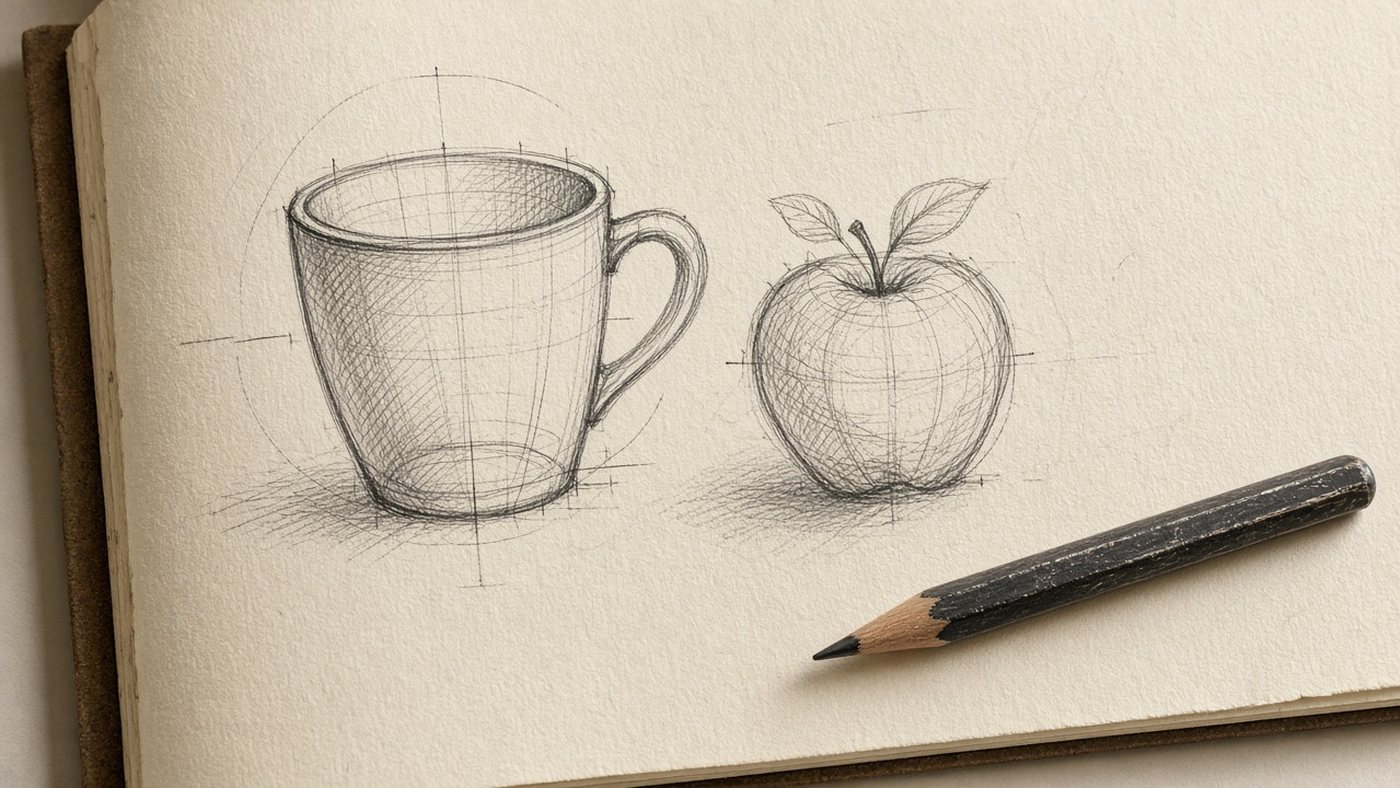
8–15 pieces are enough
Eight strong pieces are enough to show your level and your direction. If you only have five strong ones so far, show five and add one a month.
- Gather every finished piece into one folder.
- Score each from 1 to 5 and keep the 4s and 5s.
- When two pieces are similar, keep the stronger one.
- Lay the rest out in a row and remove the weakest.
- Repeat the previous step until 8–15 pieces remain.
Why weak pieces hurt
An average piece next to a strong one does not "round out" the set. It lowers the overall impression. Remove anything you yourself think of as "well, this one's fine."
What to include
A portfolio answers one question: what can you do for me? The set of pieces should match the work you want to do next.
Work in the direction you want
If you want to draw characters for games, show characters, not a mix of landscapes and lettering. Three pieces aimed at that work get more response than twenty unrelated ones.
A series instead of random pictures
A series of four pieces in one style shows that the result can be repeated, not that it happened once. Plan the series ahead and make it in two or three weeks.
Check
Show the portfolio to someone who does not draw and ask, "What do you think I know how to draw?" If the answer does not match your direction, the selection is wrong.
Presentation
Presentation is not decoration. It is ease of looking. Matching previews and a clear order show that the artist finishes what they start.
Matching previews and a clear order
- one aspect ratio for every preview, with no frames and no captions on top of the image;
- the strongest piece goes first, and the second strongest goes last;
- the long side is at least 1600 pixels, in PNG or a high-quality JPG;
- no collages of six pictures inside one preview;
- file size up to 2 MB, so the page opens quickly.
Before you upload, check that the export did not eat the detail. The rules are in the guide to saving a drawing without losing quality.
A short description of the brief
Two lines under a piece are worth a lot. They show that you think in jobs, not in pictures. For example: "Cover for a hiking podcast. It needed a silhouette that still reads at a small size."
Where to put it
A portfolio should open from one link, without a request to "message me and I will send an archive." The minimum is a profile on an art platform plus a social account you actually keep current.
Art platforms
On art platforms, people find you by tags and by direction, so fill those out completely: the description, the tags, the links. Update the profile once a month. Fresh work moves you up in the results.
Social media and your own page
Social media is good for process and drafts. A portfolio is for finished work. You need your own page once you have more than twenty pieces and want to split them into sections.
Common mistakes
Most rejections happen because of how the set is organized, not because of the level of the drawing. The three mistakes below are the most common, and you can fix them in one evening.
Everything in one pile
A portrait, pixel art, a cat, a still life, and a logo in one stream read as "I am still looking for myself." Split the work by direction and put one main direction first.
Copies and fan art with no original work
A copy shows technique. It does not show thinking: someone else invented the composition and the idea. Keep no more than two or three pieces like that, and credit the original artist. The boundaries are covered in the guide to copying other artists' work.
No contact information
People liked the work and had nowhere to write, so the job went to someone else. Put your email on the portfolio page itself, not only in a social profile. Add one line about which projects you take. It filters out extra mail and speeds up the mail you want.
If posting the work feels frightening, the techniques in the guide to the fear of showing your work will help, and the shift from hobby to a career explains what to do after the first responses.
Time to draw, not just read
Theory fades in a couple of days if you never use it. Open the editor and spend 15 minutes on what you just read. That is enough for the skill to stick.
Try it now
A free online editor: brushes, layers, a palette, and a shared canvas. No install and no sign-up.
Start drawingTopics in this guide
- artist portfolio
- how to build a portfolio
- beginner illustrator portfolio
- how many pieces in a portfolio
- where to host a portfolio
← Drawing for adults from scratch: it is not too late to start Getting feedback on your drawings: how to improve faster →