
Why Copy
A copy is reading someone else's decisions with your hands. You are not looking at a pretty picture. You are looking at a chain of choices: where the accent was placed, how long the shadow is, and how many colors are left in the palette.
Access to a Master's Decisions
A master has already settled the questions a beginner trips over for an hour. By repeating the piece, you take apart a finished plan of light and composition. The eyedropper will show that a "black" shadow is actually blue. Discoveries like that stick less well from theory than they do with a brush in your hand.
Training the Eye and the Hand
The eye learns to measure relationships: this shape is twice as dark, this mass is wider than the one next to it. The hand learns to draw a line with the same energy as the artist. Both skills later work on your own subjects. A copy with no measuring is just a tracing.
How to Copy the Right Way
The benefit sits in your head, not in a pixel match. Breakdown first, then the hand, then a check from memory.
Break It Down First: Light, Palette, Composition
Before the first line, answer in writing. Where is the light source, and what are the value zones. How many colors were used: sample five to seven patches with the eyedropper. Where is the focal point, and what sets it apart. Check the color foundation against the article on color theory for beginners.
A Copy from Memory after the Breakdown
- Describe the original in words, and with a small value diagram.
- Copy the large masses. Do not climb into eyelashes and ornament.
- Close the original and draw the diagram from memory in five minutes.
- Open it again and mark three differences. Correct only those from here on.
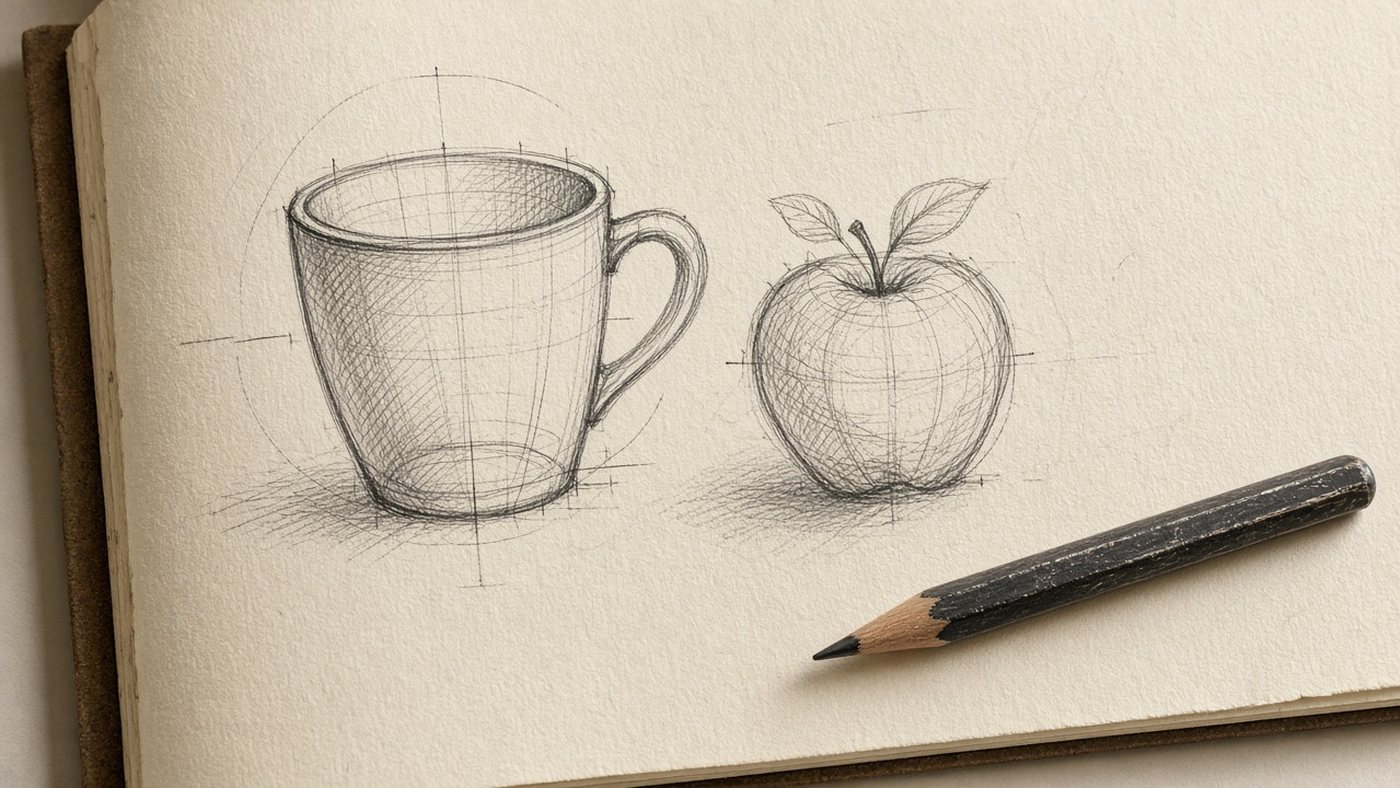
- The next day, repeat the subject with your own object: their light, your mug.
The last step separates study from a tracing. If your own object does not sit in the same plan, the breakdown has not landed yet.
What a Beginner Should Copy
Do not take a complex portrait in the first month. The copy should sit a little above your level. Otherwise you drown in detail and never see the construction.
Simple Forms and Value
Start with still lifes of two or three objects, simple landscape studies, and classroom setups. Look for work with few details and clear light. A copy of a sphere and drapery teaches more than a weak attempt to repeat a scene with many figures.
Work a Little Harder Than Your Level
A benchmark: you understand which forms the object is built from, but you are not sure about the value. If you do not understand the overall plan, the piece is too early. If you copy without a single question, pick something harder. For photos, the same rules apply as in the article on drawing from reference.
Tip
Copy a fragment, not the whole picture: one sleeve, one apple, one patch of sky. In 20 minutes you will take the method apart, instead of spending the evening on the background.
When Copying Hurts
The harm starts when the copy becomes your only genre. The hand gets used to ready-made decisions and gets lazy about looking for its own.
Nothing but Copies for Months
A month of nothing but copies, with no setups of your own, slows taste and composition. Alternate: one study copy, then two pieces of your own on the same topic. A style does not form from copies alone. That is covered in the guide on finding your art style.
A Copy Instead of Your Own Idea
Fear of the blank page pushes you to open someone else's file again. Then copying turns into hiding from a decision. If you have an idea, sketch it first in your own shapes, and open someone else's work only as a reference for the light, not as a finished frame.
Ethics and Publishing
Study is allowed. Passing someone else's work off as yours is not. The line runs through the credit, the platform, and the money.
Credit the Original Artist
Any published copy starts with the artist's name and the title of the work. The wording: "study copy, original by …." Do not crop out someone else's signature, and do not post a fragment as your own sketch. In Stories, the rule is the same as on a website.
What You Cannot Sell
- An exact copy of someone else's painting, even labeled "copy," on a marketplace.
- Fan art of a character sold as a product without the rights.
- A piece where only the colors changed, while the pose and composition belong to someone else.
- A series "in the artist's style," if the buyer thinks they are getting your subject.
In a portfolio, if you keep copies at all, keep them separate and labeled. How to build the display is in the article on an artist portfolio. For yourself, leave copies in a study folder: that is notes, not a showcase.
Time to draw, not just read
Theory fades in a couple of days if you never use it. Open the editor and spend 15 minutes on what you just read. That is enough for the skill to stick.
Try it now
A free online editor: brushes, layers, a palette, and a shared canvas. No install and no sign-up.
Start drawingTopics in this guide
- copying other artists
- copying someone else's drawings
- a study from a painting
- learning by copying
- plagiarism in drawing
← Free Drawing Lessons: Where to Study without Drowning in Them Drawing for kids online: how to set up the sessions →