Why this works
Anxiety lives in thoughts and feeds on attention. When your hands are busy with a repeated action you understand, less attention is left for spinning anxious scenes. Drawing is handy because it gives the hand a rhythm and does not require words.
There is no magic here, and promising a treatment would be dishonest. This is a working way to lower the tension for an evening, about like a walk or washing dishes, only more pleasant.
A repeated action and your attention
What calms you best is something you can do almost without thinking: matching strokes, dots, a repeating pattern. The thought "what is the right way?" does not switch on, because there is no right version. After five to seven minutes, breathing usually evens out on its own.
The result is not the point
As soon as the goal becomes "make it beautiful," judgment comes back, and tension comes with it. So this kind of drawing has one goal: the process. You can even skip saving the finished file.
Formats for anxiety
Tasks with a clear start and no forks work best. Below are three formats that work for almost everyone.
- hatching and pattern fills, when you want rhythm without decisions;
- coloring pages and flat fills, when you do not even have the energy for a contour;
- scribbles with no goal, when any frame already feels like pressure.
Hatching and pattern fills
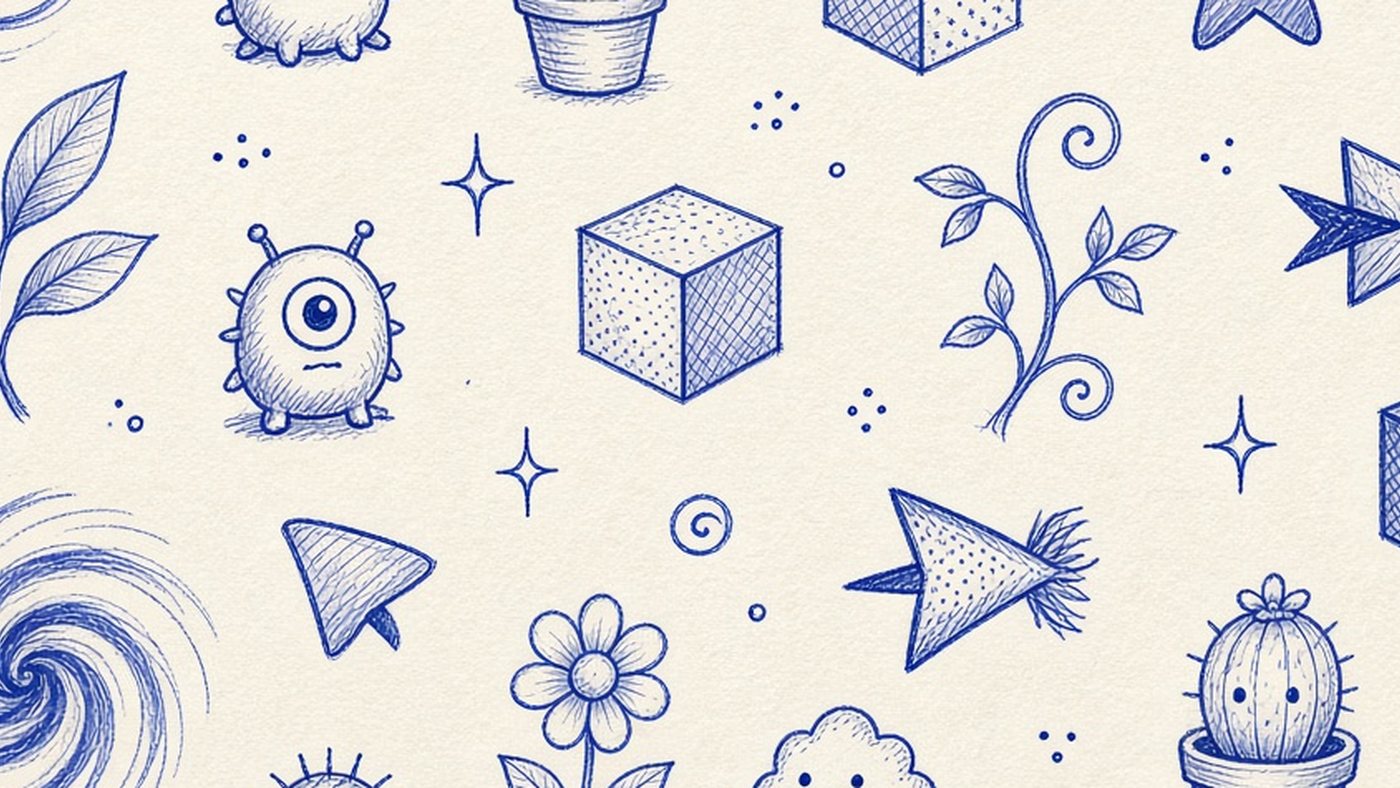
Divide the canvas into 12–16 cells and fill each with its own pattern: lines, waves, dots, scales. One cell is about a minute, and you can stop at any of them. Ways of laying down a stroke are covered in the article on hatching techniques.
Coloring pages and flat fills
A finished contour removes the heaviest part, inventing. What is left is choosing a color and filling areas, and that is almost mechanical. In the editor it helps to keep the contour on its own layer and paint underneath it. A similar format is described in detail in the piece on paint by number online.
Scribbles with no goal
Take a small canvas and one brush, and draw a continuous line without lifting the stylus. Let it tangle and cross itself. Then color the areas that appear in any colors you like. That is another ten calm minutes.
Tip
Build an emergency kit ahead of time: one open file at 800 by 800 pixels, one brush, and three colors. On an anxious evening you will not have to choose. You open what is ready and draw.
Rules with no pressure
The rules for calming drawing are the reverse of ordinary practice. There are no assignments, no deadlines, and no error review.
No assignments about the result
Do not set a subject, do not use a reference, and do not compare the work with anyone else's. Do not post these drawings: posting brings the viewer and the grade back. Put them in a separate folder, or delete them, whichever feels calmer.
Permission to stop whenever you want
Tell yourself ahead of time: you can close the file after two minutes, and that does not count as a failure. That permission removes the resistance at the door. The reverse rule helps too: if it is going well, do not force yourself to stop when the timer ends.
How to fit it into the day
What works is the thing you do not have to plan. Tie drawing to an evening ritual you already have.
Fifteen minutes in the evening
- Put the phone out of sight.
- Open the prepared file and put on a calm track.
- Set a timer for 15 minutes, but do not look at it.
- Fill a pattern or keep the line going, without judging the result.
- Close the file and do not open it until the next evening.
Drawing instead of scrolling
A swap works better than a ban: not "stop scrolling the feed," but "open a canvas instead of the feed." A phone works as well as a tablet for this. You can draw with a finger, as described in the article on drawing on a phone. For the first few days your hand will still reach for social media. After a week it gets easier.
Where this method stops
Be honest about the limits: drawing helps you wait out the tension, and it does not sort out the cause. It is a support tool, not a replacement for help.
What drawing does not fix
It does not solve a conflict at work, it does not clear debts, and it does not replace sleep. If anxiety holds for weeks, the issue is usually not a missing hobby. Drawing stays useful in that situation, and on its own it will not change anything.
When to see a professional
See a doctor or a psychologist if anxiety gets in the way of sleep and work for more than two or three weeks, if it is getting worse, or if it comes with thoughts of harming yourself. That is ordinary medical help, not a last resort. You can keep the practice. How to keep it going in a hard stretch is covered in the article on drawing motivation.
Time to draw, not just read
Theory fades in a couple of days if you never use it. Open the editor and spend 15 minutes on what you just read. That is enough for the skill to stick.
Try it now
A free online editor: brushes, layers, a palette, and a shared canvas. No install and no sign-up.
Start drawingTopics in this guide
- drawing for stress relief
- art therapy
- drawing for anxiety
- calming drawing
- meditative drawing
← Fear of sharing your art: how to start posting your drawings From hobby to career: how to start earning with your art →