
Step one: pause
Do not delete anything in the first minutes. Right now you are not seeing the piece. You are seeing how tired you are of it.
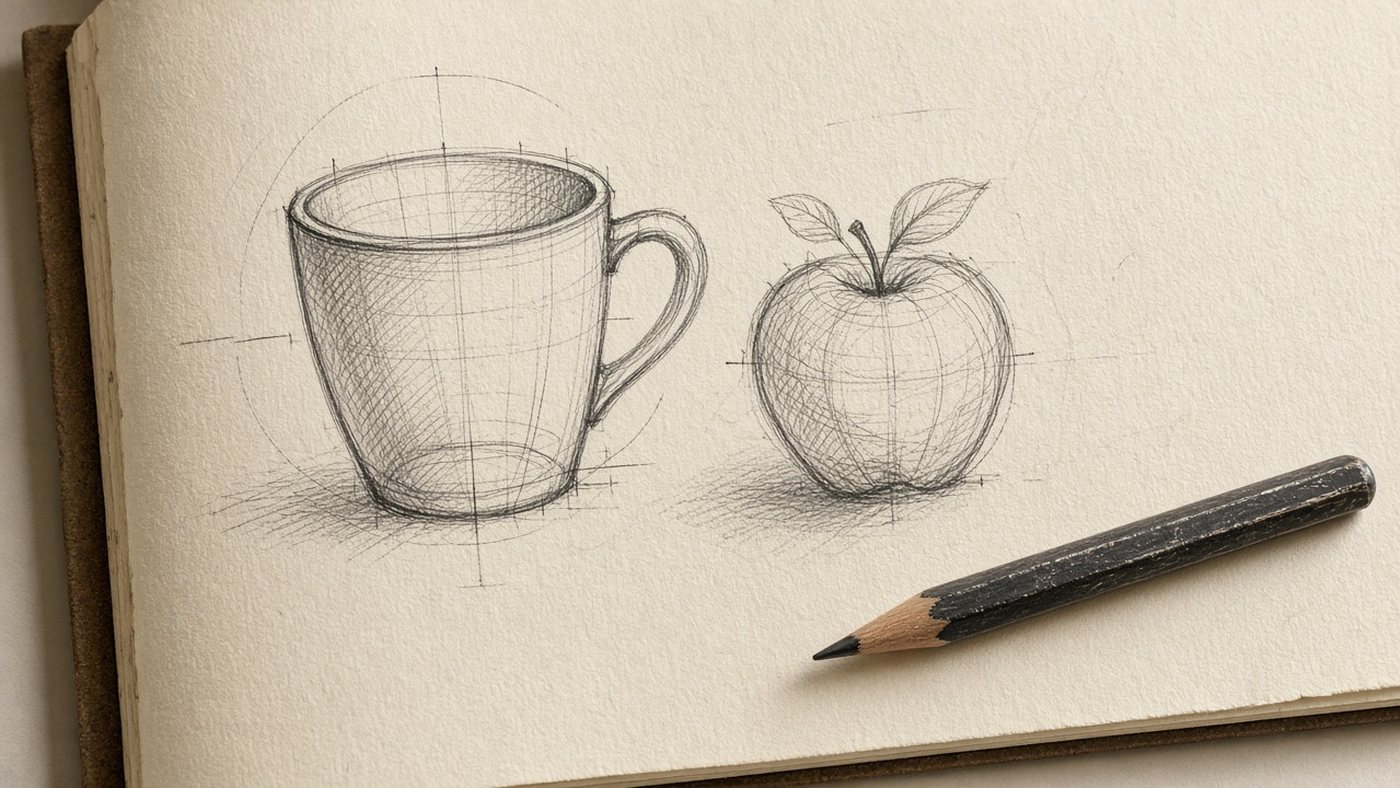
A tired eye
After two or three hours on one image, your brain stops noticing the whole and grabs at details. You fix the eyelashes while the whole portrait tips sideways.
Come back after a day
Close the file and do not open it until tomorrow. After 24 hours you will look at the piece almost like a stranger, and you will see the mistake in ten seconds.
Diagnosis
"I hate it" is not a diagnosis. It is a symptom. Three quick checks almost always show exactly where it broke.
A black-and-white check
Desaturate the image. If the picture falls apart into gray mush, the problem is value, not color. Color will not save a piece like that. Separate the light and the dark first.
Flip it horizontally
Flip the canvas. Your eye has gotten used to its own mistake, and in the mirror the mistake pops out at once: a skewed face, a tilted horizon, a crooked axis on the figure. Do this every 15 minutes, not only at the end.
Shrink it to a thumbnail
Shrink the piece to icon size, about 100 pixels. At that scale you only see composition and the big shapes. If the thumbnail does not tell you what was drawn, details will not help.
Common reasons it feels off
Nine times out of ten, one of three things is to blame. Check them in this order.
Weak contrast and gray mush
Every value collapsed into the middle range, and the piece looks muddy. Take three anchor values: nearly white, middle, and nearly black, and place them in different zones. How that works is covered in the guide on light and shadow.
A proportion mistake
The head is a bit too big, the hand is smaller than it should be, the eyes sit too high. Measure the main relationships by eye: the head fits into the height about seven times, and the eyes sit at the middle of the skull. Detailed landmarks are in the guide on proportions.
A composition with no center
Every object is equally important, and the eye has nothing to catch on. Pick one center of interest and give it the strongest contrast. Quiet the rest. A breakdown of the methods is in the guide on composition.
Rescue operations
Once you find the cause, try to fix it before you start over. Work on a copy of the layer so you can go back at any moment.
A tint and a correction
Lay a layer of one overall color on top and drop its opacity to 20 percent. Scattered colors will pull together. Then strengthen the contrast in the center.
Crop and reframe
Cut away the extra. A weak composition often becomes a good one if you remove a third of the canvas and move the center off the edge.
Add one accent
Add one bright shape, or the darkest spot, at the point that needs it. One spot of pure color covering a couple of percent of the canvas can carry the whole piece.
Common mistake
Edits stacked on edits with no new layer. An hour later you cannot get back to the version that was better. The rule is simple: before each rescue, duplicate the layer and name it with the attempt number.
When to quit
Sometimes the repair costs more than a new drawing. Admitting that saves time. It is not a defeat.
A mistake in the foundation
If the construction is broken, perspective, pose, or angle, painting over it is pointless. Those things do not get fixed from the top. You would have to redo the whole piece. It is more honest to close the file and start again, already knowing where you stumbled.
A lesson instead of a result
Before you close it, write one line about what went wrong: "I let the value collapse in the shadows," "I never checked the flip." That line is worth more than a saved picture. After ten pieces you will have a personal list of weak spots.
An archive instead of the trash
Deleting failures is the most popular way to throw away proof that you grew. Make a folder called "archive" and put everything in it.
Why keep the failures
- in six months you will see how far you have come;
- some of the "failures" will turn out to be perfectly decent pieces;
- the archive shows the mistakes that repeat;
- abandoned sketches become ideas for new work.
Review the folder once a month
- Open the archive and pick five pieces that did not work.
- For each one, name one main cause, not a list of ten items.
- Look for a repeat. If value fails three times, that is your topic for the month.
- Invent a 15-minute daily exercise for it.
- Take the unclear cases to feedback from other artists.
Time to draw, not just read
Theory fades in a couple of days if you never use it. Open the editor and spend 15 minutes on what you just read. That is enough for the skill to stick.
Try it now
A free online editor: brushes, layers, a palette, and a shared canvas. No install and no sign-up.
Start drawingTopics in this guide
- hate your own drawing
- a drawing that failed
- how to fix a drawing
- review your own mistakes
- what to do with a bad piece
← Stop comparing your art: measure last month, not other artists Finding time to draw: when the day has none →