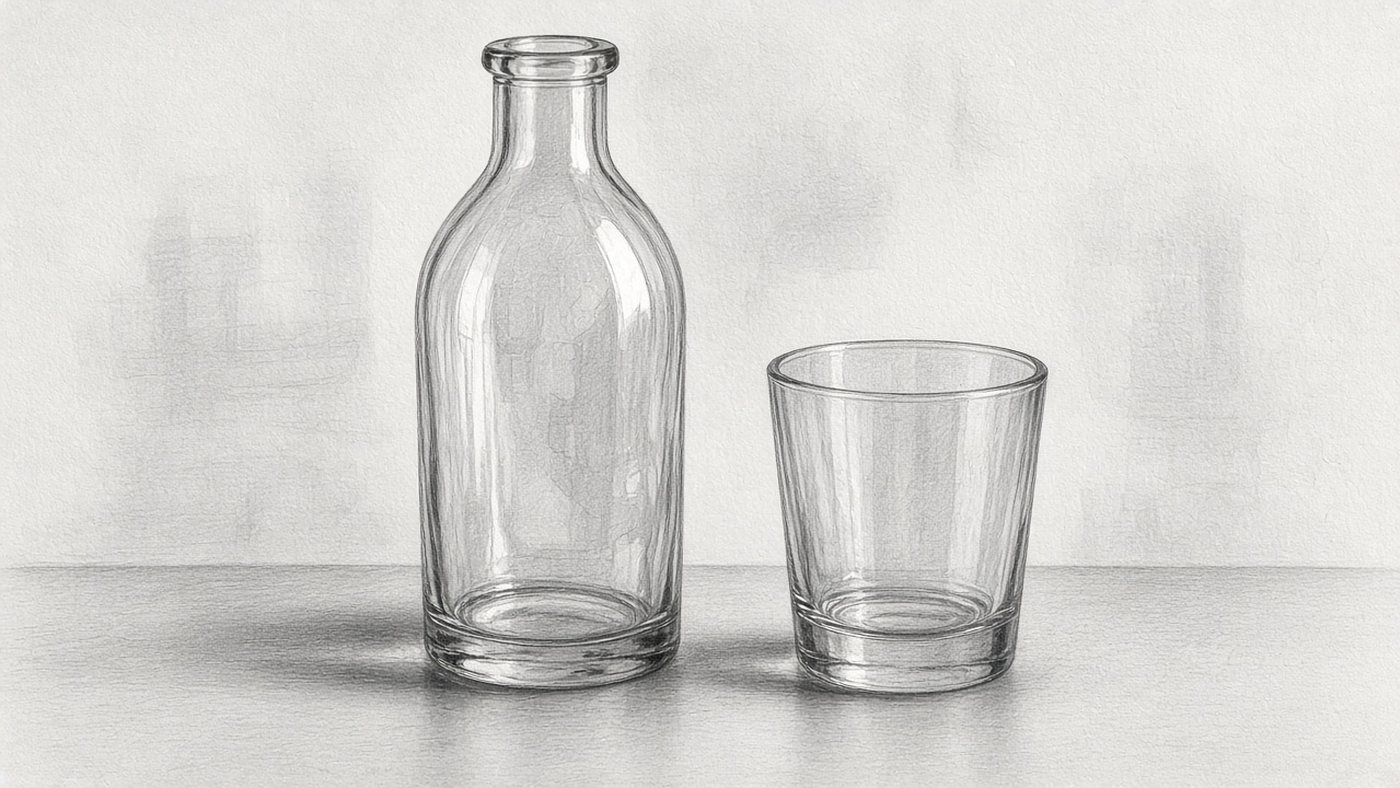
Glass is edges and holes
Glass has no glassy fill. It has an edge, a thickness, and a hole through which the background is still visible. A gray silhouette of a bottle is plastic. Transparency depends on the background remaining readable inside the contour. Those edges are easier to judge against the scale in light and shadow.
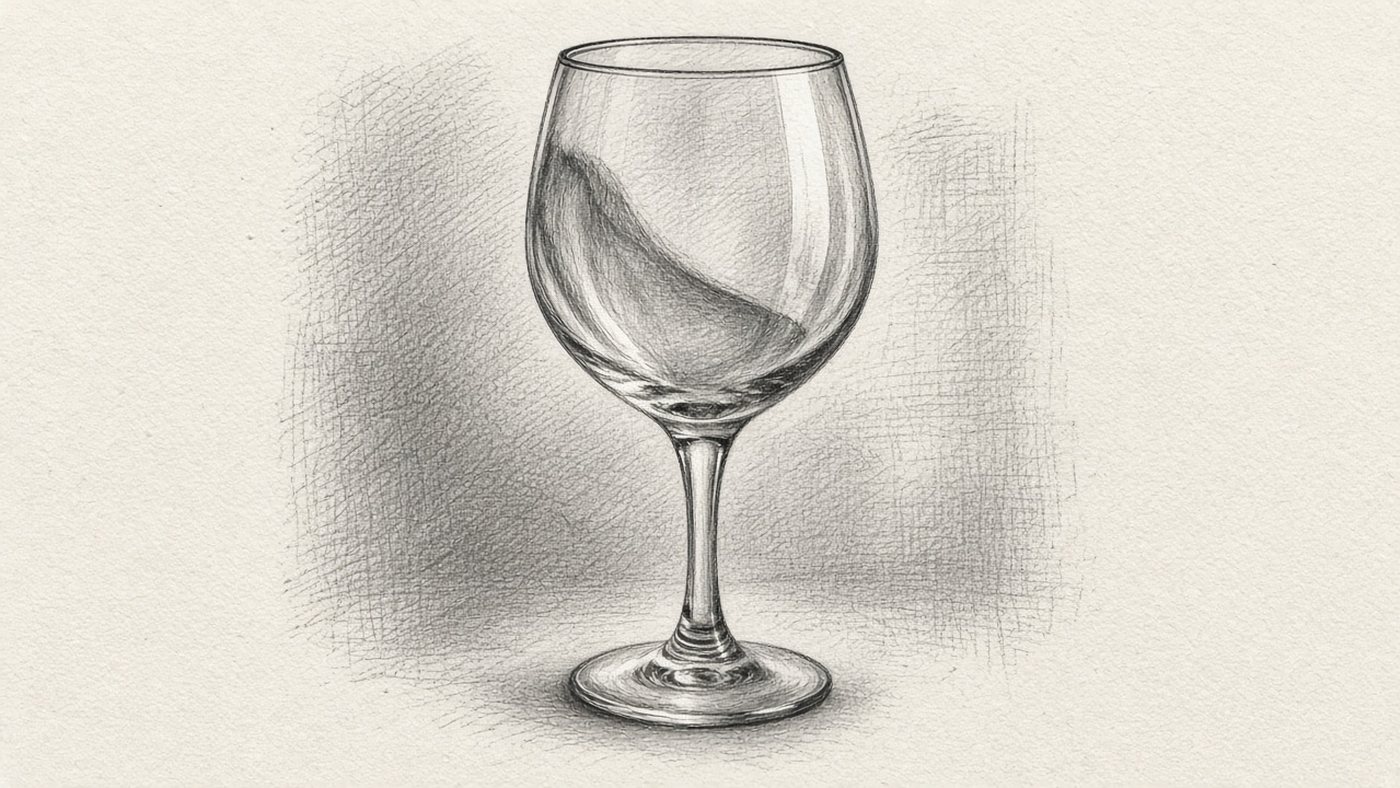
The ellipse of the rim
The rim is an ellipse, not a guessed oval and not a slit. The higher your eye, the rounder the ellipse. At eye level it is almost a line. Its axis is perpendicular to the axis of the bottle. A crooked ellipse breaks the glass even if the highlight is pretty.
A double contour
Thick glass gives two edges, outer and inner. Between them is a dark band of thickness. A thin tumbler has a narrow band. The bottom of a bottle has a wide one. One contour with no second line reads as wire, not as volume.
- Set the axis of the object and the line of the table.
- Draw the ellipse of the rim and the ellipse of the base.
- Join them with the outer edge.
- Add the inner edge where the glass is thick.
- Only then look for the highlight.
Highlights
A highlight on glass is hard. A soft white patch is already ceramic or skin.
One hard highlight
One main highlight beats a scatter of sparks. It sits on the light side and follows the curve of the wall. A second, weaker one can sit on the far edge as a reflection of the room. A third is noise.
Do not fill it all with white
Leave white for the highlight itself and maybe a thin rim. The rest of the glass is darker than the paper, because the background shows through and the background is rarely white. A fill “for shine” kills the transparency.
What shows through
The background does not vanish through glass. It shifts, and it darkens a little where the glass is thick.
The background shifts
A tablecloth line or the edge of a box behind the glass does not continue as a straight line inside the glass. It jumps. That jump sells the material. If the line runs through the tumbler like a thread, there is no glass. A nearby shift of color is discussed in color theory.
Wall thickness
At a thick base the background almost disappears: a dark ring. At a thin wall the background is almost the same, only shifted. Do not make the whole bottle equally cloudy.
- Ellipses on one axis.
- A double edge only where the glass is thick.
- One hard highlight. The rest darker than the paper.
- The background line inside the contour is shifted.
Check
Cover the highlight with a finger. If the object still reads as glass because of the double edge and the shifted background, the highlight was an accent, not the only evidence.
A bottle and a glass together
Two glass objects side by side are useful because their thickness differs. Matching highlights on both are a stamp.
One table line
Both stand on one plane. The ellipses of the bases share one perspective: the farther one is shorter vertically if the table recedes. Different tilts of the bases mean the objects came from different photos.
Different glass thickness
A bottle is darker at the base and in the neck. A tumbler is lighter and thinner. The bottle's highlight is narrower. The tumbler's can run longer down the wall. Do not copy one highlight onto the second object.
Time to draw, not just read
Theory fades in a couple of days if you never use it. Open the editor and spend 15 minutes on what you just read. That is enough for the skill to stick.
Try it now
A free online editor: brushes, layers, a palette, and a shared canvas. No install and no sign-up.
Start drawingTopics in this guide
- how to draw glass
- drawing a bottle
- highlight on glass
- ellipse of a rim
- transparent object
← How to draw water and reflections How to draw an ear that sits on the head →