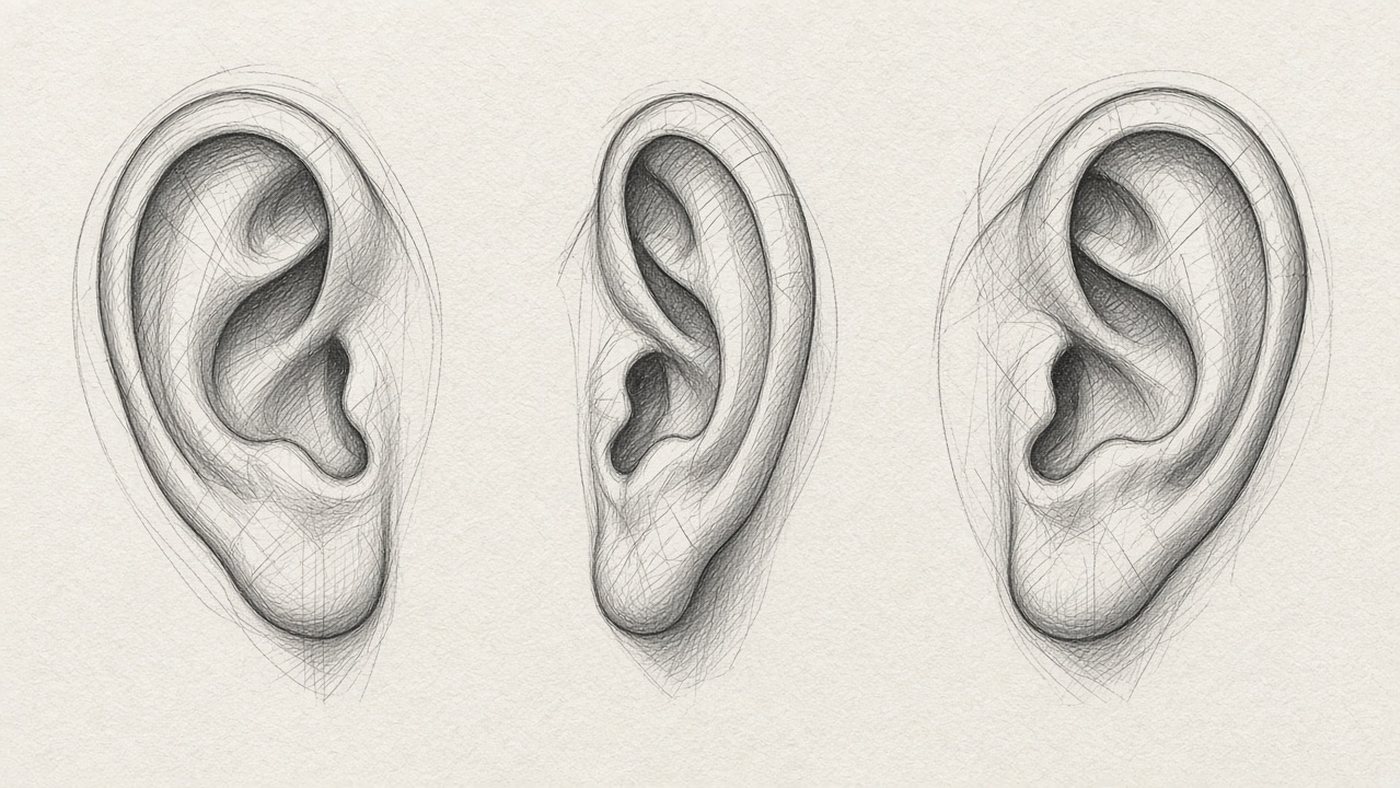
Where the ear sits
The ear is not “somewhere on the side of the head.” In profile its top sits near the brow line, its bottom near the base of the nose, and its front edge does not climb onto the cheek. Glue it to the cheekbone and the head goes flat. That seat belongs to the whole construction, as in how to draw a portrait.
From the brow to the base of the nose
Carry a horizontal back from the brow and from the base of the nose. The ear lives between those two lines. A particular person sits a little higher or lower, but the start is always that gap, not the middle of the neck.
Not on the cheek
There is a cheek between the wing of the nose and the ear. The ear begins where the head turns toward the back. If the ear is drawn on the same plane as the eye, you are looking at a symbol, not a volume. A simple check: from the outer corner of the eye to the ear there should be about an eye's width of cheek.
- Mark the brow line and the line of the base of the nose.
- Place the ear's box between them, closer to the back of the head.
- Leave the cheek empty.
- Only then look for the helix.
Three parts
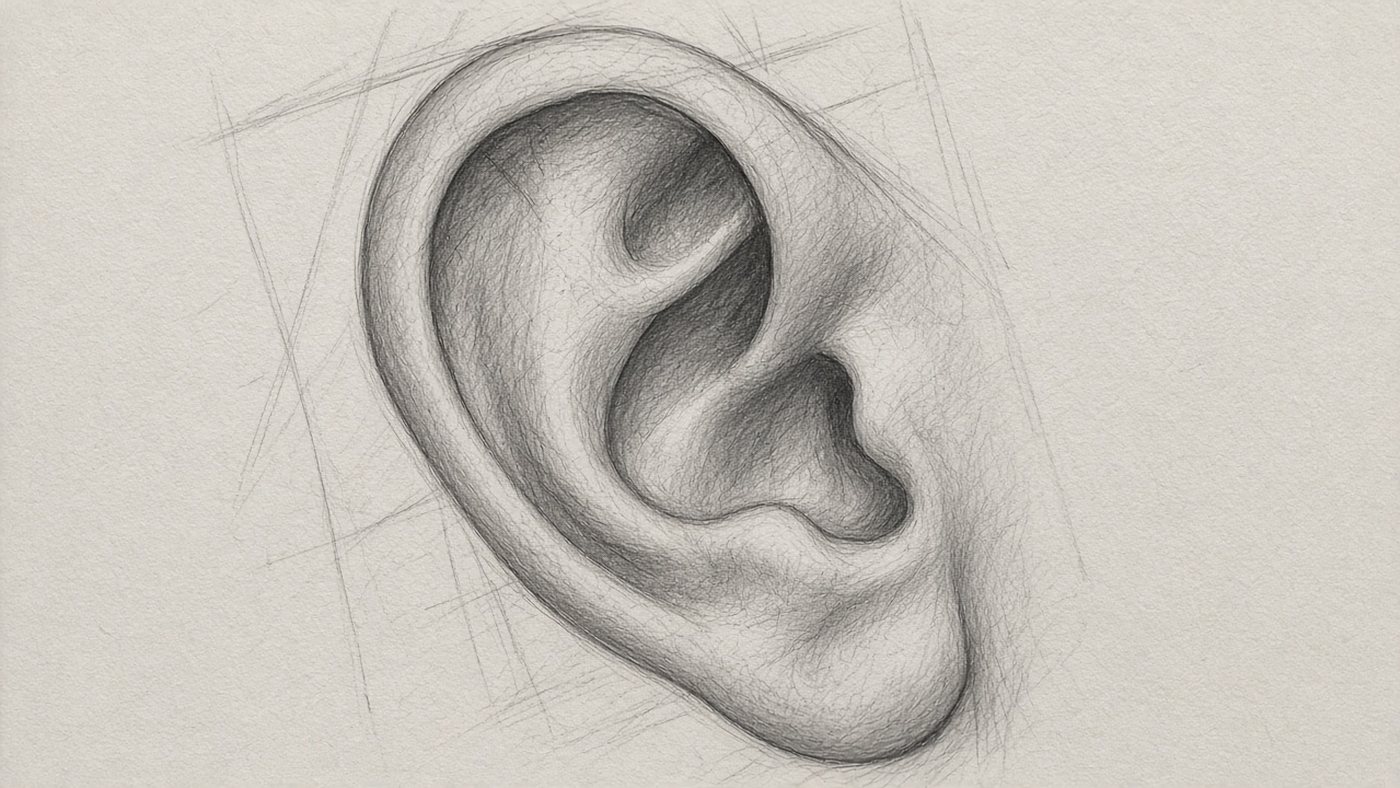
An ear is a rim, an inner ridge, and a lobe. Everything else is the gaps between them.
Helix, antihelix, lobe
The helix is the outer rim. It starts at the top and runs down toward the lobe. The antihelix is the ridge inside, a Y if you look closely. The lobe is the soft bottom with no cartilage, lighter and simpler. You do not need every fold if these three read.
The hollow in the center
The center is darker than the rim. That is the hollow where shadow sits. The darkest note is usually a small spot at the opening, not a hole through the head. If the center is as light as the cheek, the ear is a sticker. The volume of the head around it is in anatomy for artists.
The ear in three-quarter view
On a three-quarter turn the ears stop being twins.
The near ear is larger
The near ear is almost fully visible and it is larger than the far one. The rim reads, and so does the lobe. Do not shrink it for symmetry.
The far ear almost disappears
The far ear hides behind the cheek. Often only a piece of rim shows, or nothing, if the turn is strong. Drawing a second matching ear turns the head back to a front view while the face is still three-quarter.
- Top of the ear near the brow, bottom near the nose.
- A cheek remains between the eye and the ear.
- Three parts: rim, inner ridge, lobe.
- On a turn, the far ear is smaller or hidden.
Check
Cover the face and leave the ear. If it looks like a question mark or a hook, the parts are missing: there is no hollow and no lobe, only the outer curve.
Common mistakes
Two mistakes show up more often than fine anatomy. Both are fixed by comparison, not by a new lesson on folds.
A hook instead of an ear
A hook is one contour with no inner ridge. Add a second line inside and a dark spot at the opening. The ear becomes an object instead of a squiggle.
Matching ears on a turned head
On a front view the ears are similar, but even then the one nearer the light is lighter. On a turn they also differ in size. Check both against the brow and nose lines. If one has slid onto the neck, the pair is already broken.
Time to draw, not just read
Theory fades in a couple of days if you never use it. Open the editor and spend 15 minutes on what you just read. That is enough for the skill to stick.
Try it now
A free online editor: brushes, layers, a palette, and a shared canvas. No install and no sign-up.
Start drawingTopics in this guide
- how to draw an ear
- ear on a portrait
- ear structure
- three-quarter ear
- ear drawing mistakes
← How to draw glass: edges, thickness and highlights How to draw feet and simple shoes →