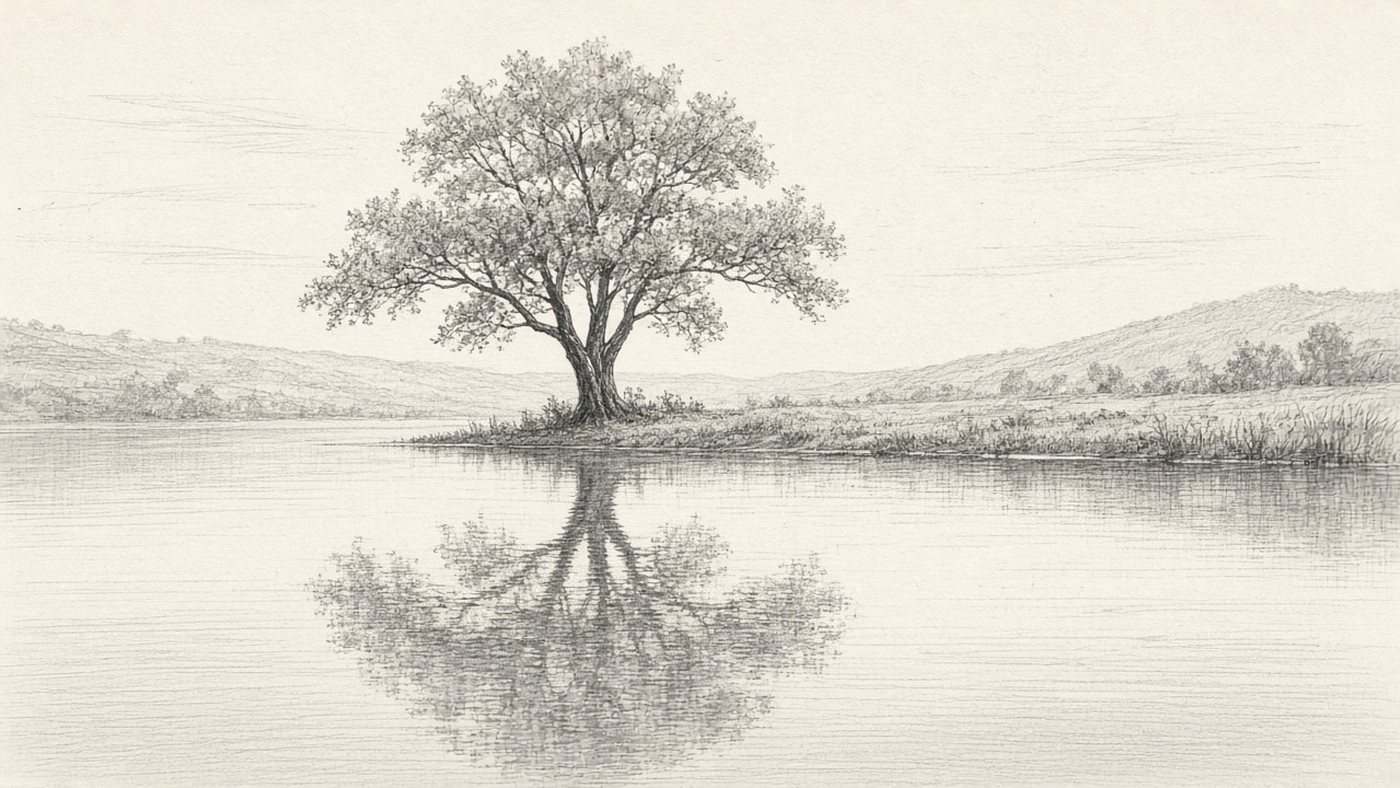
A reflection is not a copy
A second tree under the first is the usual miss. The reflection is about one value step darker than the object, and often shorter, because you look at the water at an angle rather than straight down. How the plans around water are built is in how to draw a landscape.
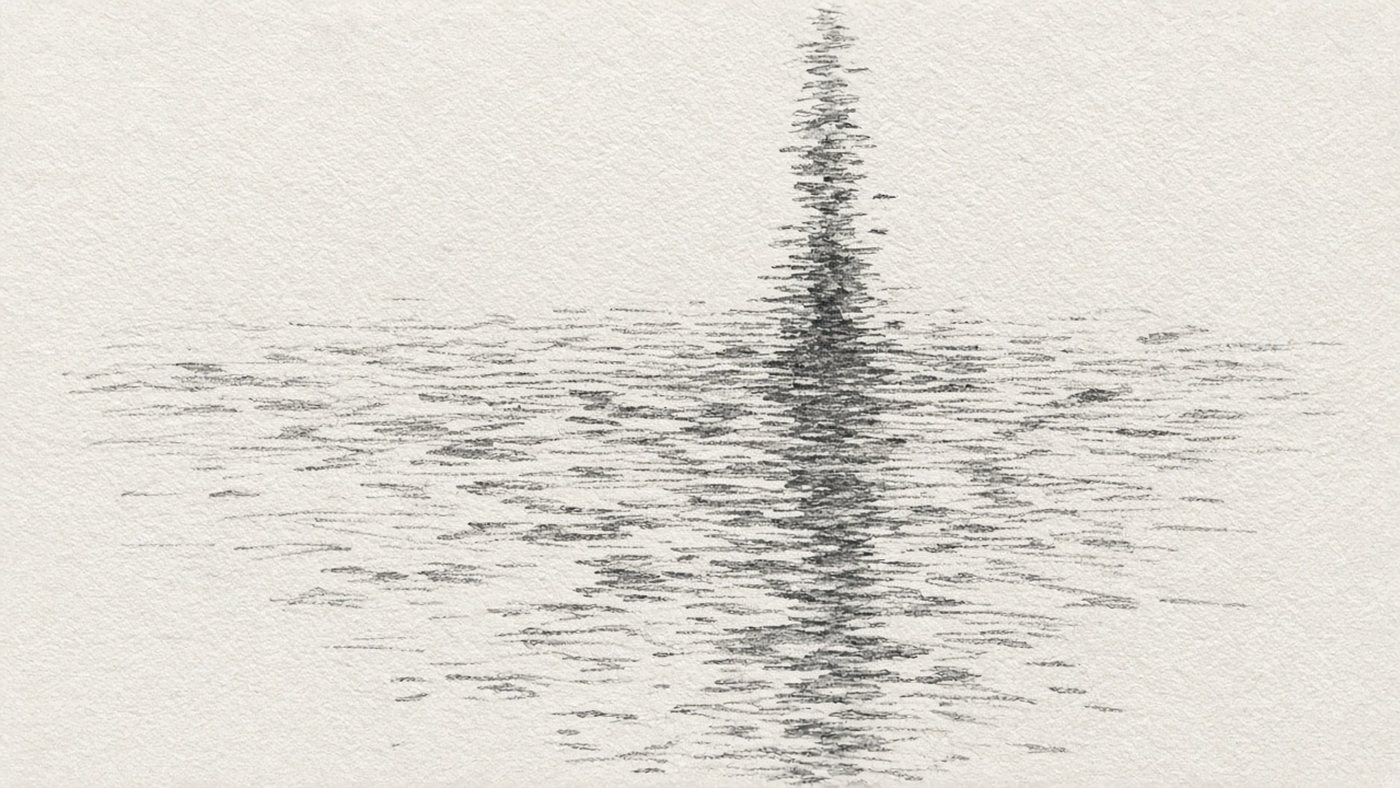
It is darker and shorter
A bright sky darkens in the reflection. A dark trunk stays dark, but it does not become a black copy. Measure the height from the line where the object meets the water, not from an identical treetop. If the bank is high, only the lower part of the object reaches the water.
A vertical becomes a horizontal
The stroke on water lies horizontally, even when the object is vertical. The object's verticals stay vertical as directions, but you build them with horizontal touches of the pencil. Otherwise the water reads as glass, not as a surface.
- Mark the bank or the edge of the water.
- Note which part of the object actually reaches the reflection.
- Make the reflection one step darker than the object.
- Build it with horizontal strokes.
- Stop the bottom. Do not chase symmetry.
Still water
Calm water is the honest test. If the reflection is wrong here, ripples only hide the error.
A mirror under the bank
Draw the object and the edge first. The reflection is built downward from that edge. Do not paint the gap between object and reflection as water in advance. It may be bank, a boat, or a lighter strip.
Where to stop the reflection
A reflection rarely reaches the bottom of the sheet. Distance, murk, or the shadow of the near bank kills it. End it softly. A hard stop reads as a hole.
Ripples
Ripples break a reflection. They are not a scale pattern across the whole lake.
Short horizontal strokes
The stroke is shorter than it looks. A long wave across the sheet is swell or weather, not a breeze. Leave paper between the strokes: those are the glints on the crests. Value here works like any other light, as in light and shadow.
What disappears first
Thin verticals go first: a mast, reeds, the edge of a roof. Wide shapes, a hull or a dark tree, last longer, but they break into bands. If every twig survives the ripples, there is no ripple. There is a second drawing of the tree.
- The stroke is horizontal and shorter than the object.
- Light paper remains between strokes.
- Thin details die before wide masses.
- Strokes get larger toward the foreground.
Check
Turn the sheet upside down. The reflection should not become as sharp and light as the object. If it does, it was a copy, not water.
Transparency
Shallow water shows the bottom. Deep water shows the sky. They are different drawings. Do not mix them in one puddle with no boundary.
The bottom shows in the shallows
Near the bank, where the depth is ankle-high, draw stones and sand. Their value is a little cooler and softer than dry stones beside them. Farther out, less bottom and more reflection.
Water is not the color of the sky
Even in a reflection the water adds its own note, a little greener or browner from local murk. A pure sky pasted into the water looks like a sticker. One shift is enough. You do not need a special sea paint if it is not in the box.
Time to draw, not just read
Theory fades in a couple of days if you never use it. Open the editor and spend 15 minutes on what you just read. That is enough for the skill to stick.
Try it now
A free online editor: brushes, layers, a palette, and a shared canvas. No install and no sign-up.
Start drawingTopics in this guide
- how to draw water
- reflection in water
- drawing ripples
- lake sketch
- transparent water
← Gesture drawing: how to catch a pose in 30 seconds How to draw glass: edges, thickness and highlights →