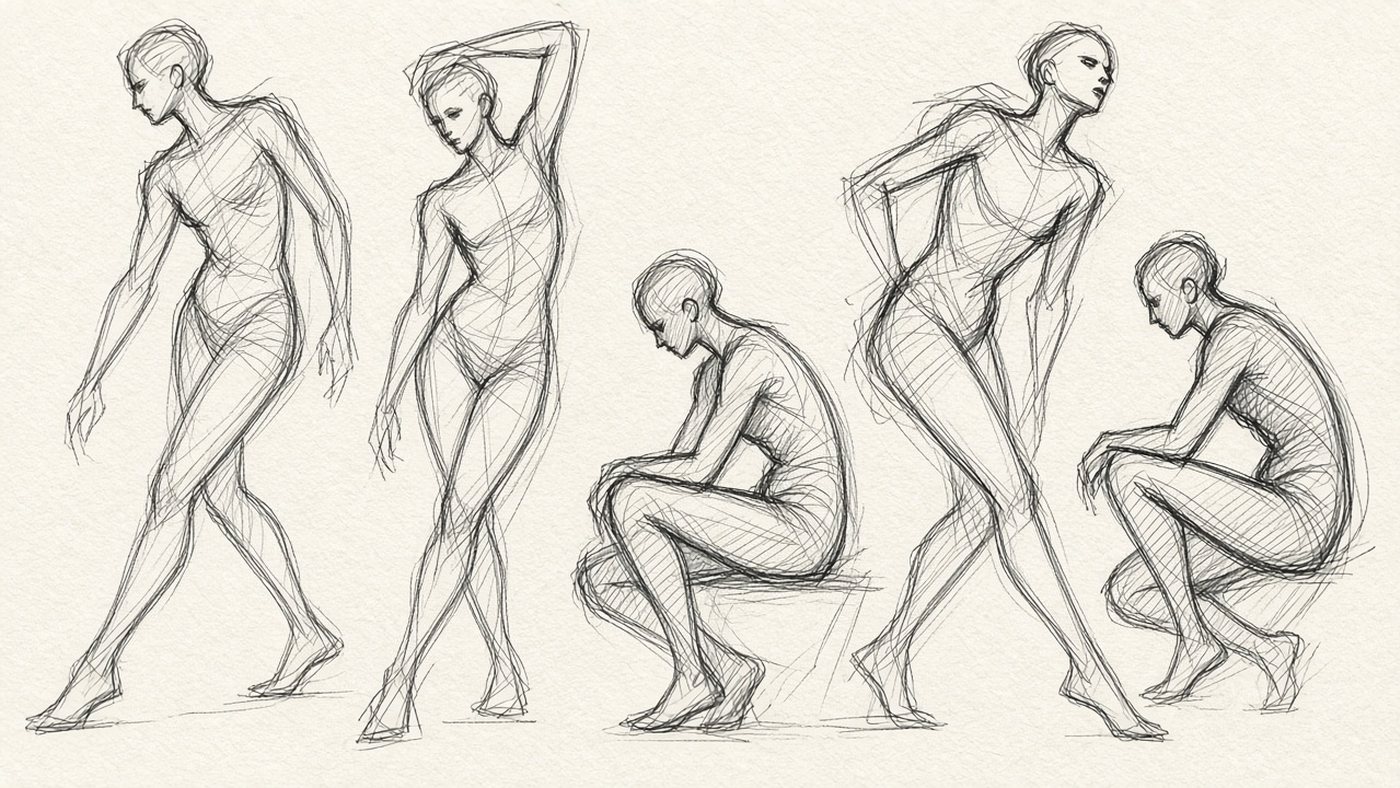
Why a 30-second gesture
A long drawing of a person starts with the pose, not the face. If the pose is wrong, matching the eyes will not fix it. Thirty seconds forces one choice: which way the body leans. How the standing leg and the height of the figure fit together is covered in proportions.
What fits in half a minute
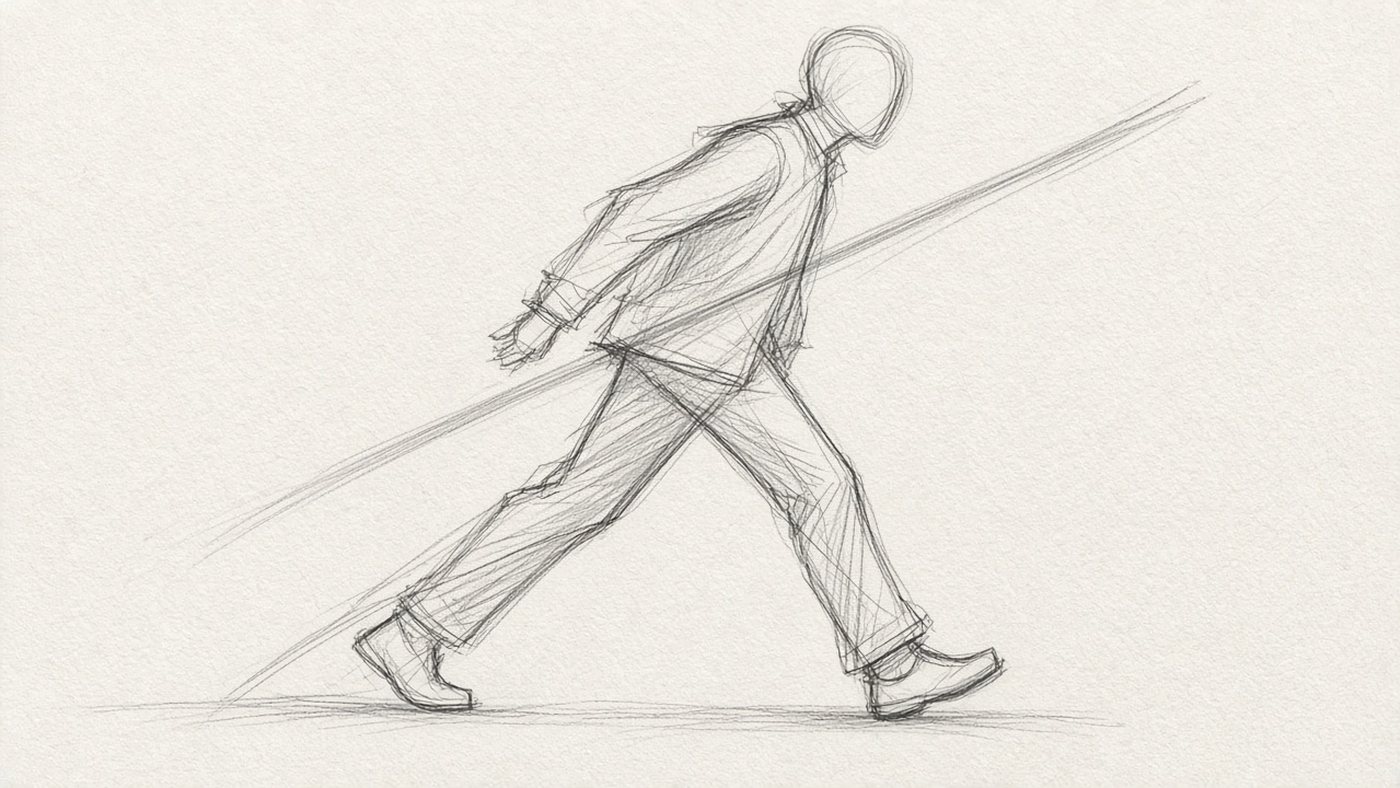
Half a minute holds two things: a line through the whole body and a note of weight. The line runs from the head to the standing foot, even if it is crooked. The weight sits where the body is thicker, usually the pelvis and the ribcage. Fingers, folds and the face do not fit into these 30 seconds.
- Look at the pose for two seconds before you draw.
- Put down one line of action from the crown to the standing foot.
- Mark two volumes: chest and pelvis.
- Note which leg carries the weight.
- Stop, even if you want to finish it.
Why the head can wait
The head occupies you because likeness lives there. In a gesture it is a small oval at the end of the line. Start with the eyes and the timer ends on a portrait with no body. The pose was never recorded.
Timer and page
One gesture trains nothing. You need a stack of them. A timer ends the argument about “one more second on the hand”.
30, 60 and 120 seconds
Thirty seconds is the line and the weight. Sixty adds the limbs as simple axes, with overlap where an arm passes the torso. One hundred and twenty can clarify the silhouette and one fold of clothing. Past two minutes this is no longer a gesture. It is a short drawing, and the rules change.
Ten poses on one sheet
Ten poses on one sheet stop you polishing the first. When a pose ends, move to the next box. Compare them at the end, not after each one. A slower study session is described in drawing basics.
- Divide the sheet before you start.
- One pose, one box, no overlapping.
- Do not erase a miss. Start the next one cleaner.
- At the end, mark two gestures where the weight reads without a caption.
Check
Close the drawing for ten seconds and open it again. If you cannot tell which leg the person stands on, the gesture is not done, even if the contour is neat.
What to catch in the pose
A pose is a direction and a support. Everything else can wait for the long session.
The line of action
The line of action is not a bone-by-bone spine. It shows where the body wants to fall or push. Walking is a diagonal. A seated person often breaks at the pelvis. A vertical line on a leaning person is a mannequin.
Weight on the standing leg
The standing leg is thicker at the thigh, and the foot under it sits nearer the center of the mass. The free leg is lighter and often bent. If both legs match, the person is hanging. On a gesture, one darker pass of the pencil on the standing leg is enough.
Moving it into a long drawing
The gesture is not the finished piece. Move it onto the large sheet while the line is still visible.
Do not trace the gesture
Tracing turns a search into a fence. A contour belongs where the form turns away from the light, not around the whole silhouette at once. First copy the line of action and the two volumes at the same tilt. Then grow the edges.
Keep the line of action
Do not erase the line of action until the middle of the work. It holds the tilt while you are busy with a knee or a hand. Erase it at the end if it fights the finished silhouette. Until then it is more useful than a clean page.
Time to draw, not just read
Theory fades in a couple of days if you never use it. Open the editor and spend 15 minutes on what you just read. That is enough for the skill to stick.
Try it now
A free online editor: brushes, layers, a palette, and a shared canvas. No install and no sign-up.
Start drawingTopics in this guide
- gesture drawing
- 30 second pose
- line of action
- figure gesture
- how to draw a gesture
← Transferring a Drawing: Grid, Window, and "Is That Cheating?" How to draw water and reflections →