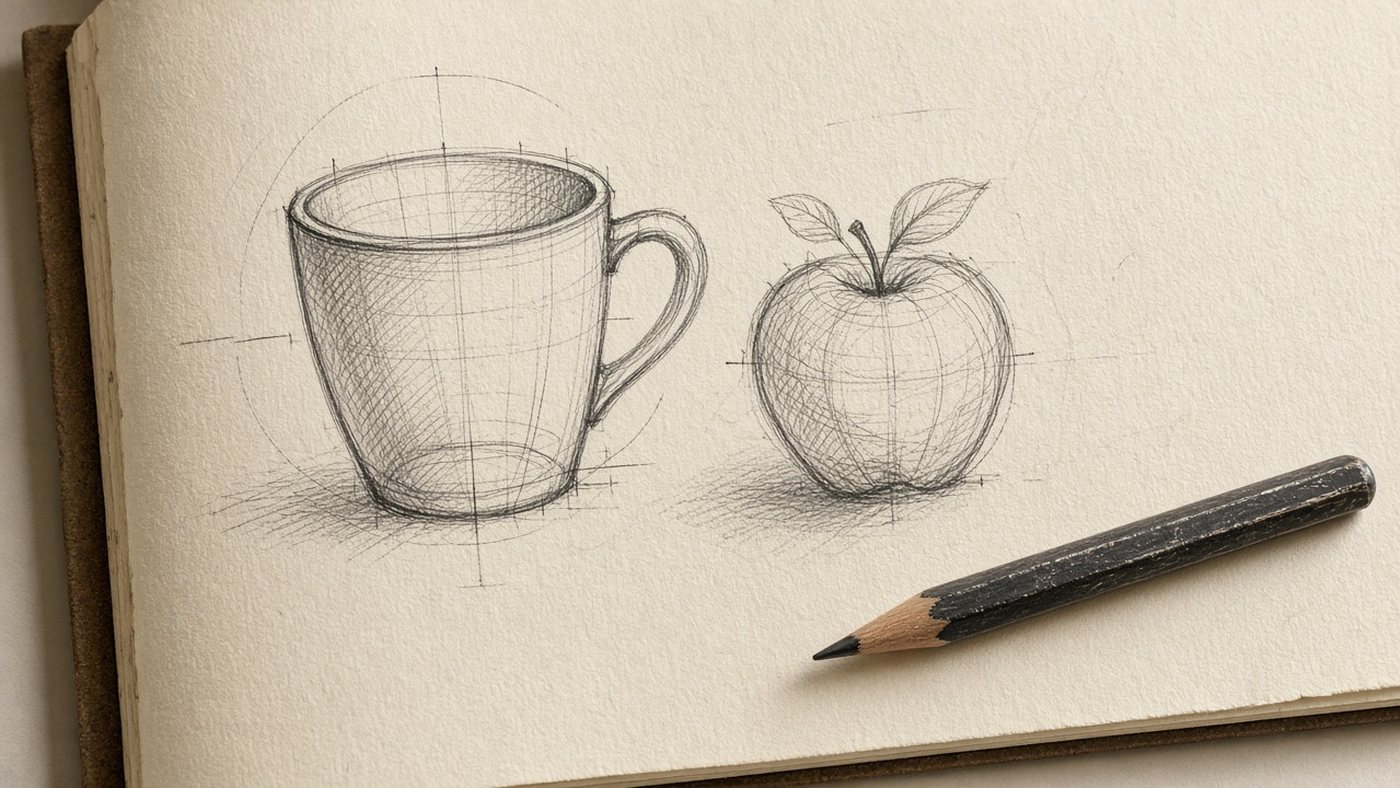
Why progress is hard to see
Growth is invisible from the inside because it is spread across weeks and moves in small steps. You see your work every day and get used to its level. You can notice a shift only by comparing it with a specific point in the past.
The journal is that point. It stores facts, not impressions: what you drew, how long it took, and what came of it.
The bar rises with your skill
The better you draw, the more mistakes you notice in your own work. Six months ago you did not see the proportions fall apart. Now they jump out. So being unhappy with yourself often means your eye has grown, not that you are stuck.
Memory cleans up old work
The brain remembers past drawings as better than they were: the failed details get erased, and the overall impression gets smoothed out. That is why it feels like you drew about the same a year ago. Open an old folder and the picture changes in a minute. More on this effect is in the article on imposter syndrome.
What to write down
The journal should take five minutes a week, or you will drop it. No long essays: three or four lines per session. Write after you work, while you still remember what got in the way.
Date, task, and time spent
The first line is dry facts. For example: "Sep 12, hands from reference, 25 minutes." After a month those lines show how often you actually worked, not how often it feels like you did.
What worked and what did not
The second and third lines are specifics, without grades like "bad" or "awful." Phrase it through a detail: "I put the thumb in the wrong place," "the shadow values collapsed." Those notes later turn into assignments for the week.
A one-line takeaway
The last line is what to do next time. One action, not a list: "build the palm as a box," "start with two value shapes." A finished example looks like this:
- date and time: Sep 12, 25 minutes;
- task: ten hands from a photo;
- what worked: the silhouette and the overall mass of the palm;
- what did not: finger length, the thumb;
- takeaway: the next 10 start with the palm as a box.
A before-and-after format
Text helps you think, but pictures are what convince you. Pairs of pieces a few months apart do more than any sentence.
Folders by month
Make folders named like "2026-09" and put everything in them, with no filtering, including abandoned sketches. Name files by date and subject: "12-hands-reference." Do not delete the failures. They give the clearest contrast.
A collage once a quarter
Every three months, put nine pieces from the quarter on one canvas: three early, three from the middle, three recent. Put them on separate layers so you can change the order. That collage also prepares material for next month's drawing practice assignments.
Tip
Photograph or save any five of your pieces today and label the folder with the date. That is your zero point. In three months you will have something to compare. Without it, you will be comparing from memory again.
Redraw the same piece
The most honest test of progress is to draw the same thing again. The conditions should match: the same subject, about the same time limit, and no peeking at the old file.
The same subject at 3 months and 12 months
- Pick a benchmark piece: a portrait, a character, or a landscape from a photo.
- Write down the conditions: the reference, the time, the canvas size.
- Set a reminder for a date three months out.
- On the redraw day, draw right away, without opening the old version.
- Only then put the pieces side by side and compare them.
Compare specific points
A general "it got better" tells you nothing. Compare four or five things: proportions, value, how clean the line is, composition, and speed. For each one, say what changed. A list of typical problems for that check is in the piece on beginner drawing mistakes.
A review once a month
A journal with no review turns into an archive nobody reads. Set aside twenty minutes at the end of the month and go through the notes.
Three questions to ask yourself
Ask yourself: what got easier, which mistake repeats most often, and what kept you from sitting down to work. Write the answers short, one line each. The repeating mistake is the subject of the next month.
Adjust the plan
After the review, change one thing, not everything: the subject, the length of the session, or the number of pieces. If the whole month fell apart, cut the minimum in half and do not look for someone to blame. How to rewrite tasks to match the facts is covered in the article on drawing goals.
Time to draw, not just read
Theory fades in a couple of days if you never use it. Open the editor and spend 15 minutes on what you just read. That is enough for the skill to stick.
Try it now
A free online editor: brushes, layers, a palette, and a shared canvas. No install and no sign-up.
Start drawingTopics in this guide
- artist progress journal
- how to track drawing progress
- before and after drawings
- redraw the same piece later
- artist self-review
← Where to find inspiration: 12 sources of drawing ideas Fear of sharing your art: how to start posting your drawings →