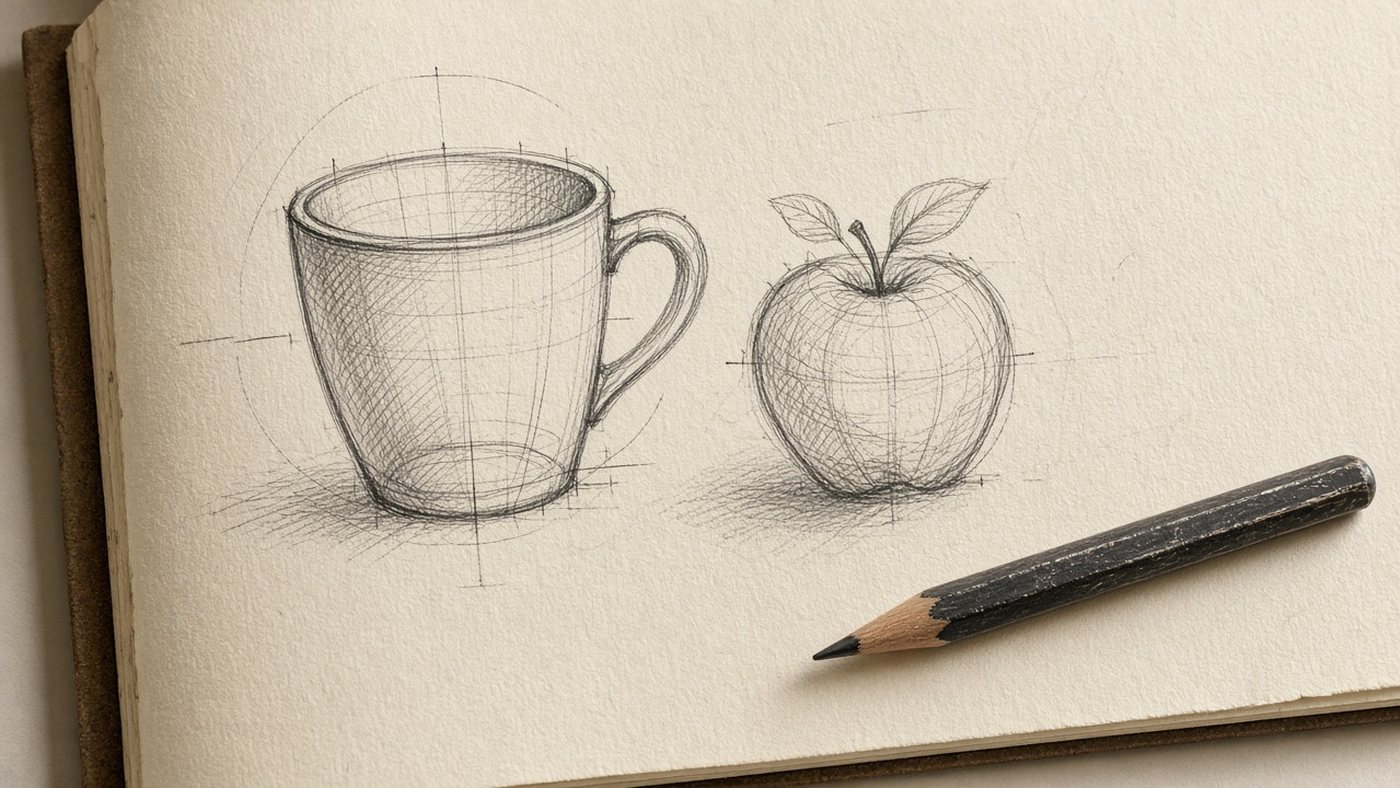
Sketchbook format and tools
A year-long sketchbook starts not with page one, but with a format you will actually put in your bag. I have seen dozens of “perfect” notebooks sitting on a shelf: too big, too expensive, with paper you are “afraid to ruin.”
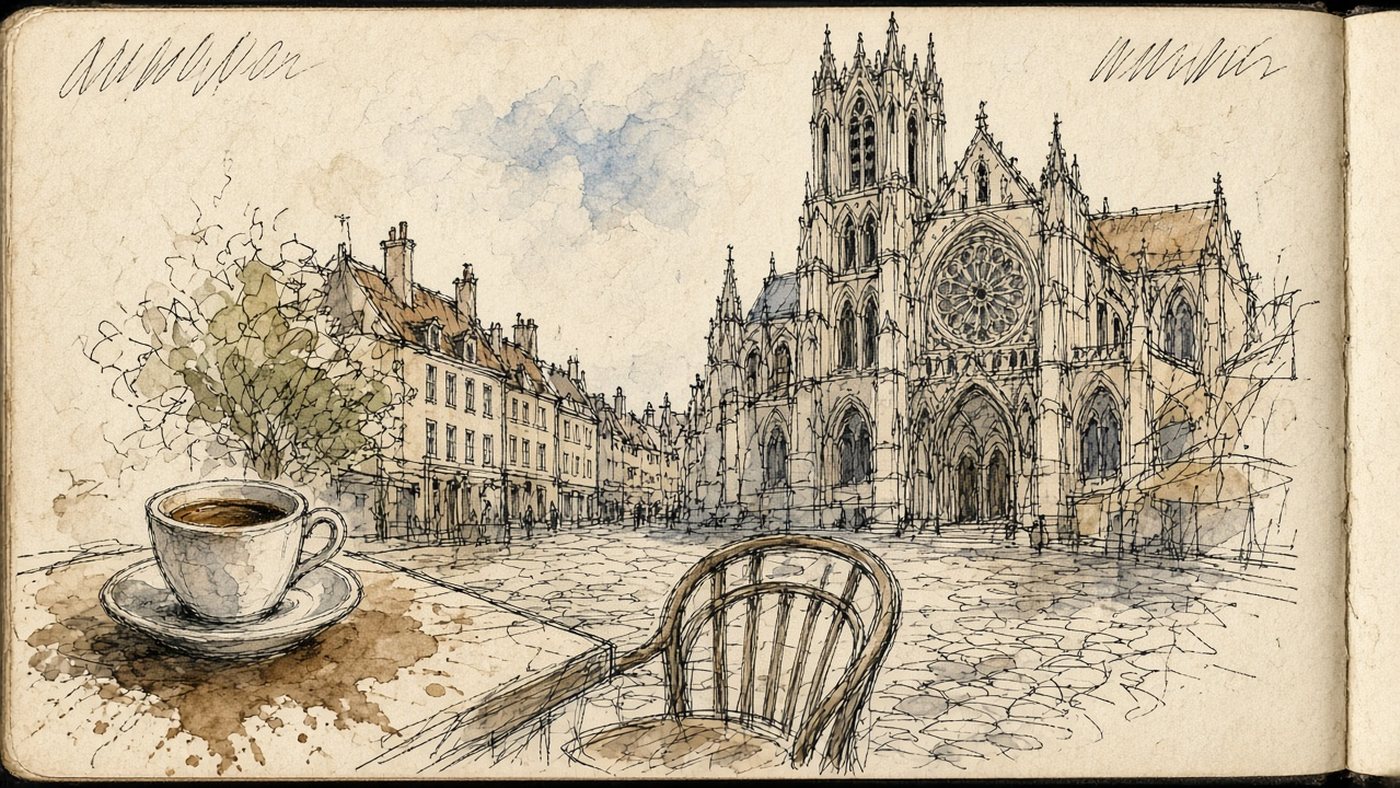
A 52-week plan holds if the entry bar is low: one pencil, a notebook you are not afraid of, a place in the backpack. The rest — markers, watercolor, liners — add after the fourth filled week, not sooner.
A5 vs A4
A5 is easier to carry and faster to fill psychologically: the page feels doable. A4 gives the shoulder room and wide strokes, but it stays home when you are tired after work.
For a year-long plan I recommend portrait A5: one theme — one page or spread, with no pressure to “fill a canvas.” If you only draw at home and love detail — A4, but then lower the expectation for how many themes you do in a month.
Compare two trial spreads in a shop or at a friend’s: take the format where the line feels more natural. Not the one that “looks better on Instagram.”
The digital analog of A5 is a canvas 1500–2000 px on the short side; larger on a phone wears you out in navigation. More on the digital format is in the piece on a digital sketchbook.
If you are unsure, buy an inexpensive 52-sheet A5 and keep a backup in an app at the same time. In a month it will be clear which way the hand leans.
Binding
A spiral binding lies flat — good for left-handers and for working on both sides. A hard cover protects the bag, but it is heavier.
A stitched notebook feels nicer to draw in, but the spread does not always open to 180° — factor that in if you plan watercolor across the gutter.
On a year-long marathon the brand matters less than the notebook still holding together by November. Check the corner: bend the cover, tug a sheet — does it tear out at once?
One year I kept a ring-bound sketchbook: I inserted hole-punched A5 sheets. A missed week I closed with an empty collage — flexible, but it is easy to “reorganize” instead of drawing.
Pick one binding and do not change it through the 52 weeks — otherwise comparing progress page to page becomes meaningless.
One pencil to start
HB or 2B covers 90% of a year-long plan: contour, shadow, the date text. A set of twelve graphite grades at the start distracts you into choosing hardness.
For the first eight weeks draw only in graphite — that way you see the line grow without being “saved” by color. Add color in week nine as one accent, not a full palette.
Keep the pencil freshly sharpened: dull graphite slides into fuzzy forms, and you will blame “no talent.”
If you work in the browser — one “pencil” brush, black, no textures. Do not touch the brush settings until the end of the month.
One tool speeds up the start on days when the theme feels boring: fewer decisions, more chance you will open the notebook.
52 weekly themes
Fifty-two themes are not a list of “draw a dragon.” They are a calendar of small observations. Each week is one prompt you can finish in 30–60 minutes or in two 20-minute evenings.
I split the themes into three blocks: daily life, trips/museums, fantasy. Daily life anchors you in reality, travel widens the eye, fantasy takes the pressure of realism off.
Daily life and people
Weeks 1–18: breakfast, shoes by the door, hands in motion, a face in profile (a photo is fine), the window from the room, groceries in a bag, the elevator mirror, a cat/the neighbor’s dog, a pharmacy queue, the desk, a cup with a stain, keys, a door handle, stairs, a trash bin, a bicycle in the yard, rain on glass, a delivery package, the neighbor’s balcony.
Write the prompt specifically: not “people,” but “a person’s back in a queue, three silhouette lines.” Specifics walk around the freeze.
You do not have to show people by the face — a gesture or clothing is enough. That lowers the fear that “the portrait does not look like them.”
Daily-life themes repeat every day — you can return to “breakfast” in six months and compare the line. That is part of the progress journal.
If the week fell on being sick — draw the medicine on the nightstand: still daily life, still a checkmark.
- one theme = one date in the corner of the page;
- no more than two colors before week 20;
- a phone photo as reference is a tool, not a shame;
- bored — add the constraint “silhouette only.”
Travel and museums
Weeks 19–35: a train station, a suitcase, the view from a train window, a map, a souvenir, a museum vitrine, a statue (contour), a building facade, a market, a café in another city, a street musician, a beach/river, distant mountains, a bridge, a taxi, an airport, a hotel room, a museum bench, a label in a language you do not know.
You do not have to go far: a “trip” can be a neighborhood you have not walked, or a museum in your own city.
In a museum, draw fast, no flash and without blocking the aisle: one object, five minutes, then move. Security and ethics — respect the room rules; often a pencil and no tripod is fine.
A link for inspiration without copying: where to find inspiration — and there, too, the ethics of looking rather than photographing every work.
If there is no trip — draw a ticket, a route on a map from the internet (as a composition), or a souvenir from a past trip.
Fantasy without pressure
Weeks 36–52: an object with legs, a house on a cloud, a robot cup, a tree with eyes, a map of a city that does not exist, a cover for a book that does not exist, a monster from three household objects, a costume from what is at hand, transport of the future, a portal in the wardrobe, a fish in the sky, a rocket boot, a New Year card early, a hybrid of a plant and a tool, a legendary pet, food with a personality, weather as a character, “if I were an object,” finale — a free page “what changed this year.”
Fantasy is not a concept-art contest: crooked perspective is allowed if the idea reads.
Tie fantasy to daily life: “a kettle with a personality” is easier than “an epic dragon.”
For a warm-up, the drills in doodling in a sketchbook work: five minutes of scribbles before the week’s theme.
The last week is not a masterpiece, it is an honest summary: what got easier to draw, what is still scary.
The ugly-page rule
A year-long sketchbook dies of shame: page 4 “does not measure up,” you tear it out, and the notebook becomes a museum of empty sheets. The ugly-page rule says: any filled page is better than a perfect empty one.
No tearing pages out
Tearing pages breaks the chronology and proves to the brain that a mistake is a catastrophe. I put a “closed” sticker on weak pages, but I do not tear them out.
If the paper is truly ruined (you spilled coffee) — leave the stain and write the date: in a year that will be a story, not a failure.
On a ring binding the temptation to pull a sheet is higher — replace it with the rule “flip and continue on the next one.”
For kids and adults it is the same: tearing out = perfectionism. Perfectionism kills 52 weeks faster than a lack of talent.
Show the notebook to a friend only when you want to — but leaf through it yourself in full, including the “embarrassing” pages.
Date and one line
In the corner — the date and one line of text: “tired,” “rain,” “in a hurry.” Not a description of the picture, just the context of the day.
The line helps a year later to understand why the stroke shook — not because “the hands are crooked,” but because there was an exam.
You can add a week number (12/52) — you see progress without the pressure to “catch up with the calendar.”
Write the text small in pencil so it does not dominate the drawing.
If the page is empty after a miss — still the date and the line “skipped, still here”; that is part of the year too.
Flip through once a quarter
Once every three months, leaf through the whole notebook over tea: do not grade, look for repeats — the same perspective error, the same safe angle.
Mark three pages that surprised you — not “the best,” but “alive.” That is a hint for where to grow next.
Photograph a spread as a backup — more on the digital twin below.
If the quarter has a lot of misses — do not catch up, switch the themes to simpler ones from the “daily life” block.
Leafing through is a ritual, as described in the drawing habit, only once a season.
Missing a week
Do not "catch up"
Do not turn two missed weeks into a “double marathon” on the weekend — you will burn out and abandon the notebook.
A miss is a neutral event. The next week = the next theme, with no debt.
A 52-week calendar is not tied to January: you can start in March and finish a year later.
If there are many misses — cut the theme time to 20 minutes, but do not double the number.
Travel for work: one micro-session in the hotel counts, even if it is only the date and scribbles.
- missed one week — open the next theme;
- missed three — a collage, not three themes at once;
- missed a month — simplify the prompts to daily life;
- do not tear out pages “for shame.”
Double spread collage
After a streak of misses, make a collage on a spread: tickets, photos, bits of packaging, glued over a light pencil ground.
A collage does not require “knowing how to draw” — it returns the link to the notebook without fear of the line.
Do not turn the collage into a six-hour project: 30–40 minutes, or it is perfectionism again.
You can collage prints of your own digital sketches — a bridge between the paper and the screen.
The exact name from the plan is saved: "Double page - collage" — with a hyphen, as in the list of topics.
Forgive without drama
The phrase “I quit again” is a drama that sells a notebook on the shelf. The phrase "I missed it, I continue with topic 23" is a working one.
Do not announce on social networks "I'm starting over" — it's too stressful. Just open the next page.
If shame prevents you from opening the notebook — start a new sheet with a doodle for five minutes, the topic of the week is then.
Talk to a friend who also leads a sketchbook: comparing passes normalizes.
Forgiveness is a skill; it trains just like a line.
Digital backup
Photos of pages
Shoot in daylight, camera parallel to the sheet, no flash. The shadow of the phone is a sign of tilt.
One spread — one frame; do not cut the edges — then cut in the gallery.
File names: year-week, e.g. 2026-w12.jpg — easier to build PDF at the end of the year.
Once a month, check that the photos are readable — blurry frames are useless.
Photo — not a replacement for a drawing, but an insurance against the loss of a notebook.
Cloud backup
Auto-upload to the cloud from your phone (→cloud gallery) removes the question "where the archive is located".
A separate folder "sketchbook-year", access only to you until you are ready to share.
Put digital originals from the editor in the same place — a single archive of the year.
The cloud is described more broadly in cloud storage for art.
Password and two-factor - if there is a future portfolio.
Sketch with a friend
Once a month, there is one topic for two: everyone has their own "lunch", then they exchange photo pages.
Online — reference to the room, one turn, one line at a time; ethics as in drawing together online.
Do not compare “who is better” — compare how different eyes see the same topic.
A friend keeps you in a gentler rhythm than a public challenge.
Can be drawn in the browser editor together if the friend is far away.
End of year: what to review
First 10 vs last 10
Lay out copies or scroll through: the first ten pages filled in and the last ten. Don't look for “masterpiece”, look for line density, angle boldness, less erasure.
Often, progress is seen in everyday topics, and not in fantasy — there is less self-deception.
Record three observations in a list, with no grades 1–10.
If progress is not visible, the tool or format may have been hindered; change them in the new year, not “talent”.
Comparison with the benchmark from Pinterest is pointless — compare yourself with yourself.
One skill
Choose one skill that has grown: for example, “the silhouette reads faster” or “I am less afraid of people in the sketch”.
One skill is a trick for next year, not a twenty-point list.
If you do not choose a skill, it means that the topics were too fragmented; in the new year, narrow the block.
The skill can be confirmed with a mentor or through feedback on your art.
Write down the skill on the first page of the new notebook — the anchor.
Portfolio
Of the 52 pages in the portfolio, there are 3–6, not all. Criterion: completeness and readability, not "the most beautiful".
A series of one theme (for example, a cafe) is stronger than a zoo of genres.
A scan is better than a photo to serve; see also artist portfolio and a separate guide for newcomers in your cluster.
Annual sketchbook — proof of discipline for the training application; attach a photo of the spread and date.
Sketchbook ideas at museums: the sketchbook article on Wikipedia — historical context, not a reference.
Tip
I started a year-long notebook in February, missed four weeks because of a move, and closed them with a collage of boxes. By December the last ten pages were braver than the first — not “prettier,” more honest. That is enough to start a second year without a new notebook “for a clean reputation.”
- 52 concrete themes beat “draw something nice”;
- A5 lowers the fear of a blank page;
- ugly pages stay in the book;
- missed weeks get collage, not guilt;
- photograph pages for backup.
Personal note
My year plan survived because themes were boring—breakfast, shoes, bus stop—not portfolio heroes.
- Pick format and one pencil.
- Print the 52-theme list.
- Date every spread.
- Review first ten vs last ten in December.
- Swap one theme for “object left of the monitor.”
Year plans fail when pages feel sacred; yours should feel like a logbook. For digital backup habits, pair paper with digital sketchbook notes once a week.
When travel kills studio time, a phone photo of a page plus a browser sketch on the online editor keeps the chain unbroken.
Frequently asked questions
How much time per week do I need?
30–60 minutes is enough for one theme; you can split into two 20-minute evenings.
Start in January or any time?
Any time; what matters is 52 marks on the calendar, not syncing with New Year.
Paper or digital sketchbook?
Paper teaches pressure; digital is backup and sharing—combining both is ideal.
What if a theme does not inspire me?
Swap it for "object to the left of the monitor"—specific beats mood.
Time to draw, not just read
Theory fades in a couple of days if you never use it. Open the editor and spend 15 minutes on what you just read. That is enough for the skill to stick.
Try it now
A free online editor: brushes, layers, a palette, and a shared canvas. No install and no sign-up.
Start drawingTopics in this guide
- year long sketchbook
- sketchbook plan
- sketchbook ideas
- how to fill a sketchbook
- weekly sketch
← Five Minutes Is Not "Too Little": Twelve Exercises I Do Between Meetings YouTube Artists: How Not to Turn Subscriptions Into an Endless Course With No Progress →