Why Doodling Helps Artists
Doodling eases fear of the blank page and keeps motor skills warm when there is no time for a full study.
Warm-Up Without a Goal
Five minutes of spirals and angular frames before a serious drawing stabilizes line work like exercises from creative warm-up exercises. The goal is not a masterpiece—it is hand movement. Your brain gets a break from judging \"pretty / ugly.\"
Ideas in the Margins
A tiny character in lecture or meeting margins can become a comic sketch. Save pages with good doodles—in a month they often hold a style you cannot invent at the desk.
Materials
Any notebook and any pen beat waiting for the \"right\" sketchbook.
Pen or Pencil
Gel 0.5 or plain HB pencil: doodling does not need blended tones. Pen teaches you not to erase—each line is more deliberate. Pencil forgives and suits hatch shadows in patterns.
Don't Wait for the Perfect Notebook
Ruined first pages are normal. A separate \"messy\" notebook only for doodles lowers pressure. The digital equivalent is a small canvas in an digital sketchbook, where you drop photos of paper scribbles.
10 Patterns
Patterns repeat—the hand learns rhythm, the head switches off.
Spirals and Waves
Fill a 5×5 cm square with continuous waves or spirals from the center. Change direction every three lines. That warms the wrist before hatching in hatching techniques.
Cubes and Dot Faces
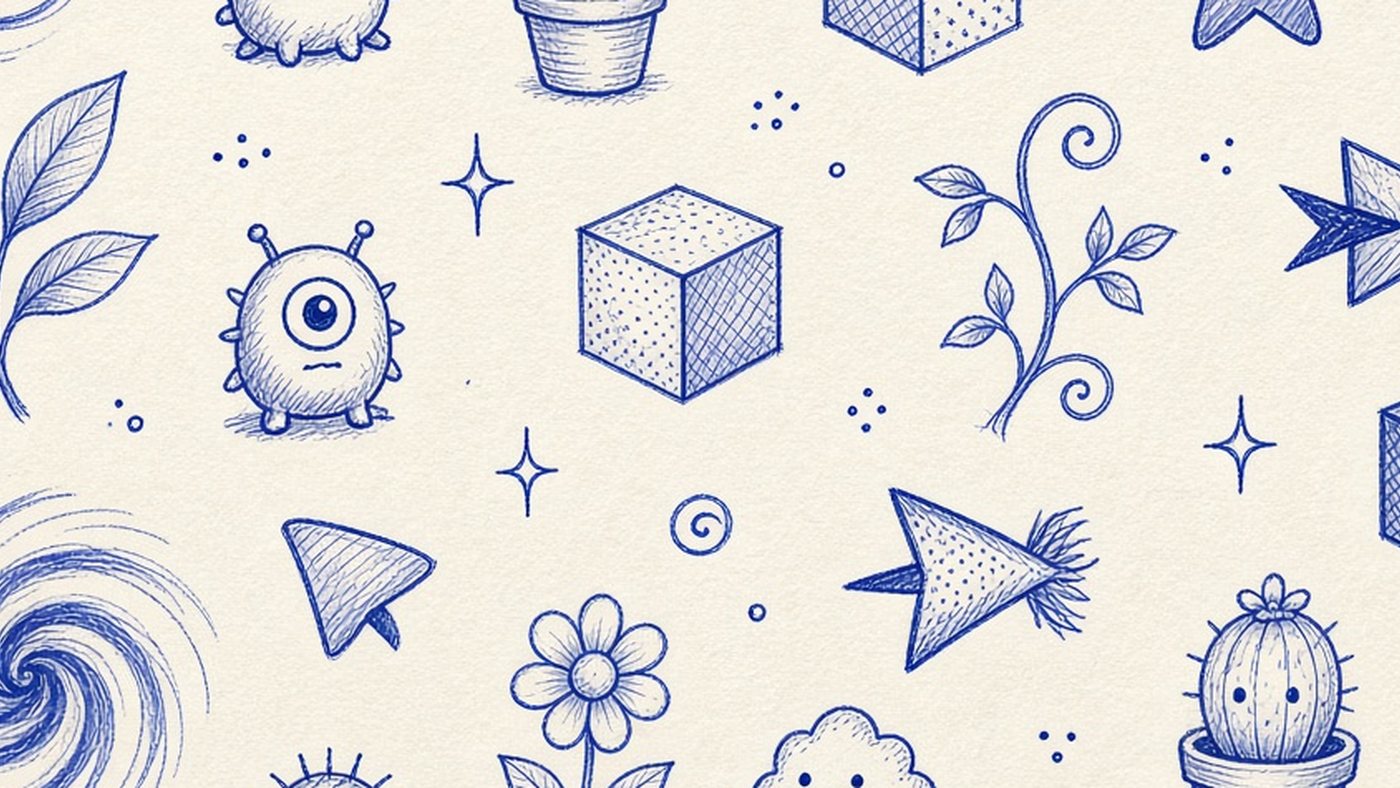
A row of isometric cubes (from memory after isometric drawing) or ten \"faces\" from two dots and a mouth arc. Time limit—30 seconds per cube, 10 seconds per face.
- Spirals in a circle.
- Parallel waves.
- Checkerboard hatching.
- Cubes in a row.
- Leaf teardrops.
- Stars and dots.
- Arrows and zigzags.
- Mini flower with five petals.
- Cloud of bubbles.
- Combo: frame + pattern inside.
From Doodle to Sketch
Doodling becomes practice when one good scribble moves into a working file.
One Doodle a Day in a File
Photograph the best doodle of the day, import it into an editor, trace confident lines on a new layer. That way the notebook is not a dead archive. On building the habit, see daily drawing habit.
Photo to Digital
Shoot in daylight, without heavy perspective—or lines \"drift\" when you trace. You can boost contrast with a filter, but do not erase weak ideas: sometimes the value is the hatch in the margin.
Tip
Hold the pen in the same hand you use for digital work, but doodle only on paper. The chain \"paper → photo → layer\" trains both workflows.
When to Stop
Doodling is a supplement, not a replacement for focused study.
Don't Replace Main Practice
- if doodling fills the whole evening and the study never starts—cut doodling down to warm-up;
- if scribbles repeat the same thing—add reference or a lesson from drawing basics;
- if doodling brings joy—keep it as a reward after a hard assignment.
5–10 Minutes Is Enough
Set a ten-minute timer: when it rings, close the notebook and move to a task with a goal (still life, character, perspective). A short doodle energizes; an endless one delays growth.
Time to draw, not just read
Theory fades in a couple of days if you never use it. Open the editor and spend 15 minutes on what you just read. That is enough for the skill to stick.
Try it now
A free online editor: brushes, layers, a palette, and a shared canvas. No install and no sign-up.
Start drawingTopics in this guide
- doodling
- notebook doodles
- doodle drawing
- sketchbook doodles
- drawing warm-up
← Isometric Drawing: Rooms and Objects at 30° How to Draw Food: Volume, Highlights, and Appetizing Color →