Basic Shapes
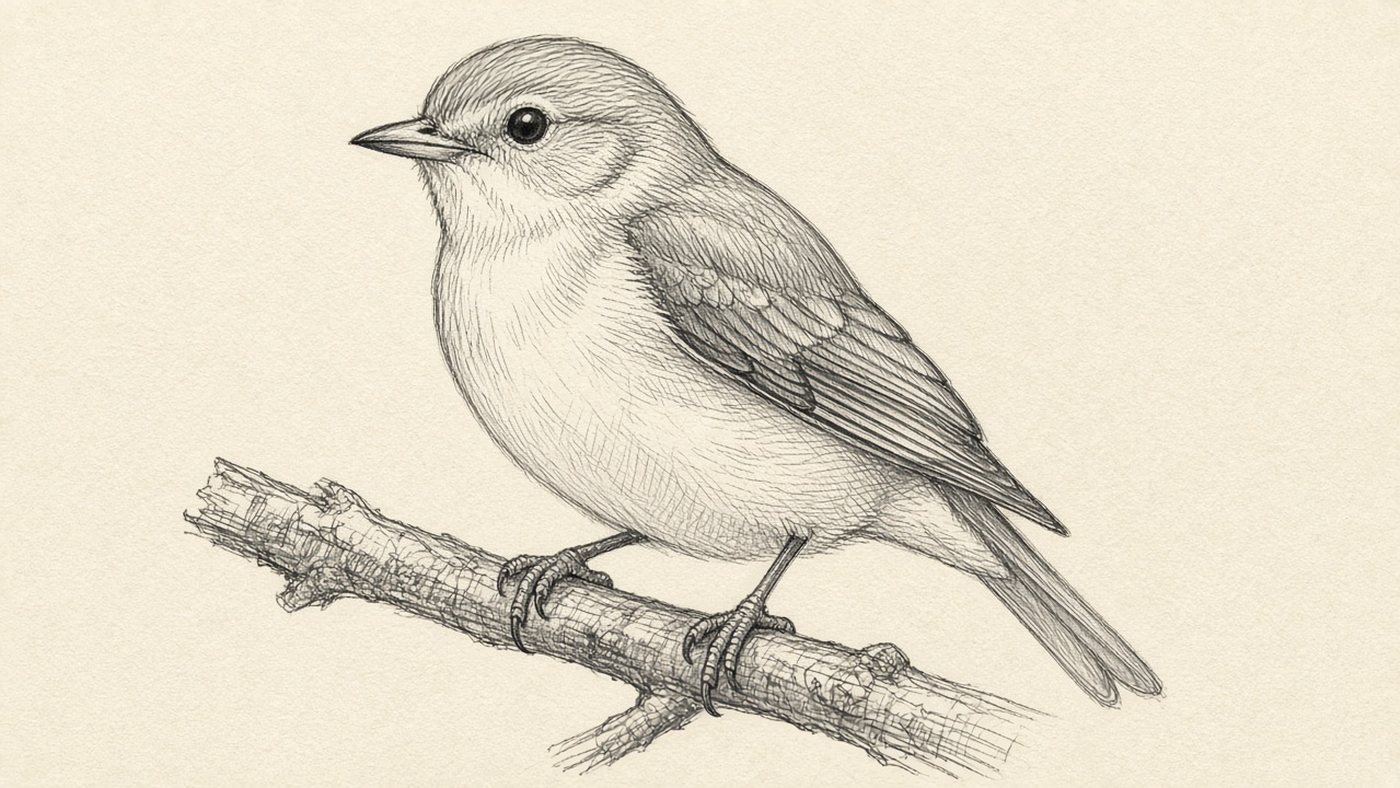
A bird on paper starts with a teardrop body and a wing triangle, not feathers. While the silhouette reads, beak details will suggest the species.
Teardrop Body
The breast is the round part of the teardrop; the tail is the pointed end. The head is a small extension or a separate circle shifted forward. The teardrop tilt sets the pose: horizontal—rest; up—singing; down—foraging. The same \"one shape—whole object\" trick works in how to draw flowers, where a petal is also built as a teardrop.
Wing as a Triangle
A folded wing is a long triangle along the side, apex at the shoulder, base at the hip. Do not draw the wing separate from the body: the lower edge of the triangle \"enters\" the teardrop. In a turn the triangle becomes a trapezoid—one wing larger, the other hidden.
Beak and Eye
Beak and eye are the two recognition points. Wrong beak length breaks \"sparrow\" and \"crow\" at once.
Beak Defines the Breed
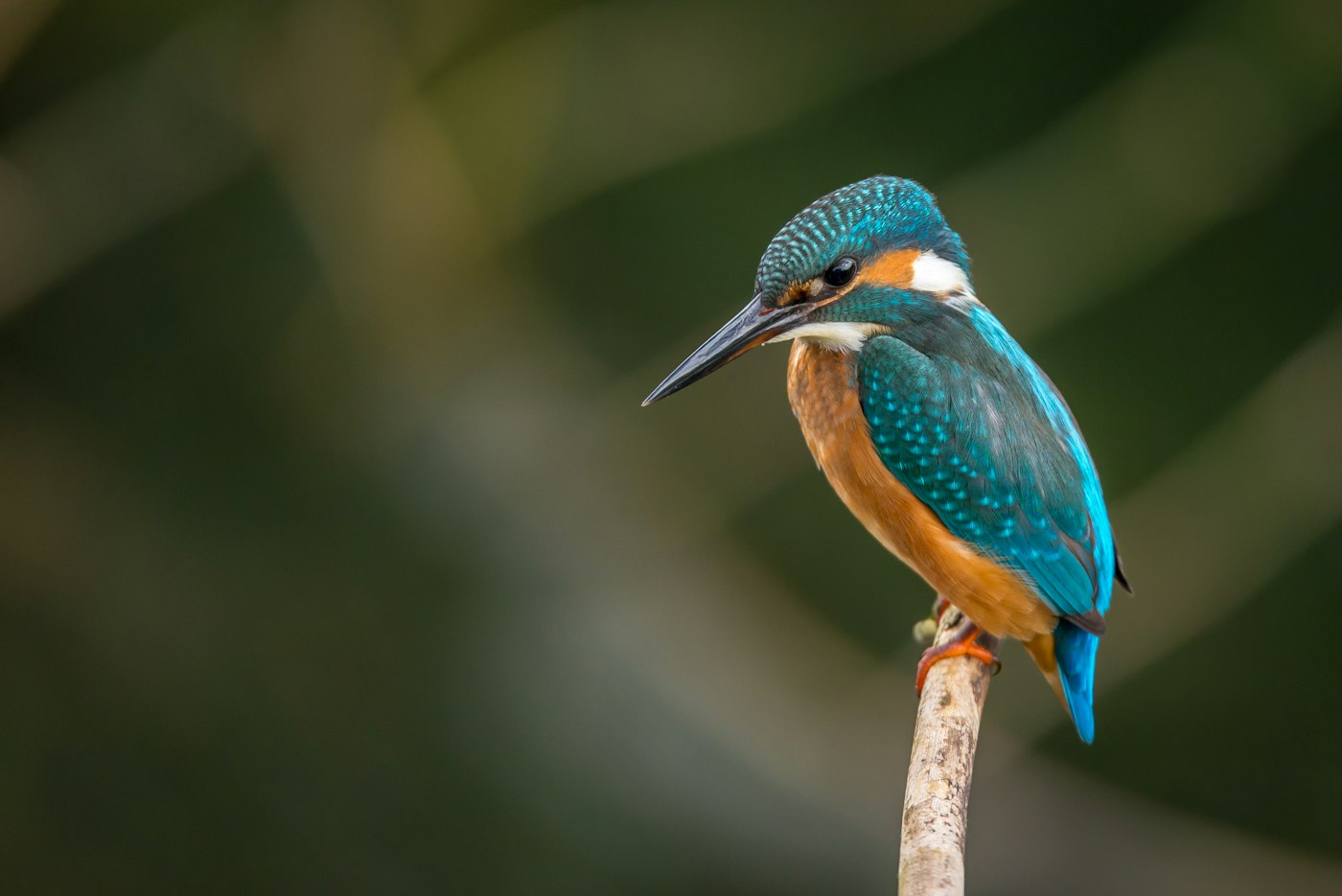
The beak is a cone from the forehead: short and blunt on seed eaters, a hook on raptors, a wide shovel on ducks. The beak line continues the forehead, not glued on from the side. The nostril is one dot or an oval on the upper surface.
Eye as Character
The eye sits on the line where head meets beak. The sclera shows as a crescent; the pupil is a dark dot with a highlight. On small birds the eye looks huge—that is normal for stylization and for anatomy. More on highlight and form is in how to draw eyes.
Wing and Tail
Wing and tail balance the silhouette: a long tail balances the beak; broad wings widen the shoulders.

Folded and Spread Wing
Folded—one triangle with a slight break at the \"elbow.\" Spread in flight, divide into three zones: shoulder (short), mid feathers (long), tip (narrow fan). Do not draw every primary feather—one big shape first, then 3–5 cuts.
Tail as a Rudder
The tail is a fan or wedge from the teardrop backward. On a perched bird the tail often touches the branch and completes the support triangle. In flight the tail looks shorter because perspective compresses it along the view.
Feathers in Rhythm
Draw feathers in layers following the body, not a grid of identical strokes.
- Teardrop silhouette, wing triangle, tail wedge.
- Beak, eye, cylinder feet on the branch.
- 3–4 arcs of flight feathers from breast to wing.
- Dark edge on feather groups, light center on the breast.
- On the wing—only large secondary feathers; hint at the rest.
Direction From the Body
Strokes on the breast run from the beak down and outward. On the wing—from shoulder to tip. On the tail—from base to fan edge. Lines across the form make the bird look scaly, not feathered.
Dark Edge, Light Center
A feather group reads through contrast: dark rim on one side, light stripe on the other. The breast center is often lighter than the back—that gives volume without hundreds of lines.
Tip
Draw silhouettes of a sparrow, pigeon, and duck using only teardrop and triangle—no details. If all three read, move on to feathers.
Bird in Flight
In flight, gesture first, then wing. Beak details can wait until the end.
Silhouette Without Details
One stroke or contour: breast forward, tail back, wing an arc up or down for the wingbeat phase. Compare with the line of action in sketching for beginners: a bird is a curved stick with two wing \"ears.\"
Wing as One Shape
- upstroke—wing above the back, narrow silhouette;
- mid-stroke—wide arc, the \"arm\" of the wing visible;
- gliding—wings to the sides, almost a straight line from beak to tail.
For backgrounds with branches and sky, basic perspective helps: the near bird is larger; the far one is a blob without feather detail.
Time to draw, not just read
Theory fades in a couple of days if you never use it. Open the editor and spend 15 minutes on what you just read. That is enough for the skill to stick.
Try it now
A free online editor: brushes, layers, a palette, and a shared canvas. No install and no sign-up.
Start drawingTopics in this guide
- how to draw birds
- bird drawing
- feathers in drawing
- bird silhouette
- bird beak drawing
← How to Draw a Dog: Proportions, Muzzle, and Fur How to Draw Fire and Glow: Flame, Neon, and Magical Light →